
Vitrafy’s No-Wash Platelet Tech Matches Army Benchmark in 60-Sample Study
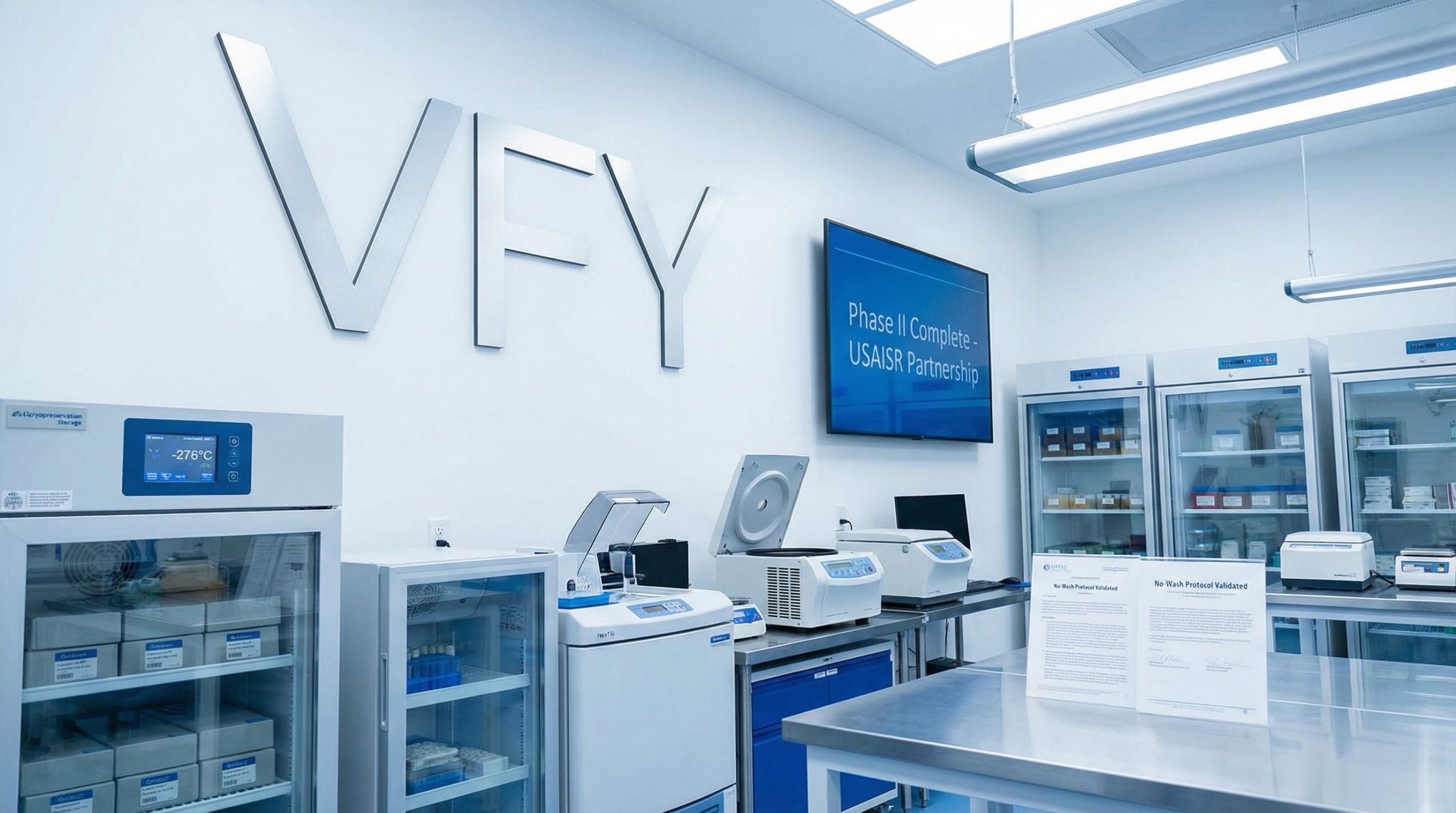
Vitrafy Life Sciences has announced completion of Phase II platelet cryopreservation testing with the U.S. Army Institute of Surgical Research (USAISR), with indicative results from no-wash protocols matching or exceeding the current industry standard. The Vitrafy USAISR Platelet Study Results represent the company’s largest third-party testing programme, involving over 60 samples tested across 9 months of collaborative work.
Vitrafy completes Phase II platelet study with U.S. Army
The Phase II study builds on earlier testing by significantly expanding sample size to validate reproducibility and robustness across multiple cryopreservation formulations. Testing was conducted under the ongoing Cooperative Research and Development Agreement (CRADA) between Vitrafy and the U.S. Army, focussed on deploying rapid response platelet solutions for trauma settings.
The work assessed performance across two distinct approaches: the current legacy benchmark wash-based protocol and Vitrafy’s simplified no-wash protocols designed for rapid deployment.
Final analysis and report preparation are underway, with publication of results targeted for Q4 FY2026. Both parties intend to present findings at international scientific conferences this year, whilst discussions regarding potential next steps on commercialisation and partnership expansion with the U.S. Army continue.
For investors, this represents third-party validation from a prestigious military research institution, de-risking the technology and supporting near-term commercialisation and medical device registration milestones.
When big ASX news breaks, our subscribers know first
What is platelet cryopreservation and why does it matter?
Platelets are critical blood components that enable clotting and wound healing in trauma and surgical patients. Current limitations present significant logistical challenges: platelets have an extremely short shelf life of 5-7 days, requiring constant fresh supply and complex distribution networks.
Cryopreservation allows long-term storage by freezing platelets at ultra-low temperatures. However, existing methods require complex washing processes to remove toxic cryoprotectant chemicals before transfusion, limiting deployment to specialised laboratory environments.
Vitrafy’s technology aims to solve this constraint by enabling platelets to be stored long-term and deployed rapidly in emergency or remote settings without the washing step. This capability could expand access to life-saving blood products in military combat zones, civilian trauma centres, regional hospitals, and resource-constrained healthcare settings where specialised processing facilities are unavailable.
No-wash protocol results match or exceed legacy benchmark
Indicative Phase II results from no-wash protocols were comparable to, or exceeded, those observed using the current market standard, representing what the company describes as a potential step-change in cryopreservation standards for platelets.
The significance lies in removing the wash step: this eliminates handling of toxic cryoprotectant chemicals, reduces processing time from hours to minutes, and enables deployment beyond specialised laboratory environments. Wash-based protocols require the addition and subsequent removal of toxic levels of cryoprotectant before and after cryopreservation, reducing workflow efficiency and negatively impacting post-thaw quality and rapid patient transfusion capability.
Two no-wash formulations were tested: a 3% DMSO formulation and a trehalose-based formulation. Both demonstrated performance comparable to, or exceeding, the legacy benchmark.
| Protocol Type | Cryoprotectant | Wash Required | Deployment Setting | Phase II Outcome |
|---|---|---|---|---|
| Legacy Benchmark | 6% DMSO | Yes | Specialised labs only | Consistent with Phase I |
| No-Wash Protocol | 3% DMSO | No | Emergency/remote | Comparable or exceeded benchmark |
| No-Wash Protocol | Trehalose-based | No | Emergency/remote | Comparable or exceeded benchmark |
The removal of manual washing could provide meaningful market utility by enabling deployment beyond specialised processing environments, including emergency, regional, and resource-constrained settings. This protocol, combined with effective capability to cryopreserve and store platelets, could reduce handling time, operational complexity, and may ultimately deliver improved patient outcomes.
Wash-based testing validates reproducibility at scale
Phase II wash-based results using the 6% DMSO formulation (the global benchmark in platelet cryopreservation) were consistent with outcomes observed in Phase I testing conducted by USAISR and Australian Red Cross Lifeblood.
Indicative results from Phase II samples cryopreserved under the wash protocol aligned with earlier USAISR study results for a commercial unit of platelets. The inclusion of the current legacy benchmark within Phase II testing established a point of comparison against both historical Vitrafy testing and broader market performance.
Replicating earlier results at larger scale validates the consistency of the Vitrafy cryopreservation ecosystem in a go-to-market setting and provides important support for ongoing medical device registration workstreams. Regulatory bodies require reproducible results at scale, making this data directly relevant to the commercialisation pathway.
U.S. Army partnership advances toward commercialisation
The CRADA agreement represents a strategic partnership with one of the world’s most demanding end-users. The military’s focus on rapid response platelet solutions for trauma settings aligns with civilian emergency medicine applications, potentially validating the technology across multiple markets simultaneously.
The Phase II programme represents Vitrafy’s largest third-party testing programme ever undertaken, with cumulative testing of over 60 platelet samples across wash and no-wash protocols during more than 9 months of Phase II work.
Brent Owens, Managing Director and CEO
“We are really pleased to finalise the testing with the U.S. Army which represents over 9 months of work on Phase II. The relationship with the U.S. Army goes from strength-to-strength whilst continuing to propel Vitrafy towards our upcoming commercial and medical device registration milestones.”
Key upcoming milestones identified by the company include:
- Final Phase II report publication targeted for Q4 FY2026
- Presentation of findings at international scientific conferences in 2026
- Ongoing commercialisation and partnership discussions with U.S. Army
- Continued progress toward medical device registration milestones
Military validation provides a dual pathway: potential defence procurement contracts and enhanced credibility for civilian healthcare markets. The U.S. military’s endorsement through extensive testing could accelerate regulatory approval processes and commercial adoption in civilian trauma centres and regional healthcare facilities.
The next major ASX story will hit our subscribers first
What this means for Vitrafy’s investment case
The completion of Phase II testing with USAISR delivers multiple validation points: independent verification from a prestigious military research institution, reproducible results at commercial scale, and breakthrough no-wash performance matching or exceeding current standards.
The study positions Vitrafy ahead of competitors still relying on complex wash protocols that limit deployment settings. Near-term catalysts include final report publication in Q4 FY2026 and international scientific conference presentations that will generate further visibility within the medical community and investment markets.
Key reasons this study matters for shareholders:
- Independent validation: Testing conducted by U.S. Army Institute of Surgical Research provides third-party credibility that de-risks the technology platform
- Commercial viability demonstrated: No-wash results matching or exceeding legacy benchmark confirm the simplified protocol can perform in real-world conditions
- Regulatory pathway supported: Reproducible results at scale directly support medical device registration workstreams required for commercialisation
- Market expansion potential: Growing U.S. Army partnership opens pathways to both defence procurement contracts and civilian healthcare markets
Longer-term, successful commercialisation of no-wash protocols could unlock substantial market opportunities across emergency medicine, remote healthcare, military procurement, and regional hospitals lacking specialised processing facilities. The global blood products market represents a significant addressable opportunity, with Vitrafy’s technology potentially solving longstanding logistical constraints that have limited platelet availability in critical care settings.
The announcement establishes multiple near-term catalysts whilst validating the commercial thesis that simplified cryopreservation protocols can match or exceed current standards without complex laboratory infrastructure requirements.
Get Biotech News Before the Market Reacts
Join 20,000+ investors receiving FREE breaking ASX biotech alerts delivered within minutes of release, complete with in-depth analysis. Click the “Free Alerts” button at Big News Blast to get market-moving healthcare and biotech news in your inbox the moment announcements hit the ASX.