
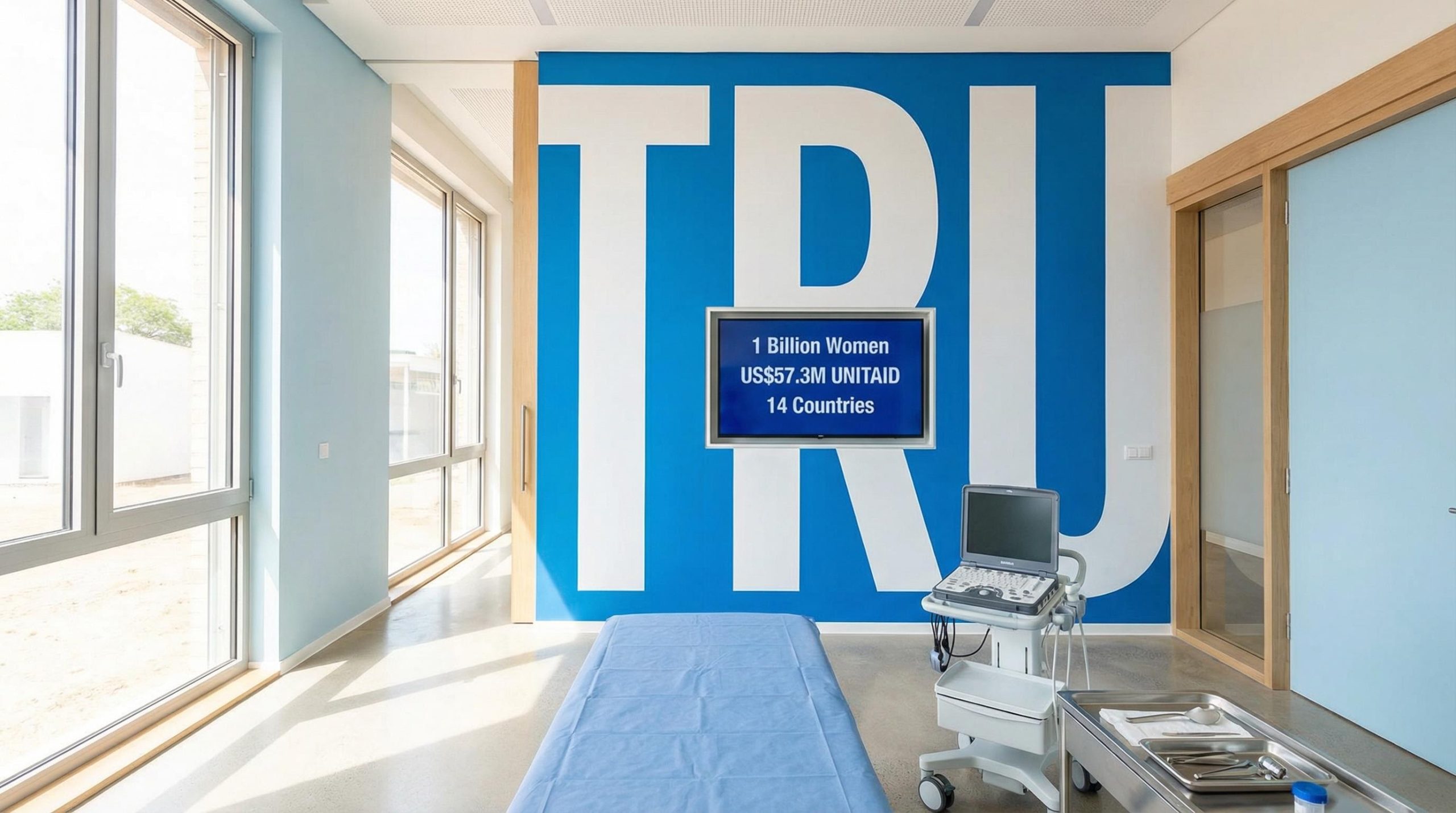
TruScreen Group (ASX: TRU) has submitted three proposals to global health funder UNITAID seeking up to US$57.3 million to deploy its AI-enabled cervical screening technology across 14 high-burden countries in Africa, Asia-Pacific, and Latin America. The programmes target an addressable market of 1 billion women of screening age, with TruScreen positioned to receive up to US$18.4 million as consortium lead over the 36-month period to December 2030. Successful applicants will be advised around November 2026.
Understanding UNITAID and the WHO 90-70-90 cervical cancer elimination targets
UNITAID is a global health funder focused on accelerating access to prevention, diagnosis, and treatment in low and middle-income countries. The proposals respond to UNITAID’s Call for Proposals: Accelerating Cervical Cancer Elimination through Secondary Prevention, which seeks catalytic investments in next-generation diagnostics, digital health, and integrated delivery models.
The World Health Organisation has set 90-70-90 milestones to eliminate cervical cancer as a public health threat by December 2030. The targets require 90% of girls to be vaccinated for HPV, 70% of women to be screened, and 90% of women who test positive to be treated. The December 2030 deadline creates urgency, with member nations implementing programmes to achieve these goals.
Traditional screening methods such as Pap smears and laboratory-based testing have failed in low-resource settings because they require laboratories, pathologists, cold chains, and follow-up visits. Screening coverage remains below 25% across target markets due to these structural barriers. TruScreen’s portable, point-of-care device delivers real-time results without requiring laboratory infrastructure, making it purpose-built for decentralised, rural, and peri-urban primary care settings where cervical cancer burden is greatest.
When big ASX news breaks, our subscribers know first
Three proposals spanning Africa, Asia-Pacific, and Latin America
Each proposal builds on existing regulatory approvals, established partnerships, and proven deployments. The strategic logic centres on scaling validated pilots into nationally owned, publicly funded elimination services.
Proposal 1 – Sub-Saharan Africa scale-up (US$15.3 million)
This proposal targets six African countries: Zimbabwe, South Africa, Eswatini, Rwanda, Nigeria, and Kenya. The programme will deploy 270 TruScreen devices across 120+ health facilities, train 500+ health workers, and screen 500,000 women over 36 months. TruScreen’s revenue share as consortium lead would be US$3.34 million.
| Metric | Target |
|---|---|
| Countries | 6 |
| Devices deployed | 270 |
| Health facilities | 120+ |
| Health workers trained | 500+ |
| Women screened | 500,000 |
| TruScreen share | US$3.34M |
The proposal leverages TruScreen’s track record in Zimbabwe, where the company has partnered with the National AIDS Council since 2022. More than 30,000 women have been screened with TruScreen devices under this partnership. The programme targets populations that have never accessed any form of cervical screening, addressing the gap between diagnosis and care in settings where referral systems are weak or non-existent. Programme success may also unlock UNFPA, UNICEF, and other global funding pathways beyond the grant period.
Proposal 2 – African screen-and-treat programme (US$19.5 million)
This proposal introduces a same-visit screen-and-treat model across the same six African countries. The programme will screen 400,000 women and treat up to 90% of those eligible. Patients will receive an HPV rapid test and a TruScreen examination, followed by immediate treatment, all in a single clinic visit. TruScreen’s revenue share would be US$5.85 million.
The dual approach is validated by the landmark China COGA (Chinese Obstetricians and Gynecologists Association) multicentre study, which examined 14,982 women across 64 hospitals and confirmed that combining HPV testing with TruScreen examination has the best performance and catches the most number of cancers. The screen-and-treat protocol eliminates the time gap between diagnosis and care, dramatically increasing treatment uptake. This is critical in low-resource settings where a positive result often does not translate into a health outcome because referrals may never be acted upon.
Proposal 3 – Asia-Pacific and Latin America expansion (US$22.5 million)
This proposal addresses the cervical cancer crisis across eight countries: China, India, Indonesia, Vietnam, Uzbekistan, Mexico, Malaysia, and Thailand. These markets represent over 840 million screening-age women and approximately 345,000 new cervical cancer cases annually. Screening coverage ranges from 9% in Indonesia to 40% in Mexico. The programme will screen over 650,000 women in 250+ health facilities during four years. TruScreen’s revenue share as lead implementer would be US$9.17 million, the largest of the three proposals.
TruScreen holds regulatory approval in all eight target countries and maintains active screening programmes or advanced pilots in each. In China, TruScreen devices are deployed across 11 provinces with public health insurance reimbursement. Vietnam’s Ho Chi Minh City Public Health Association has a signed memorandum of understanding for a 260,000-woman screening programme across six public hospitals. Uzbekistan has an MoU with its Ministry of Health for national screening integration. The proposal provides catalytic investment to transition these commercial pilots into nationally owned, publicly funded elimination services, establishing TruScreen as a cornerstone of national cervical screening strategies across the eight high-burden countries.

Consortium partners and implementation infrastructure
TruScreen leads the consortium but partners with established in-country organisations to deliver programme requirements. The partner network de-risks implementation by providing on-ground delivery capability and government relationships, whilst TruScreen provides the technology platform.
-
National AIDS Council Zimbabwe: The apex body responsible for coordinating Zimbabwe’s national response to HIV and AIDS, NAC operates nationally and works directly with the Ministry of Health and Child Care to integrate cervical cancer screening into the national public health agenda. NAC has maintained a formal partnership with TruScreen since 2022, adopting TruScreen as its preferred cervical cancer screening technology and driving deployment across primary care centres nationwide.
-
PATH: A global nonprofit organisation with more than four decades of experience in low and middle-income countries, PATH has pioneered affordable HPV-DNA testing and thermal ablation treatment, and shaped national screening policies across Africa, Asia, and Latin America. PATH brings deep expertise in strengthening health systems, supply chain management, regulatory navigation, and the design of scalable screening programmes.
-
Solina Centre for International Development and Research (SCIDaR): A Nigerian nonprofit institution dedicated to accelerating positive health, social, and economic reforms through high-quality programme design, implementation, and capacity building. SCIDaR has established relationships with state and federal health authorities, experience in training frontline health workers at scale, and a track record in managing complex multi-site health programmes.
-
RedAid Nigeria: A Nigerian community health organisation with a strong presence in primary and community-level health service delivery. RedAid plays an essential demand-generation and outreach role by mobilising communities, supporting health worker training, and facilitating access to screening services at the primary care level.
-
Baylor College of Medicine Children’s Foundation Eswatini: The national leader in paediatric HIV/AIDS and tuberculosis care in one of the world’s most heavily HIV-affected countries. Baylor Foundation Eswatini has expanded its scope beyond paediatric HIV to encompass cancer screening, treatment, and education, including an established Education for Cancer Prevention and Treatment programme.
Chairman’s perspective on global health positioning
TruScreen’s technology has been recognised by WHO and UNITAID as suitable for use in low and middle-income countries, with over 40,000 women in clinical trials and publications and 12 years of cervical screening in the field.
Tony Ho, Executive Chairman
“TruScreen’s point-of-care portable AI technology is purpose-built for the settings where cervical cancer kills most, where there are no laboratories, no pathologists, and no second visit. These three proposals to UNITAID represent our commitment to reaching the women who need screening most, in the communities where the burden is greatest.”
Ho noted the company’s collaboration with global and national NGOs and Ministries of Health to put together a comprehensive response to UNITAID’s Call for Proposals.
What success would mean for TruScreen investors
For a company at TruScreen’s scale, US$18.4 million in potential revenue over 36 months represents material growth. In financial year 2024 alone, over 200,000 examinations were performed with the TruScreen device, with over 200 devices installed and used in China, Vietnam, Mexico, Zimbabwe, Russia, and Saudi Arabia. Programme success may also unlock additional UNFPA, UNICEF, and other global funding pathways beyond the grant period.
Investors will have clarity within the calendar year, with the November 2026 decision timeline providing a defined milestone. The proposals build on proven deployments and established partnerships, reducing implementation risk. TruScreen holds regulatory approval in all 14 target countries, with active programmes or advanced pilots already in place in multiple markets.
This is a competitive process with no guaranteed outcome. However, TruScreen’s track record in Zimbabwe, regulatory approvals across all target markets, and partnership with nationally rooted implementation organisations position the company as a credible delivery partner for UNITAID’s cervical cancer elimination objectives.
- Total funding sought: US$57.3 million
- TruScreen’s potential share: US$18.4 million
- Countries covered: 14
- Women in addressable market: 1 billion
- Decision timeline: November 2026
Want the Next Healthcare Breakthrough in Your Inbox?
Join 20,000+ investors getting FREE breaking ASX healthcare news delivered within minutes of release, complete with in-depth analysis. Click the “Free Alerts” button at Big News Blast to start receiving alerts the moment market-moving announcements hit the ASX, so you’re ahead of the market every time.