
Ramsay Health Care Posts 8.1% Profit Growth as Australian Hospital Margins Expand
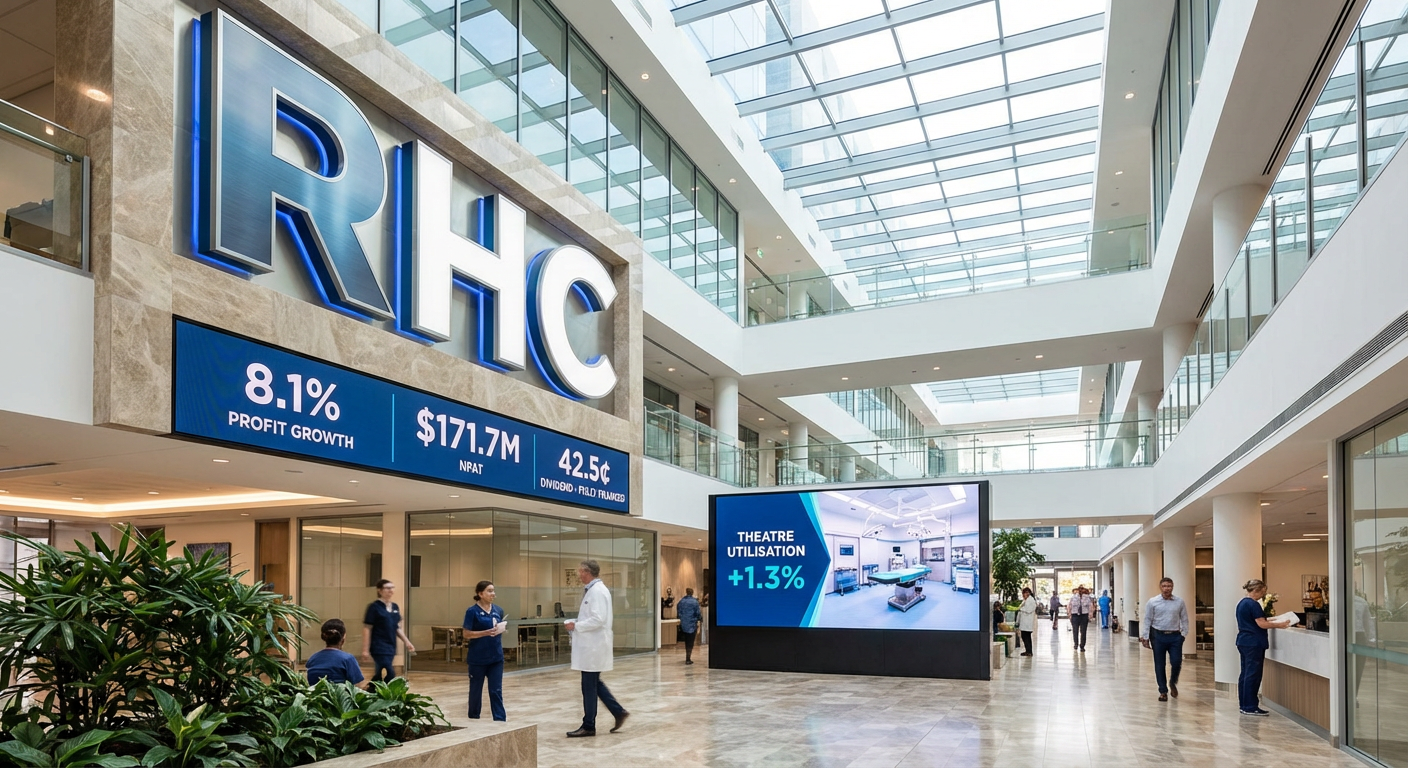
Ramsay Health Care delivers 8.1% profit growth as Australian transformation gains momentum
Ramsay Health Care has reported underlying net profit after tax (NPAT) growth of 8.1% to $171.7 million for the six months ended 31 December 2025, with earnings per share (EPS) increasing 8.6% to 71 cents. The Board declared a fully franked interim dividend of 42.5 cents per share, up 6.3% on the prior period, representing a 60% payout ratio.
The result reflects solid progress in CEO Natalie Davis’s transformation priorities after 12 months in the role. Group revenue climbed 9.7% to $9.3 billion, whilst underlying EBIT rose 7.3% to $536.7 million. The Funding Group leverage ratio of 2.22x sits comfortably within the target range below 2.5x, providing capacity to fund strategic acquisitions whilst maintaining credit rating and dividend policy.
CEO Natalie Davis
“After 12 months in the role, I am pleased to report that we are making good progress on our key priorities. The refresh of our Group Executive is now complete, strengthening capability and supporting the acceleration of our multi-year transformation program.”
The Ramsay Health Care 1H FY26 Results demonstrate the Australian hospitals business is responding to operational improvements, with management progressing a disciplined capital allocation strategy across the portfolio. The company’s proposed demerger of its 52.8% stake in Ramsay Santé, subject to shareholder approval, is expected to simplify the Group and enable sharper focus on the core Australian transformation.
When big ASX news breaks, our subscribers know first
Australian hospitals lead the charge with surgical growth and improved margins
Australia delivered the strongest regional performance, with underlying EBIT increasing 7.1% to $330.9 million. Revenue from customers rose 8.2% to $2.64 billion, supported by surgical admissions growth of 5.7% and overall admissions growth of 3.1% (excluding Peel Health Campus). Theatre utilisation increased 1.3% with 16 new theatres opened in 2025.
EBIT margins excluding Joondalup Health Campus improved 40 basis points, reflecting higher activity levels, increased case acuity, improved private health insurance (PHI) indexation and cost management initiatives. The company gained 0.4% market share of benefits paid over the 12 months, with the number of admitting visiting medical officers (VMOs) up 4% compared to the prior period.
| Metric | 1H FY26 | 1H FY25 | Change |
|---|---|---|---|
| Revenue from customers | $2,641.0m | $2,440.6m | +8.2% |
| Underlying EBIT | $330.9m | $309.0m | +7.1% |
| Admissions (ex-Peel) | 631,900 | 612,900 | +3.1% |
| Theatre utilisation | N/A | N/A | +1.3% |
| Market share of benefits paid | N/A | N/A | +0.4% |
The result was achieved despite the impact of the new funding mechanism at Joondalup Health Campus, where the team has progressed operational mitigation programs including agency cost reduction and timely discharge focus. The company’s private hospital portfolio generated revenue growth of 8.7%.
Capital discipline sharpens with reduced capex guidance
Management has lowered full-year development capex guidance to $170-190 million, down from the previous range of $200-250 million, reflecting a disciplined focus on utilising existing theatre capacity rather than building new facilities. Total capex guidance has been reduced to $385-400 million for the full year, with second-half spending expected to be lower than the first half.
The Joondalup Private Hospital expansion was completed approximately $14 million under budget, with the facility opening on 18 February 2026. The company has 23 theatres and procedure rooms scheduled to open across FY26, concentrated in major hospitals in key catchment areas.
The proposed acquisition of National Capital Private Hospital in the ACT for $251 million is expected to complete in the first quarter of FY27 and be EPS accretive in the first 12 months of ownership. The transaction will be funded from existing facilities, with leverage expected to remain within the target range of less than 2.5x.
Understanding hospital EBIT margins and what drives them
EBIT margins in healthcare measure a hospital’s ability to convert revenue into operating profit before interest and tax. For private hospital operators, several operational levers directly impact profitability.
Theatre utilisation is critical because operating theatres represent significant fixed costs. Once a theatre is built and staffed, each additional procedure generates high incremental margin. Ramsay’s 1.3% improvement in theatre utilisation means more procedures are flowing through existing capacity, improving cost efficiency without capital expenditure.
Patient acuity refers to the complexity and severity of cases treated. Higher acuity procedures typically command higher revenue per admission and often reflect more specialised services that command premium pricing from private health insurers. The 3.1% growth in inpatient and day admissions (IPDAs) matching the 3.1% growth in total admissions indicates Ramsay is treating more complex cases.
PHI indexation represents the annual increase in rates negotiated with private health insurers. This indexation must keep pace with cost inflation (particularly wages) to maintain margins. Improved indexation relative to wage inflation contributed to Ramsay’s margin improvement this period, helping offset cost pressures.
The 40 basis points margin improvement (excluding Joondalup) demonstrates these operational levers working in combination. Higher volumes, better case mix and improved pricing are offsetting wage inflation of approximately 3.5% in the UK and similar pressures in Australia.
Ramsay Santé demerger to simplify portfolio and sharpen focus
Ramsay proposes to distribute its entire 52.8% stake in Ramsay Santé to shareholders via an in-specie distribution, subject to shareholder approval. If implemented, Ramsay shareholders would receive shares in Ramsay Santé proportional to their existing Ramsay shareholding.
The demerger is expected to complete in the fourth quarter of calendar 2026, subject to obtaining applicable regulatory approvals and a shareholder vote via a scheme of arrangement. Ramsay Santé operates with separate financing arrangements and balance sheet, with no recourse to the Ramsay Funding Group.
Strategic Rationale
The proposal will simplify Ramsay’s portfolio, enabling management to focus on transformation and growth potential of its core Australian hospitals business whilst Ramsay Santé continues to pursue its European focused strategy. Shareholders retain direct ownership exposure to European operations through their Ramsay Santé holding.
The separation carries limited implementation complexity given Ramsay Santé already operates independently with separate management, financing and operational structures. The demerger will deconsolidate Ramsay Santé from Ramsay’s financial statements, clarifying the investment thesis and reported financial profile.
UK and Elysium navigate challenging conditions
UK Hospitals reported underlying EBIT of £77 million with revenue growth of 3.5% in constant currency. Excluding backdated indexation payments, underlying EBIT margins improved 30 basis points to 9.3%. Private Medical Insurance (PMI) admissions increased 4.6%, partially offsetting NHS funding constraints that emerged in the second quarter.
The NHS activity outlook for the third quarter of FY26 is expected to remain negative compared to the prior period due to NHS budget constraints for the remainder of the UK fiscal year ending 31 March 2026. Management has mitigation plans in place and expects activity to recover when anticipated additional funding is made available in the new NHS fiscal year from 1 April 2026.
Elysium continued its turnaround program, with the following progress achieved:
- Available beds reduced by 163 in the half, with 5 sites expected to close in the second half
- December occupancy improved to 86.9% (up 0.2% on prior year)
- Central cost reduction Phase 2 delivered 49 FTE savings (Phase 1 delivered 78 FTE)
- New CEO Joe O’Connor commenced 12 January 2026
Elysium faces uncertain demand from local authorities and NHS Integrated Care Boards due to budget constraints. UK national minimum wage will increase a further 4.1% from 1 April 2026, adding cost pressure. The business is targeting a blended rate increase above the NHS tariff of 0.03% for the 2026/27 year across all payors.
Balance sheet strength supports strategic flexibility
The Funding Group leverage ratio of 2.22x sits within the target range of below 2.5x, with strong liquidity of $838 million (comprising $730 million undrawn bank facilities and $108 million cash). Fitch reaffirmed its BBB- investment grade rating during the period.
Management successfully refinanced $2.05 billion of debt facilities, extending tenor and achieving a 30 basis points margin improvement on the syndicated loan facility. The weighted average cost of debt declined 20 basis points to 5.0% (excluding CARES) at 31 December 2025, despite rising base rates, due to the improved facility margins.
| Balance Sheet Metric | 31 Dec 2025 | 30 Jun 2025 |
|---|---|---|
| Funding Group leverage | 2.22x | 2.18x |
| Liquidity | $838m | N/A |
| Weighted average cost of debt | 5.0% | 5.2% |
| Operating cash flow | $350.3m | $299.6m (pcp) |
Operating cash flow increased 16.9% to $350.3 million, driven by improved performance in Australia and lower tax paid compared to the prior period. The company has adequate liquidity to fund the $251 million National Capital Private Hospital acquisition whilst maintaining leverage within target range.
For the second half of FY26, approximately 65-67% of the Funding Group’s floating rate debt is hedged at an average base rate of 3.0-3.6% (excluding lending margin), providing protection against further rate increases. Interest cover remains strong at 8.59x.
The next major ASX story will hit our subscribers first
FY26 outlook and what investors should watch
Management provided the following guidance for the full year FY26 results:
- Australia: EBIT growth momentum to continue driven by growth in activity in priority therapeutic areas, revenue indexation, cost focus and partial mitigation of the Joondalup funding mechanism impact
- UK Hospitals: NHS activity expected to remain negative in the third quarter due to budget constraints for the remainder of the UK fiscal year to 31 March 2026. Positioned for recovery from 1 April 2026 when the new NHS fiscal year commences with anticipated additional funding
- Elysium: Turnaround expected to gain further traction with new CEO Joe O’Connor leading performance improvement initiatives
- Europe: Activity growth expected to continue, driven by day admissions, partially offset by the impact of a 3-day French doctors strike in January
- Net financing costs: Forecast at $590-610 million (inclusive of AASB 16 lease costs)
- Effective tax rate: Approximately 35% for the full year, reflecting the higher effective tax rate in Ramsay Santé
- Group capex: $755-795 million for the full year, with second-half spending lower than first-half spending
- Dividend payout ratio: Target range of 60-70% of underlying NPAT after non-controlling interests
The Australian business remains the key earnings driver, with management focused on continued activity growth through data-led growth plans and strategies in priority therapeutic areas and catchments. One major PHI contract renewal is due in the second half of FY26, with management continuing to work with payors to recover the gap created by cumulative revenue indexation below cost indexation.
Victorian and Queensland nurses enterprise bargaining agreement negotiations are underway, with management aiming to complete negotiations by the end of FY26. Digital and data operating expenditure remains on track to be at or below FY25 spend levels.
Want the Next Healthcare Winner in Your Inbox?
Join 20,000+ investors receiving FREE breaking ASX news within minutes of release, complete with in-depth analysis. Click the “Free Alerts” button at StockWire X to get healthcare announcements delivered straight to your inbox the moment they hit the market.