
Radiopharm Theranostics Doses First Patient in BetaBart Cancer Trial
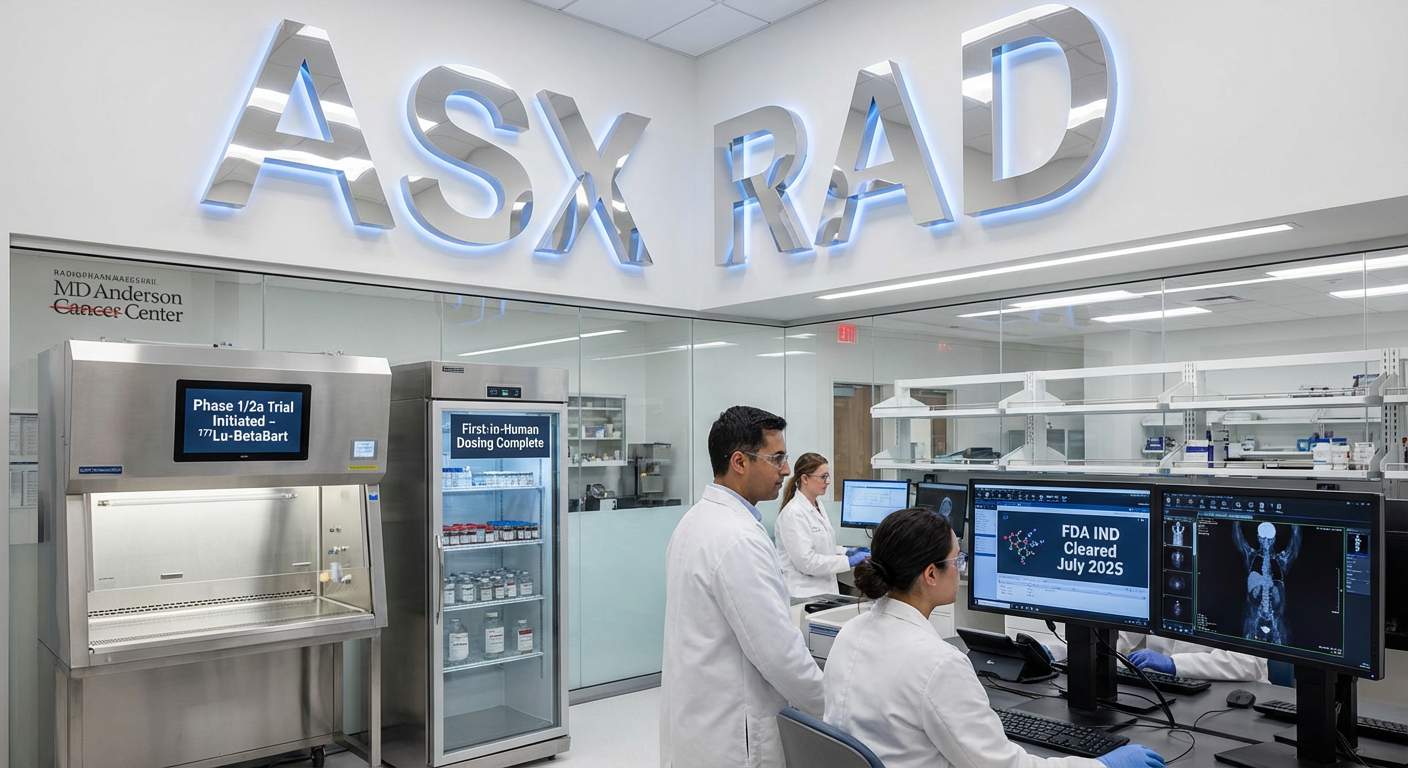
Radiopharm Theranostics (ASX: RAD) has dosed the first patient in its BetaBart trial, marking a significant clinical milestone for the company’s lead radiotherapeutic candidate. The First-In-Human (FIH) Phase 1/2a trial of 177Lu-BetaBart (RV-01) represents the first radiotherapeutic agent developed by Radiopharm Ventures, a joint venture between Radiopharm and The University of Texas MD Anderson Cancer Center, to reach clinical testing.
Radiopharm Theranostics doses first patient in BetaBart Phase 1/2a trial
The Phase 1/2a dose escalation and expansion trial is designed to evaluate the safety, biodistribution and radiation dosimetry of 177Lu-BetaBart, alongside its preliminary anti-tumour activity. The study aims to enroll 61 participants across multiple solid tumour types and will determine the recommended dosing regimen for future clinical studies.
The U.S. Food and Drug Administration (FDA) granted Investigational New Drug (IND) clearance for BetaBart (RV-01) on 28 July 2025, enabling the trial to proceed under identifier NCT07189871. BAMF Health is administering the treatment as part of the clinical programme.
177Lu-BetaBart is a lutetium-177-tagged engineered monoclonal antibody designed with strong affinity for the 4Ig isoform of B7-H3, an immune checkpoint molecule overexpressed across several tumour types. The therapy delivers targeted radiation to cancer cells expressing this specific protein variant.
Riccardo Canevari, CEO and Managing Director
“Dosing of the first patient in the Phase 1/2a trial of 177Lu-BetaBart marks an important milestone for Radiopharm, as this is the first radiotherapeutic agent from our joint venture to enter the clinic. 177Lu-BetaBart has the potential to become a highly differentiated radiotherapeutic for patients with aggressive advanced solid tumours.”
When big ASX news breaks, our subscribers know first
What is B7-H3 and why does it matter for cancer treatment?
B7-H3 is an immune checkpoint molecule that is overexpressed across several tumour types and has emerged as a compelling target for antibody-based cancer immunotherapy. In healthy tissue, it plays a role in controlling inflammation, but cancer cells frequently overexpress this protein to evade immune detection and destruction. The 4Ig isoform of B7-H3 is the specific variant targeted by 177Lu-BetaBart.
The therapy operates through a targeted radiotherapeutic mechanism:
- An engineered monoclonal antibody binds specifically to the 4Ig isoform of B7-H3
- The antibody carries lutetium-177, a radioactive isotope that emits beta radiation
- Once bound to cancer cells, the radiation damages tumour DNA while minimising exposure to surrounding healthy tissue
B7-H3 overexpression has been documented across multiple solid tumour types, creating potential applicability beyond single-indication therapies. This broad expression profile supports the trial’s design to evaluate efficacy across ten different cancer types.
Preclinical evidence supporting clinical advancement
Multiple preclinical studies of 177Lu-BetaBart demonstrated tumour shrinkage and prolonged survival in animal models treated with the radiotherapeutic agent. This evidence supported the FDA’s decision to grant IND clearance and enabled progression to human clinical testing.
The preclinical data showed the therapy successfully targeted the specific 4Ig isoform of B7-H3, with research indicating potential efficacy across prostate, pancreatic, breast and other solid tumours.
Trial design targets multiple solid tumour types
The FIH Phase 1/2a study is structured as a dose escalation and expansion trial to establish the safety profile, biodistribution, pharmacokinetics and radiation dosimetry of 177Lu-BetaBart. The trial will enroll 61 participants with histopathologically confirmed advanced cancers who meet specific eligibility criteria.
| Cancer Type | Classification | Trial Eligibility |
|---|---|---|
| Castrate Resistant Prostate Cancer | Genitourinary | Eligible |
| Colorectal Cancer | Gastrointestinal | Eligible |
| Non-Small Cell Lung Cancer | Thoracic | Eligible |
| Small Cell Lung Cancer | Thoracic | Eligible |
| Head and Neck Squamous Cell Cancer | Head & Neck | Eligible |
| Ovarian Cancer | Gynaecological | Eligible |
| Cervical Cancer | Gynaecological | Eligible |
| Endometrial Cancer | Gynaecological | Eligible |
| Triple Negative Breast Cancer | Breast | Eligible |
| Esophageal Squamous Cell Carcinoma | Gastrointestinal | Eligible |
The multi-tumour eligibility expands the commercial opportunity if efficacy signals emerge across multiple indications. Dose escalation studies typically progress through cohorts of increasing dose levels to identify the maximum tolerated dose and recommended Phase 2 dose.
Dr Brandon Mancini, Medical Director at BAMF Health
“We are honoured to administer the first dose of 177Lu-BetaBart in this Phase 1/2a clinical trial. As a leading centre for radiopharmaceutical therapeutic trials, we appreciate the opportunity to provide this novel, first-in-class radiotherapeutic for the treatment of a variety of advanced refractory solid tumours.”
Radiopharm Ventures delivers first clinical candidate
RV-01 represents the first clinical-stage asset to emerge from Radiopharm Ventures, the joint venture formed between Radiopharm Theranostics and The University of Texas MD Anderson Cancer Center. The successful translation from preclinical development to clinical testing validates the collaboration’s research and development capabilities.
The Radiopharm Ventures partnership combines Radiopharm’s radiopharmaceutical development platform with MD Anderson’s clinical research infrastructure and oncology expertise. RV-01’s progression to clinical trials demonstrates the joint venture’s ability to advance novel candidates from laboratory research through regulatory clearance and into human testing.
Radiopharm Theranostics maintains a broader clinical pipeline beyond the BetaBart programme:
- One Phase 2 trial in solid tumour cancers
- Four Phase 1 trials spanning lung, breast, and brain metastases
- Platform technologies including peptides, small molecules and monoclonal antibodies
The company holds dual listings on the ASX (RAD) and NASDAQ (RADX), providing access to both Australian and U.S. capital markets.
The next major ASX story will hit our subscribers first
What comes next for investors
The Phase 1/2a trial’s dose escalation phase will generate initial safety data as cohorts progress through increasing dose levels. Key near-term catalysts include safety readouts, pharmacokinetic data, and dose escalation updates as the trial advances through its cohort structure.
Phase 1/2a studies typically provide preliminary safety profiles and early efficacy signals that inform dosing decisions for later-stage trials. The trial aims to establish the recommended dose of 177Lu-BetaBart for future clinical studies, a critical milestone for advancing the programme toward pivotal trials.
For radiotherapeutic candidates, early clinical data on tumour targeting, radiation dosimetry and safety profiles inform both clinical development strategy and potential partnership discussions. The broad tumour eligibility in this trial allows for assessment across multiple indications, with the potential to prioritise specific cancer types based on early response signals.
Radiopharm Theranostics’ dual listing on the ASX and NASDAQ positions the company to access capital across both markets as clinical data emerges from the BetaBart trial and the broader pipeline progresses.
Want the Next Healthcare Breakthrough in Your Inbox?
Join 20,000+ investors receiving FREE breaking ASX healthcare news within minutes of release, complete with in-depth analysis. Click the “Free Alerts” button at Big News Blast to get market-moving announcements delivered straight to your inbox the moment they break.