
Radiopharm Treats First Patient in Phase 1 Prostate Cancer Trial
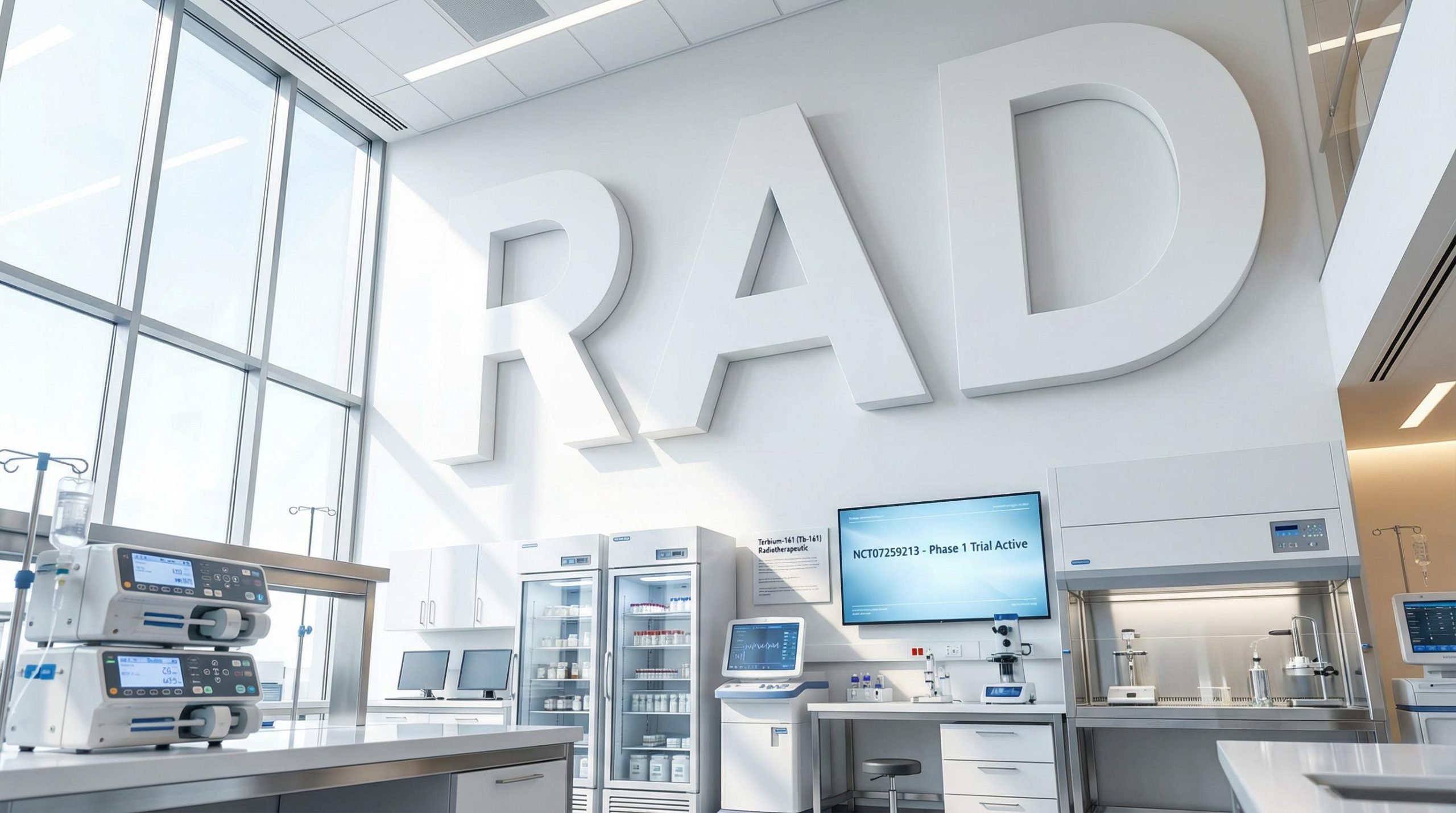
Radiopharm doses first patient in RAD 402 Phase 1 trial
Radiopharm Theranostics (ASX: RAD) has dosed the first patient in its Radiopharm RAD 402 Phase 1 clinical trial, a first-in-human study evaluating the monoclonal antibody in advanced prostate cancer. RAD 402 targets KLK3 and is radiolabelled with Terbium-161, positioning it as a first-in-class, next-generation radiotherapeutic designed to selectively target tumour-expressing cells while minimising off-target exposure. The trial is registered as NCT07259213.
First patient dosing de-risks the program timeline and validates regulatory and manufacturing readiness. Initiating human studies represents a critical value inflection point for clinical-stage biotechnology companies, providing tangible evidence that preclinical development has translated into clinical execution.
When big ASX news breaks, our subscribers know first
What is RAD 402 and why does KLK3 matter?
KLK3 is the gene encoding Prostate Specific Antigen (PSA), a widely used biomarker for detecting prostate cancer. The gene is highly expressed in prostate cancer cells and most adenocarcinomas of the prostate, including metastases, but has limited expression outside the prostate. This selective expression profile makes KLK3 an attractive target for radiotherapeutic interventions, potentially enabling higher tumour-specific delivery while reducing systemic toxicity.
RAD 402 combines an anti-KLK3 monoclonal antibody with Terbium-161, a radionuclide with dual emission properties that offer both therapeutic and potential imaging benefits. By targeting a well-validated biomarker with restricted off-target expression, the therapy aims to improve efficacy and tolerability compared to existing radiotherapeutics.
Targeting a well-validated biomarker with limited off-target expression could translate to improved efficacy and tolerability versus existing radiotherapies. The KLK3 approach differentiates RAD 402 from PSMA-targeting competitors in the prostate cancer radiopharmaceutical space.
Riccardo Canevari, CEO and Managing Director
“RAD 402 is a differentiated, first-in-class, next-generation radiotherapeutic designed to selectively target KLK3-expressing tumors while minimizing off-target exposure.”
Phase 1 trial design and data timeline
The Radiopharm RAD 402 Phase 1 trial is designed to study the safety, tolerability, whole-body distribution, and preliminary clinical activity of the therapy in patients with advanced prostate cancer. As a dose escalation study, the trial aims to determine the Maximum Tolerated Dose (MTD) and/or recommended Phase 2 dose (RP2D) for expansion.
The company expects to share results from the first two dose levels in the second half of 2026, providing investors with a near-term data catalyst to assess the therapy’s clinical profile.
The trial’s key objectives and endpoints include:
- Safety and tolerability assessment across escalating dose levels
- Whole-body biodistribution analysis to map RAD 402’s pharmacokinetic profile
- Preliminary clinical activity evaluation to inform efficacy potential
- MTD and RP2D determination to guide Phase 2 trial design
Near-term data catalysts in 2H 2026 provide visibility on upcoming value drivers. Dose escalation progression will inform the path to Phase 2 expansion and validate whether the preclinical safety and efficacy signals translate to human subjects.
Preclinical data supports RAD 402’s clinical rationale
Preclinical proof-of-concept biodistribution studies in mouse xenografts demonstrated RAD 402’s strong tumour targeting, limited bone and marrow uptake, and a hepatic excretion profile consistent with expectations for a monoclonal antibody. These findings support a favourable clinical profile, particularly regarding haematological safety, a common dose-limiting toxicity in radiotherapeutic development.
| Preclinical Finding | Observation | Clinical Implication |
|---|---|---|
| Tumour targeting | Strong uptake in xenografts | Supports therapeutic efficacy potential |
| Bone/marrow uptake | Minimal | May reduce haematological toxicity risk |
| Excretion pathway | Hepatic clearance | Consistent with antibody pharmacokinetics |
Preclinical biodistribution profiles that show strong tumour targeting with limited bone marrow exposure are encouraging for radiotherapeutics, where myelosuppression is a common dose-limiting toxicity. The hepatic clearance pathway aligns with standard monoclonal antibody pharmacokinetics, reducing uncertainty around metabolic handling.
Manufacturing and supply partnerships in place
Radiopharm has partnered with TerThera and Cyclotek to support the supply of Terbium-161, radiolabelling, and distribution for RAD 402. These partnerships enable clinical execution by securing access to a novel radionuclide that is not widely available in commercial radiopharmaceutical supply chains.
Secured supply chain for a novel radionuclide like Terbium-161 reduces execution risk as the trial scales. Manufacturing capability for radiolabelled antibodies requires specialised infrastructure, making these partnerships material to the program’s operational feasibility.
Where RAD 402 fits in Radiopharm’s pipeline
RAD 402 forms part of Radiopharm’s broader clinical portfolio, which includes one Phase 2 trial and four Phase 1 trials across solid tumours. The company’s pipeline spans:
- Lung cancer
- Breast cancer
- Prostate cancer
- Brain metastases
The company has committed to delivering meaningful data across its portfolio in 2026, positioning RAD 402’s 2H 2026 data readout within a series of potential value catalysts over the coming 12 months.
Multiple clinical readouts expected in 2026 provide diversified catalysts. RAD 402’s advancement adds another potential value driver to the portfolio, reducing single-asset dependency and offering multiple pathways to clinical validation.
The next major ASX story will hit our subscribers first
Clinical momentum builds ahead of 2H 2026 catalyst
The dosing of the first patient in the Radiopharm RAD 402 Phase 1 trial represents a meaningful clinical step for Radiopharm Theranostics (ASX: RAD), validating the company’s ability to advance novel radiotherapeutics from preclinical development into human studies. With a data readout from the first two dose levels expected in 2H 2026, investors have a defined timeline for assessing the therapy’s safety, tolerability, and early efficacy signals.
The company’s pipeline breadth, spanning multiple tumour types and trial stages, positions it to deliver clinical data across several programs over the next 12 months, providing diversified near-term catalysts for portfolio de-risking.
Want the Next Biotech Breakthrough in Your Inbox?
Join 20,000+ investors getting FREE breaking ASX healthcare news delivered within minutes of release, complete with in-depth analysis. Click the “Free Alerts” button at Big News Blast to receive market-moving biotech announcements the moment they drop.