
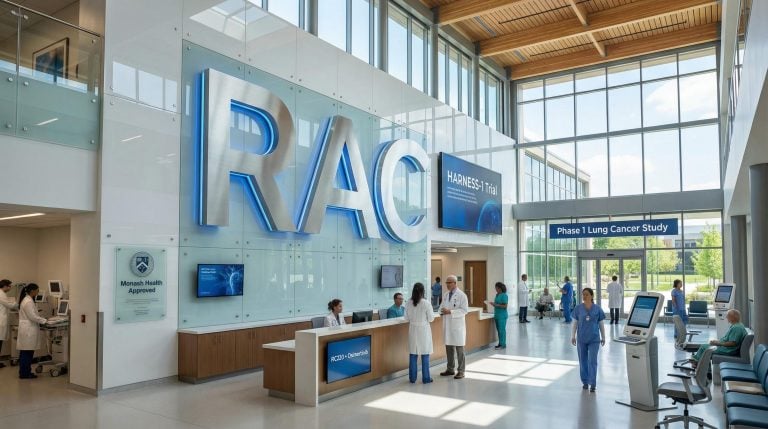
Racura Oncology secures governance approval for HARNESS-1 lung cancer trial
Racura Oncology (ASX: RAC) has received governance approval from Monash Health for its Phase 1 HARNESS-1 trial. This approval clears the final administrative hurdle before patient recruitment can begin, converting the company’s November 2025 ethics approval into operational readiness and moving RC220 from planning to execution stage.
The governance approval confirms that Monash Health has the necessary site infrastructure, resources, and oversight in place to safely conduct the trial. A site initiation meeting is scheduled for 23 March 2026 at Monash Medical Centre in Clayton, Victoria, under the supervision of Principal Investigator Dr Surein Arulananda. Four additional clinical trial sites are expected to activate in the coming months, reducing single-site dependency and potentially accelerating enrolment timelines.
The Racura HARNESS-1 trial approval represents a material de-risking event for investors, as it demonstrates concrete progress from regulatory permission to operational capability. The trial will assess the safety, tolerability, and pharmacokinetics of RC220 (E,E-bisantrene) in combination with osimertinib in patients with EGFR-mutated non-small cell lung cancer.
When big ASX news breaks, our subscribers know first
What is governance approval and why does it matter?
Governance approval is distinct from ethics approval, which Racura secured in November 2025. Ethics approval grants permission to conduct a trial on ethical grounds, confirming that the study design respects patient rights and safety. Governance approval, by contrast, confirms that the specific hospital site possesses the physical resources, trained staff, and administrative systems required to safely execute the trial protocol.
Without governance approval, patient recruitment cannot commence even when ethics clearance is in place. This administrative checkpoint ensures that hospitals can manage the practical demands of clinical research, including staffing requirements, drug storage facilities, patient monitoring capabilities, and regulatory compliance infrastructure.
For investors, governance approval represents the final green light before real-world execution begins. It de-risks the trial timeline by confirming operational readiness rather than simply regulatory permission. The approval also validates that Monash Health, a major Victorian healthcare network, has committed institutional resources to supporting the HARNESS-1 programme.
HARNESS-1 trial design targets osimertinib resistance
The HARNESS-1 trial is structured as a multi-centre Phase 1a/b study targeting a significant unmet need in lung cancer treatment. The trial aims to prevent or delay resistance to standard of care EGFR-mutant tyrosine kinase inhibitors such as osimertinib.
The trial will proceed through four distinct stages:
- Circulating tumour DNA (ctDNA) screening stage to identify and enrol eligible patients
- Accelerated trial design (ATD) enrolling participants into single-patient cohorts for careful safety evaluation whilst reaching clinically active dose levels quickly
- Bayesian Optimal Interval (BOIN) dose escalation using larger patient cohorts to identify the maximum tolerated dose (MTD) of RC220
- Phase 1b double-blind randomised dose expansion with 40 patients across two RC220 dose levels
Phase 1a will enrol between 12 and 40 patients depending on how quickly clinicians identify the optimal RC220 dose. Participants will receive intravenous infusion of RC220 on Day 1 of 21-day cycles in combination with standard of care osimertinib therapy. Treatment continues until one of five outcomes occurs: successful disease control, one year of treatment, disease progression, unacceptable toxicity, or withdrawal of consent.
Dr. Rodney Cusack, Principal Scientist, Racura Oncology
“With governance approval now secured, we are able to move forward with the clinical trial of RC220 in patients with EGFR-mutated NSCLC. This approval confirms that the necessary site infrastructure, resources and oversight are in place, allowing us to progress safely and efficiently.”
The adaptive Bayesian trial design aligns with the US FDA’s Project Optimus requirements, which aim to better balance the efficacy and side effects of new cancer treatments. This alignment could potentially streamline future regulatory interactions in the United States market.
| Trial Stage | Design | Patient Numbers | Key Objective |
|---|---|---|---|
| Screening | ctDNA-based | Varies | Patient selection |
| Phase 1a ATD | Single-patient cohorts | Initial cohorts | Safety evaluation |
| Phase 1a BOIN | Dose escalation | 12-40 total | Identify MTD |
| Phase 1b | Randomised, double-blind | 40 | Dose expansion |
Understanding EGFR-mutant lung cancer and osimertinib resistance
EGFR mutations drive a portion of non-small cell lung cancer cases globally. Osimertinib, marketed by AstraZeneca as Tagrisso, represents a standard treatment for patients with activating EGFR mutations. Despite its efficacy, resistance to osimertinib can develop over time, creating a need for combination approaches that can prevent or delay treatment failure.
RC220 functions as an RNA and DNA G4 binder, targeting key pathways involved in osimertinib resistance. G4 structures (guanine quadruplexes) play important roles in regulating cancer growth genes, including MYC. By binding to these structures, RC220 aims to inhibit resistance mechanisms that allow cancer cells to escape osimertinib’s therapeutic effects.
The combination strategy addresses a clear commercial opportunity in a well-defined patient population where current treatments can fail. Patients who develop osimertinib resistance face limited therapeutic options, making novel combination approaches that extend treatment efficacy commercially valuable.
The next major ASX story will hit our subscribers first
Trial endpoints and pathway to Phase 1b expansion
The HARNESS-1 trial will measure multiple endpoints to assess both safety and preliminary efficacy signals. Primary endpoints focus on safety, tolerability, and pharmacokinetics of RC220 in combination with osimertinib. Secondary endpoints include progression-free survival (PFS) and overall survival (OS), providing early indicators of therapeutic benefit.
Exploratory endpoints will monitor:
- Changes in levels of circulating tumour DNA (ctDNA)
- Changes in cancer-specific mutations present in patients
Once the MTD of RC220 has been determined through Phase 1a, all accumulated safety and pharmacokinetic data will be analysed before initiating Phase 1b. In the double-blind, randomised dose expansion stage, 40 participants will be randomised to one of two RC220 dose levels in combination with standard of care osimertinib.
The comprehensive endpoint structure means Racura will generate both safety data required for regulatory progression and early efficacy signals that could inform future partnership discussions. The company has stated it is actively exploring partnerships, licence agreements, or commercial merger and acquisition opportunities to accelerate patient access to RC220.
Next steps and timeline
Racura has confirmed the following immediate milestones:
- Site initiation meeting at Monash Medical Centre (Clayton): 23 March 2026
- Principal Investigator: Dr Surein Arulananda
- First patient recruitment enabled following site activation
- Four additional sites expected to activate in coming months
The activation of multiple sites reduces execution risk by diversifying patient recruitment across several healthcare networks. This multi-site approach typically accelerates enrolment compared to single-site trials, particularly in rare patient populations or trials with specific molecular screening requirements such as EGFR mutations.
Trial details, including open and recruiting sites, are available on the Australian New Zealand Clinical Trial Registry (ACTRN12626000325303). Enquiries concerning trial participation can be directed to Racura Oncology at trials@racuraoncology.com.
Want the Next Biotech Breakthrough in Your Inbox?
Join 20,000+ investors getting FREE breaking ASX healthcare news delivered within minutes of release, complete with in-depth analysis. Click the “Free Alerts” button at StockWire X to receive real-time alerts the moment trial results, approvals, and clinical milestones hit the market.