
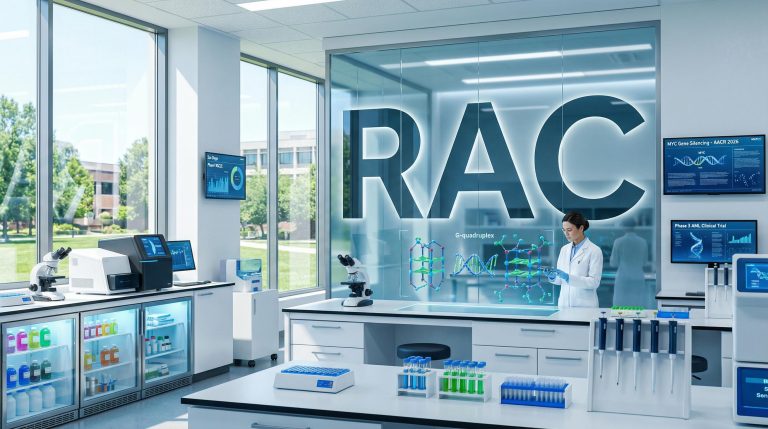
Racura Oncology (ASX: RAC) has been selected to present preclinical mechanism of action data at the American Association of Cancer Research (AACR) Annual Meeting 2026, scheduled for 17-22 April 2026 in San Diego. The Racura AACR 2026 presentation will demonstrate how (E,E)-bisantrene silences MYC gene expression by stabilising G-quadruplex DNA structures, with the abstract to be published in the peer-reviewed journal Cancer Research in April.
Dr Sumit Sahni, Senior Scientist at Racura, will present the poster titled “(E,E)-bisantrene silences c-MYC expression by stabilizing its promotor region G-quadruplex” at the largest international cancer research conference.
Dr Daniel Tillett, CEO and Managing Director
“I am delighted Racura Senior Scientist, Dr Sumit Sahni will be presenting this important preclinical work at the largest international cancer conference, AACR 2026. I would like to thank our entire preclinical team and collaborators for their exceptional work, which has been critical in advancing our understanding of RC220’s anti-cancer activity and which we believe has the potential to be a practice-changing therapy.”
How (E,E)-bisantrene silences MYC gene expression
The preclinical data describes a specific molecular mechanism by which (E,E)-bisantrene targets cancer cells. The compound works by binding to G-quadruplex (G4) DNA structures, which are non-standard DNA formations found in the promoter regions of certain genes. These G4 structures can function as molecular “off switches” when stabilised by drug binding.
Using Nuclear Magnetic Resonance (NMR) spectroscopy and molecular modelling, Racura’s research team identified that (E,E)-bisantrene binds to the MYC gene’s G4 structures with a 2:1 stoichiometry, meaning two drug molecules attach to each G4 structure. This binding stabilises the G4 formation, preventing the MYC gene from being transcribed into protein.
Circular dichroism spectroscopy established that (E,E)-bisantrene stabilises the c-MYC promotor G4 structure, whilst surface plasmon resonance measured the binding affinity between the drug and the DNA target.
Why MYC matters in cancer treatment
The MYC protein acts as a master gene regulator controlling the expression of thousands of genes involved in cell growth, differentiation, survival, metabolic reprogramming, chemotherapy resistance, and immune surveillance. Due to its central role in cancer biology, MYC has historically been considered “undruggable” through conventional small-molecule approaches, making G4-targeting strategies scientifically significant.
RNA-Seq analysis revealed that (E,E)-bisantrene potently inhibited c-MYC expression in multiple cancer cell lines. Beyond MYC, the compound also decreased expression of other oncogenes containing G4 regions in their promoters:
- MET: A receptor tyrosine kinase involved in tumour growth and metastasis
- TERT: The telomerase reverse transcriptase, enabling unlimited cell division
- VEGFA: Vascular endothelial growth factor promoting tumour blood vessel formation
- ATF4: A stress response transcription factor supporting cancer cell survival
- MDM2: A regulator that inhibits the tumour suppressor protein p53
The data showed that MYC-dependent downstream target genes were potently suppressed by (E,E)-bisantrene in non-small cell lung cancer cells.
When big ASX news breaks, our subscribers know first
Preclinical data supports ongoing clinical programmes
The mechanism of action findings directly support Racura’s two active clinical development programmes, providing scientific validation for the therapeutic strategy underlying both trials.
| Clinical Programme | Indication | Phase | How MYC Data Supports |
|---|---|---|---|
| RC220 + osimertinib | EGFRm NSCLC | Phase 1 HARNESS-1 | MYC silencing demonstrated in NSCLC cell lines |
| RC220 monotherapy | Acute Myeloid Leukaemia | Phase 3 | G4 stabilisation mechanism validated |
The preclinical work confirms target engagement at the molecular level, demonstrating that (E,E)-bisantrene functions as a G4 DNA stabiliser leading to silencing of MYC gene expression in cancer cells. This mechanistic understanding de-risks the clinical programmes by establishing the scientific rationale for using RC220 in MYC-driven tumours.
Comparison to other G4-targeting agents
The research found that (E,E)-bisantrene produced similar increases in melting temperature to other G4 ligands, including pidnarulex and pyridostatin. Pathway analysis of the RNA-Seq data demonstrated a transcriptomic profile similar to pidnarulex, a known G4-binding drug in early-stage clinical development.
The key differentiation for Racura’s compound lies in its clinical history. Bisantrene has been shown to be safe and effective in more than 1,500 clinical trial patients historically, providing an established safety profile that newer G4-targeting agents lack. Recent discoveries by Racura have enabled composition of matter intellectual property filings that provide 20 years of patent protection over (E,E)-bisantrene.
This combination of comparable efficacy to clinical-stage competitors, coupled with decades of clinical safety data, positions RC220 favourably for accelerated development in oncology indications where MYC dysregulation drives disease progression.
The next major ASX story will hit our subscribers first
Strategic context and partnership outlook
Racura is actively exploring partnerships, licence agreements, or a commercial merger and acquisition to accelerate access to RC220 for patients with cancer globally. The Racura AACR 2026 presentation provides high-profile visibility during this partnering phase.
The company has established scientific credibility through existing collaborations with leading research institutions:
- Astex
- Emory University
- MD Anderson
- Sheba City of Health
- UNC School of Medicine
- University of Wollongong
- University of Newcastle
Presenting at AACR, the largest international cancer research conference, offers Racura direct access to institutional investors, pharmaceutical companies, and potential development partners during the 17-22 April 2026 meeting in San Diego. The abstract publication in Cancer Research, a peer-reviewed journal, provides independent scientific validation of the mechanism of action data.
For investors, the conference selection demonstrates that Racura’s preclinical research meets the rigorous scientific standards required for acceptance at the industry’s premier annual gathering. This validation comes at a strategically significant time as the company advances partnering discussions whilst progressing both Phase 1 and Phase 3 clinical programmes.
Don’t Miss the Next Biotech Breakthrough
Join 20,000+ investors getting FREE breaking ASX biotech news delivered to your inbox within minutes of release, complete with in-depth analysis. Click the “Free Alerts” button at Big News Blast to receive real-time alerts the moment market-moving announcements hit the ASX.