
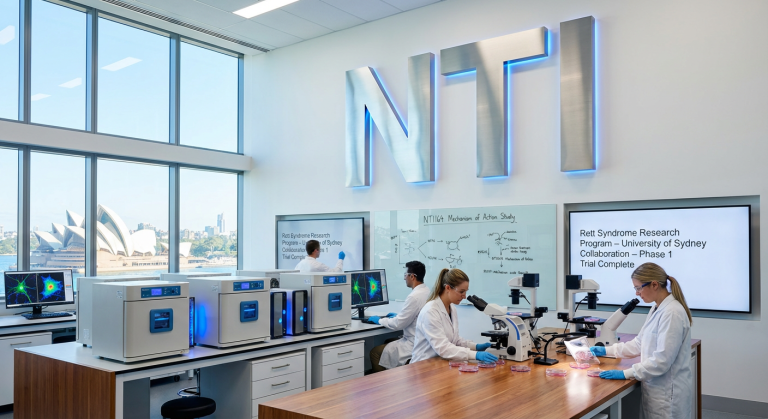
Neurotech partners with University of Sydney to advance Rett syndrome research
Neurotech International (ASX: NTI) has announced a research collaboration with The University of Sydney focused on advancing its proprietary cannabinoid compound NTI164 for Rett syndrome. The Neurotech Rett Syndrome Sydney Collaboration follows the successful completion of a Phase 1 clinical study in the rare neurodevelopmental disorder and aims to define how the compound modulates fundamental disease mechanisms.
The research programme will be led by Professor Wendy Gold, Head of School of Medical Sciences (interim) at the Faculty of Medicine and Health. Professor Gold is an internationally recognised expert in human neuronal modelling of neurodevelopmental disorders, bringing specialised expertise in translating human neuronal models into mechanistic insights. Preclinical observations to date suggest that NTI164 may exert potent, multi-modal activity across several key Rett-associated pathways, positioning this collaboration to characterise these mechanisms in greater detail.
For investors, the partnership adds scientific credibility to Neurotech’s Rett syndrome programme whilst advancing understanding of NTI164’s therapeutic potential. Academic collaborations with major Australian universities can generate publishable data supporting the therapeutic thesis and build relationships that may support future clinical development.
What is Rett syndrome and why does it matter for investors?
Rett syndrome is a rare and severe neurodevelopmental disorder with significant unmet medical need. The condition is characterised by four core biological disturbances underpinning its neurological and systemic manifestations:
- Widespread disruption of gene regulation
- Mitochondrial dysfunction
- Impaired synaptic development
- Abnormal neuronal network activity
These disturbances result from MECP2 deficiency, a genetic mutation affecting a protein critical for normal brain development and function. The disorder predominantly affects girls and typically manifests after an initial period of apparently normal development, with progressive loss of motor skills, communication abilities, and purposeful hand use.
From an investment perspective, rare disease programmes targeting conditions with significant unmet need can benefit from regulatory incentives and reduced competition. Whilst Rett syndrome affects a smaller patient population compared to more common neurological conditions, this focused approach can create commercial opportunity through orphan drug designations, accelerated approval pathways, and premium pricing potential. The lack of approved pharmacological treatments for Rett syndrome represents a clear gap in the therapeutic landscape.
Research approach using human neuronal models
The University of Sydney collaboration will utilise human-derived Rett syndrome neuronal models, enabling direct investigation of disease-relevant cellular, molecular, and functional abnormalities associated with MECP2 deficiency. These advanced human models provide a translationally relevant platform to interrogate disease mechanisms and therapeutic response, representing a methodological advancement over traditional animal models.
The research will investigate how NTI164 affects neurons directly impacted by the MECP2 mutation, potentially revealing the compound’s mechanism of action with unprecedented biological relevance. Following the successful completion of its Phase 1 clinical study, Neurotech is now expanding its Rett syndrome programme to further characterise NTI164’s effects in these human disease models.
Professor Wendy Gold
“We are very excited about this collaboration. These human neuronal systems allow Rett syndrome to be modelled with unprecedented biological relevance, enabling, for the first time, detailed investigation of disease mechanisms and therapeutic responses directly in neurons affected by Rett syndrome.”
For investors, human neuronal models provide more clinically relevant data than animal studies, potentially strengthening the evidence base for regulatory submissions and future clinical development. The ability to demonstrate mechanism of action in human neurons affected by Rett syndrome could support differentiation from other investigational therapies and provide mechanistic justification for clinical observations.
Neurotech’s broader clinical pipeline
The Neurotech Rett Syndrome Sydney Collaboration sits within a broader clinical development programme for NTI164 across multiple paediatric neurological disorders. The clinical-stage biopharmaceutical company has completed a Phase II/III randomised, double-blind, placebo-controlled clinical trial in Autism Spectrum Disorder with clinically meaningful and statistically significant benefits reported across clinically-validated measures and excellent safety. Neurotech has also received human ethics committee clearance for a Phase III Clinical Study in ASD.
| Indication | Trial Phase | Status | Key Outcome |
|---|---|---|---|
| Autism Spectrum Disorder | Phase II/III | Completed | Statistically significant and clinically meaningful benefits |
| Autism Spectrum Disorder | Phase III | Cleared | Human ethics committee approval received |
| PANDAS/PANS | Phase I/II | Completed | Statistically significant and clinically meaningful results |
| Rett Syndrome | Phase I | Completed | Successful completion |
The company has also completed and reported statistically significant and clinically meaningful Phase I/II trials in PANDAS/PANS (Paediatric Autoimmune Neuropsychiatric Disorders Associated with Streptococcal Infections and Paediatric Acute-Onset Neuropsychiatric Syndrome). This diversified pipeline approach positions NTI164 as a potentially broad-spectrum cannabinoid therapy for multiple paediatric neurological conditions.
The University of Sydney collaboration adds another dimension to this advancing clinical pipeline, with multiple indications progressing toward potential regulatory milestones. For investors, the progression across several distinct but related paediatric neurological disorders suggests the compound’s mechanism may address shared pathophysiological features across these conditions.
Strategic implications for Neurotech investors
The academic collaboration represents a de-risking step that builds scientific understanding ahead of potential further clinical development in Rett syndrome. Partnering with an internationally recognised expert in the field adds external validation to the programme whilst generating mechanistic data that could support future regulatory interactions.
NTI164 is positioned as a proprietary cannabinoid-based compound targeting multiple paediatric neurological disorders, a strategic approach that leverages a single therapeutic asset across several rare disease indications. The compound’s reported multi-modal activity across key Rett-associated pathways suggests it may address multiple aspects of the disease simultaneously, potentially differentiating it from more narrowly targeted approaches.
The collaboration’s focus on defining how NTI164 modulates fundamental disease mechanisms in human neurons provides an opportunity to generate publishable data in peer-reviewed literature. Such publications can enhance the programme’s scientific credibility, attract additional research collaborators, and support intellectual property strategies.
For Neurotech (ASX: NTI), the expansion of its Rett syndrome programme following Phase 1 completion indicates management’s confidence in the clinical data generated to date. The decision to invest in mechanistic studies using advanced human models suggests the company is building a comprehensive development package that addresses both clinical efficacy signals and underlying biological mechanisms. Academic collaborations can also provide cost-effective ways to advance programmes during early development stages, with universities often contributing resources and expertise that reduce development costs.
Want the Next Biotech Breakthrough in Your Inbox?
Join 20,000+ investors receiving FREE breaking ASX healthcare news delivered within minutes of release, complete with in-depth analysis. Click the “Free Alerts” button at Big News Blast to get market-moving biotech announcements the moment they break.