
Mesoblast Delivers US$49M RYONCIL Revenue in First Full Commercial Half-Year
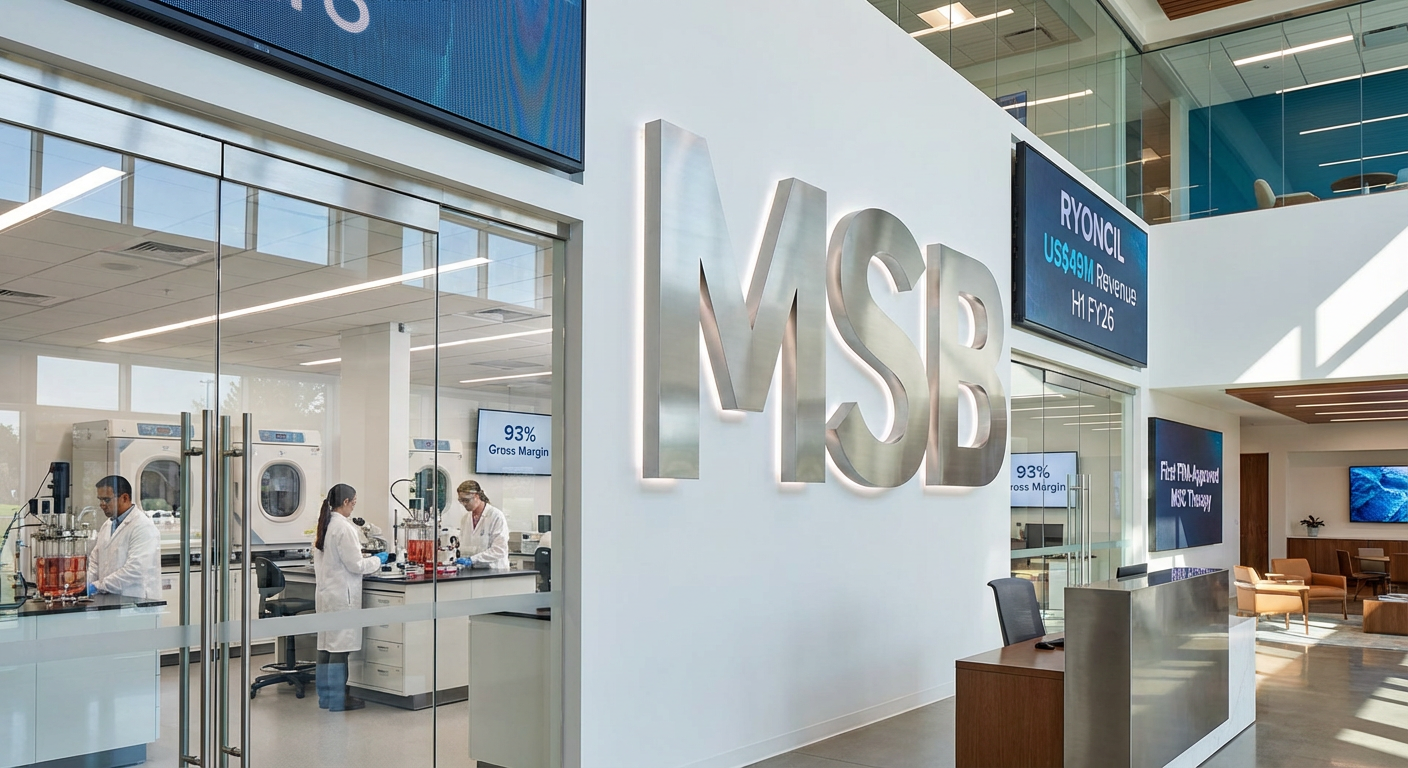
Mesoblast delivers US$49 million RYONCIL revenue in first full half-year of sales
Mesoblast Limited (ASX: MSB) has reported US$49 million in net product revenue from RYONCIL for the six months ended 31 December 2025 (H1 FY26), marking the biotech’s transition to commercial-stage revenue generation. The company’s flagship cell therapy product, which launched in April 2025 following December 2024 FDA approval, delivered a 93% gross margin and demonstrated quarter-on-quarter sales growth across the period.
RYONCIL represents the first and only FDA-approved allogeneic mesenchymal stromal cell (MSC) product, positioning Mesoblast as the category pioneer in a new therapeutic class. The company has issued full-year revenue guidance of US$110-120 million for fiscal 2026, implying second-half acceleration to US$61-71 million as hospital network penetration deepens.
Key Financial Highlights (H1 FY26):
- Net product revenue: US$49.0 million
- Gross profit (excluding amortisation): US$44.2 million
- Gross margin: 93%
- Full-year guidance: US$110-120 million
When big ASX news breaks, our subscribers know first
What are mesenchymal stromal cells and why does FDA approval matter?
Mesenchymal stromal cells (MSCs) are a type of cell capable of modulating immune responses and reducing inflammation in the body. RYONCIL’s “allogeneic” designation means the cells are derived from healthy donors rather than individual patients, enabling off-the-shelf delivery without patient-specific manufacturing delays.
The FDA approval validates not only RYONCIL’s clinical efficacy but the entire MSC therapeutic platform, de-risking Mesoblast’s broader pipeline. RYONCIL is approved for treating steroid-refractory acute graft versus host disease (SR-aGvHD) in paediatric patients, a life-threatening complication where transplanted immune cells attack the recipient’s body following bone marrow transplantation. As the first approved therapy in this cell-based category, RYONCIL holds first-mover advantage in an emerging field.
Commercial launch gains momentum across U.S. transplant centres
The company has established near-complete penetration of its target hospital network:
- 49 centres onboarded and actively administering RYONCIL
- 64 centres represent approximately 94% of U.S. paediatric bone marrow transplants
- 280 million U.S. lives covered under insurance
- Specific HCPCS J-Code assigned by CMS for reimbursement
- Patient hub established to support treatment access
This infrastructure buildout creates the foundation for revenue scaling, with the company targeting three strategic commercial priorities: proactively identifying appropriate patients, reinforcing superior patient outcomes in first-line therapy failures, and empowering caregivers to advocate for RYONCIL.
Financial position supports growth pipeline investment
Mesoblast reported a US$130 million cash balance at 31 December 2025, with net operating cash usage of US$30.3 million during H1 FY26. The company has secured a new US$125 million credit facility (with US$50 million currently available), replacing higher-cost debt and providing funding flexibility for clinical and manufacturing programmes.
RYONCIL’s US$44.2 million gross profit is now funding research and development investments, including the Phase 3 chronic low back pain trial, alongside commercial-scale manufacturing for both RYONCIL inventory and second-generation product launches. R&D spend totalled US$46 million for the half, while selling, general and administrative expenses increased US$10 million to US$28.5 million, reflecting the commercial team buildout. Loss after tax improved to US$40.2 million from US$47.9 million in the prior corresponding period.
The company stated it expects reduced net cash spend over the remainder of the fiscal year based on projected quarterly revenue receipts, indicating an emerging self-funding model.
| Line Item (US$ million) | H1 FY26 | H1 FY25 | Commentary |
|---|---|---|---|
| Product sales, net | 48.7 | — | First commercial revenue period |
| Gross margin | 93% | — | Demonstrates product economics |
| R&D expenses | (46.2) | (5.1) | Prior period included US$23M inventory gain |
| SG&A expenses | (28.5) | (18.0) | Commercial team expansion |
| Loss after tax | (40.2) | (47.9) | 16% improvement year-on-year |
| Cash position | 130.0 | — | At 31 December 2025 |
Three growth levers for continued RYONCIL expansion
Mesoblast has outlined three strategic commercial priorities to drive revenue growth: proactive patient identification and prioritisation, reinforcing superior patient outcomes in first-line treatment, and empowering caregivers to demand RYONCIL for their children.
Beyond the existing paediatric indication, the company is pursuing label expansion into adult severe SR-aGvHD, a market 3-4 times larger than the paediatric population. Following central IRB approval in March 2026, site initiation and patient enrolment will commence for a pivotal study positioning RYONCIL as part of second-line treatment regimens in adults.
Approximately 50% of adults with severe SR-aGvHD fail existing second-line treatments, facing a 25% survival rate at 100 days under current standard of care. Data from RYONCIL’s Expanded Access Programme showed 76% survival at Day 100 in patients aged 12 and older who had failed ruxolitinib or other second-line agents.
The company is also evaluating additional label expansion opportunities across inflammatory bowel, neurodegenerative, and respiratory conditions, prioritising the portfolio to maximise shareholder return through internal investment versus strategic partnership structures.
Pipeline advancing toward two potential BLA filings
Mesoblast’s second-generation MSC platform, rexlemestrocel-L, is advancing toward two Biologics License Application (BLA) filings.
Chronic Low Back Pain (CLBP):
The company is actively recruiting a 300-patient confirmatory Phase 3 trial across 40 sites in the U.S., with enrolment expected to complete in March/April 2026. Data readout and BLA filing are projected for calendar year 2027. Mesoblast received Regenerative Medicine Advanced Therapy (RMAT) designation for rexlemestrocel-L as a potential opioid-sparing therapy, following FDA feedback that clinically meaningful pain reduction at 12 months can support product efficacy. The addressable market comprises more than 7 million patients with CLBP due to degenerative disc disease in each of the U.S. and European Union.
REVASCOR (End-Stage Heart Failure):
The company is pivoting from an accelerated approval pathway to full FDA approval for REVASCOR in end-stage heart failure with reduced ejection fraction (HFrEF). LVAD Study II randomised 159 patients (2:1 ratio) and demonstrated REVASCOR reduced major mucosal bleeding events (life-threatening GI bleeding) through 6 months (p<0.05). In ischemic patients with right heart failure, REVASCOR reduced early death risk by more than 4-fold compared to controls. The company expects to file the BLA next quarter following alignment with FDA on chemistry, manufacturing, and controls requirements.
Near-term catalysts and milestones
Upcoming de-risking events include:
- Adult aGvHD study initiation following March 2026 IRB approval
- CLBP enrolment completion in March/April 2026
- REVASCOR BLA filing next quarter (Q3 FY26)
- CLBP data readout and BLA filing in calendar year 2027
These milestones represent multiple share price catalysts as Mesoblast transitions from a single-product company to a multi-indication platform.
The next major ASX story will hit our subscribers first
Revenue guidance signals confidence in commercial trajectory
Management’s full-year guidance of US$110-120 million implies second-half revenue acceleration to US$61-71 million, representing 24-45% sequential growth from H1 FY26’s US$49 million. The company stated it expects reduced net cash spend over the remainder of the fiscal year based on projected revenue receipts, indicating improving cash generation as commercial sales scale.
With 49 centres onboarded across a target network of 64 centres covering 94% of paediatric bone marrow transplants, Mesoblast has established the infrastructure for sustained revenue growth. The high 93% gross margin demonstrates RYONCIL’s product economics can support both operational self-sufficiency and continued pipeline investment, reducing future dilution risk for shareholders as the company advances toward two additional BLA filings.
Don’t Miss the Next Biotech Revenue Breakout
Join 20,000+ investors getting FREE breaking ASX biotech news delivered to your inbox within minutes of release, complete with in-depth analysis. Click the “Free Alerts” button at StockWire X to start receiving alerts the moment market-moving announcements hit the ASX—before the market reacts.