
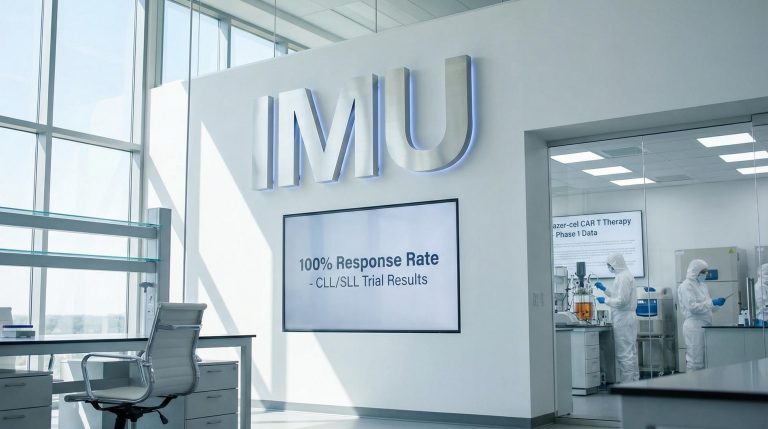
Imugene achieves 100% response rate in CLL/SLL patients with azer-cel therapy
Imugene Limited (ASX: IMU) has reported positive Imugene azer-cel lymphoma trial results in its Phase 1b basket study, with a 100% Overall Response Rate in Chronic Lymphocytic Leukemia / Small Lymphocytic Lymphoma (CLL/SLL) patients and an 80% response rate in Marginal Zone Lymphoma (MZL) patients. The clinical-stage immuno-oncology company announced these early-stage efficacy signals on 10 March 2026, highlighting the potential of its off-the-shelf CAR T therapy across multiple B-cell malignancies.
The CLL/SLL cohort consisted of heavily pre-treated patients who had received a median of ≥3 prior lines of therapy. All four evaluable patients achieved Partial Responses, a clinically significant outcome in CLL/SLL where complete responses are rare and partial responses have historically supported regulatory approvals according to U.S. FDA guidance. In the MZL subset, which included patients with a median of ≥2 prior lines of therapy, three out of five patients achieved Complete Responses whilst one achieved a Partial Response.
| Indication | Patients Evaluated | Complete Responses | Partial Responses | Overall Response Rate |
|---|---|---|---|---|
| CLL/SLL | 4 | 0 | 4 | 100% |
| MZL | 5 | 3 | 1 | 80% |
These results validate Imugene’s basket trial strategy, which allows the company to evaluate azer-cel across multiple lymphoma subtypes simultaneously. The approach enables capital-efficient development by prioritising indications demonstrating the strongest clinical activity, potentially supporting an accelerated path to market in areas with significant unmet medical need.
Join thousands of readers who start here
Our best articles, sent straight to your inbox. You can unsubscribe anytime.
What is azer-cel and why do these results matter for lymphoma treatment?
Azer-cel (azercabtagene zapreleucel) is an off-the-shelf, allogeneic CAR T cell therapy targeting CD19, a protein expressed on B-cell cancers. Unlike autologous CAR T therapies, which are custom-manufactured from a patient’s own immune cells, allogeneic therapies are donor-derived and ready-made. This distinction matters considerably for treatment access, manufacturing complexity, and patient reach.
The “off-the-shelf” characteristic addresses critical limitations of existing autologous products. Patients can receive treatment faster without waiting for personalised manufacturing, which typically requires weeks and can fail in patients with poor-quality starting material. The approach also supports broader patient eligibility, including those unable to wait for custom manufacture.
Key clinical terminology for investors:
- Overall Response Rate (ORR): The proportion of patients whose cancer shrinks or disappears after treatment, serving as a primary measure of efficacy in clinical trials
- Complete Response (CR): All measurable or visible signs of cancer are no longer detectable following treatment
- Partial Response (PR): Significant reduction in tumour size (typically at least 50%) or disease burden, though the disease has not completely disappeared
- Progressive Disease (PD): Cancer has grown or spread despite treatment
In CLL/SLL specifically, partial responses carry significant clinical and regulatory weight. The disease biology makes complete responses uncommon, and FDA guidance has recognised ORR (including partial responses) as sufficient evidence to support regulatory approvals. This precedent positions Imugene’s 100% ORR data favourably within the regulatory framework.
The commercial opportunity is substantial. Approximately 60% of patients treated with approved autologous CD19 CAR T therapies relapse, creating a significant population requiring alternative approaches. Allogeneic therapies like azer-cel address this gap whilst offering potential advantages in manufacturing scalability and cost structure.
Imugene expands azer-cel trial to include BTK inhibitor combination
The company has amended its Phase 1b protocol to evaluate azer-cel in combination with a Bruton Tyrosine Kinase inhibitor (BTKi), a class of targeted therapies that have become standard first-line treatment for CLL. BTKis are approved drugs used primarily to treat B-cell cancers, and they have largely replaced traditional chemotherapy in CLL treatment paradigms.
The global BTK inhibitor market has become a significant sector within oncology, reaching approximately $12.1 billion in annual sales in 2025. Major pharmaceutical companies including Johnson & Johnson/AbbVie, BeiGene, AstraZeneca, and Eli Lilly share this market, reflecting the commercial validation of BTKi therapy.
The combination arm will enrol patients who have previously failed BTK inhibitor therapy, a growing population with limited treatment options. This strategic expansion positions azer-cel to address an unmet need in patients who have exhausted first-line BTKi options, whilst aligning the therapy with a validated, multi-billion dollar treatment category.
The protocol amendment also includes patients with mantle cell lymphoma (MCL), further expanding the potential addressable patient population. The combination strategy will evaluate both safety and preliminary efficacy, including response rates, in relevant patient populations.
Basket trial structure supports capital-efficient development
Imugene’s Phase 1b study employs a multi-indication basket trial design, allowing the company to evaluate azer-cel across several B-cell malignancies simultaneously. This approach enables strategic resource allocation toward the most promising indications whilst managing development costs and potentially accelerating time-to-market.
The basket study currently evaluates azer-cel in CAR T-naïve patients across multiple indications:
- Primary Central Nervous System Lymphoma (PCNSL) (≥1 prior line of therapy containing high-dose methotrexate)
- Diffuse Large B-Cell Lymphoma (DLBCL) (≥1 prior line of therapy including anti-CD20 antibody and anthracycline)
- Waldenström’s Macroglobulinemia (WM) (≥2 prior lines of therapy including anti-CD20 chemoimmunotherapy)
- Chronic Lymphocytic Leukemia / Small Lymphocytic Lymphoma (CLL/SLL) (prior BTKi and BCL2i or prior BTKi with high-risk features)
- Marginal Zone Lymphoma (MZL) (≥2 prior lines of therapy including anti-CD20 chemoimmunotherapy)
As clinical data matures across these indications, the company intends to prioritise those demonstrating the strongest clinical activity. Certain indications may not be pursued further if they fail to show sufficient promise, reflecting the adaptive nature of the basket trial design.
Patient enrolment is progressing faster in the CAR T-naïve cohort compared to the earlier CAR T-relapsed DLBCL cohort, indicating strong clinical demand and investigator support for an allogeneic approach. The trial is currently enrolling patients at 10 sites in the United States and 5 sites in Australia.
CEO Leslie Chong outlines strategic positioning for azer-cel
Management has highlighted the breadth of activity emerging across multiple lymphoma subtypes, positioning the BTKi combination strategy as a meaningful opportunity to expand clinical scope whilst addressing advanced patient populations with limited options.
Leslie Chong, Chief Executive Officer
“We are encouraged to see activity emerging across multiple lymphoma subtypes within the CAR T-naïve cohort, which highlights the potential breadth of azer-cel in areas of significant unmet medical need. The addition of the BTK inhibitor combination arm represents a meaningful opportunity to expand the clinical scope of the programme, particularly for advanced patients who have failed prior BTK inhibitor therapy. We believe this strategy may further strengthen the positioning of azer-cel whilst aiming to improve outcomes for patients with limited treatment options.”
Market context and unmet medical need
The commercial opportunity for effective lymphoma therapies remains substantial across multiple disease subtypes:
-
DLBCL represents the largest segment, with approximately 160,000 global cases annually and approximately 30,000 new cases per year in the United States. As the most common type of non-Hodgkin’s lymphoma, DLBCL presents a significant addressable market.
-
Relapse rates following existing therapies create opportunity for alternative approaches. Approximately 60% of patients treated with approved autologous CD19 CAR T therapies experience relapse, establishing a clear need for second-line or alternative therapeutic options.
-
CLL/SLL represents a distinct challenge as the most common slow-growing leukaemia. The disease can become resistant to therapy over time, and patients who have failed BTKi treatment face limited options.
The substantial relapse rate following existing CAR T therapies validates the commercial rationale for developing effective alternatives. Allogeneic approaches like azer-cel offer potential advantages in manufacturing scalability, treatment access, and patient eligibility compared to autologous therapies requiring personalised manufacture.
Enjoyed this article?
We publish high-impact stories like this a few times a week. No spam.
Next steps and trial milestones to watch
Imugene continues to enrol patients across its Phase 1b basket study, with several key data points maturing over the coming months. Investors should monitor the following catalysts:
- Ongoing patient enrolment across US and Australian sites, with the CAR T-naïve cohort progressing faster than earlier cohorts
- Durability of response data, which will indicate how long patients maintain clinical benefit
- Depth of response metrics as additional patients become evaluable and follow-up periods extend
- Safety profile characterisation as patient numbers increase and exposure periods lengthen
- Updates on the BTKi combination cohort as this arm begins enrolling patients
The company has stated it will provide further updates as additional patients become evaluable and data matures. Durability of response represents a particularly important metric for investors, as sustained clinical benefit strengthens regulatory and commercial positioning. The expansion of evaluable patients across multiple indications will inform strategic decisions regarding which disease subtypes to prioritise for later-stage development.
The basket trial’s adaptive design positions Imugene to make data-driven decisions regarding resource allocation, potentially supporting a capital-efficient path toward registration in the most promising indications.
Want the Next Biotech Breakthrough in Your Inbox?
Join 20,000+ investors getting FREE breaking ASX news delivered within minutes of release, complete with in-depth analysis. Click the “Free Alerts” button at StockWire X to start receiving healthcare alerts the moment market-moving announcements break.