
Arovella’s Armoured Cancer Cells Kill 97% of Pancreatic Tumours in Four Rounds
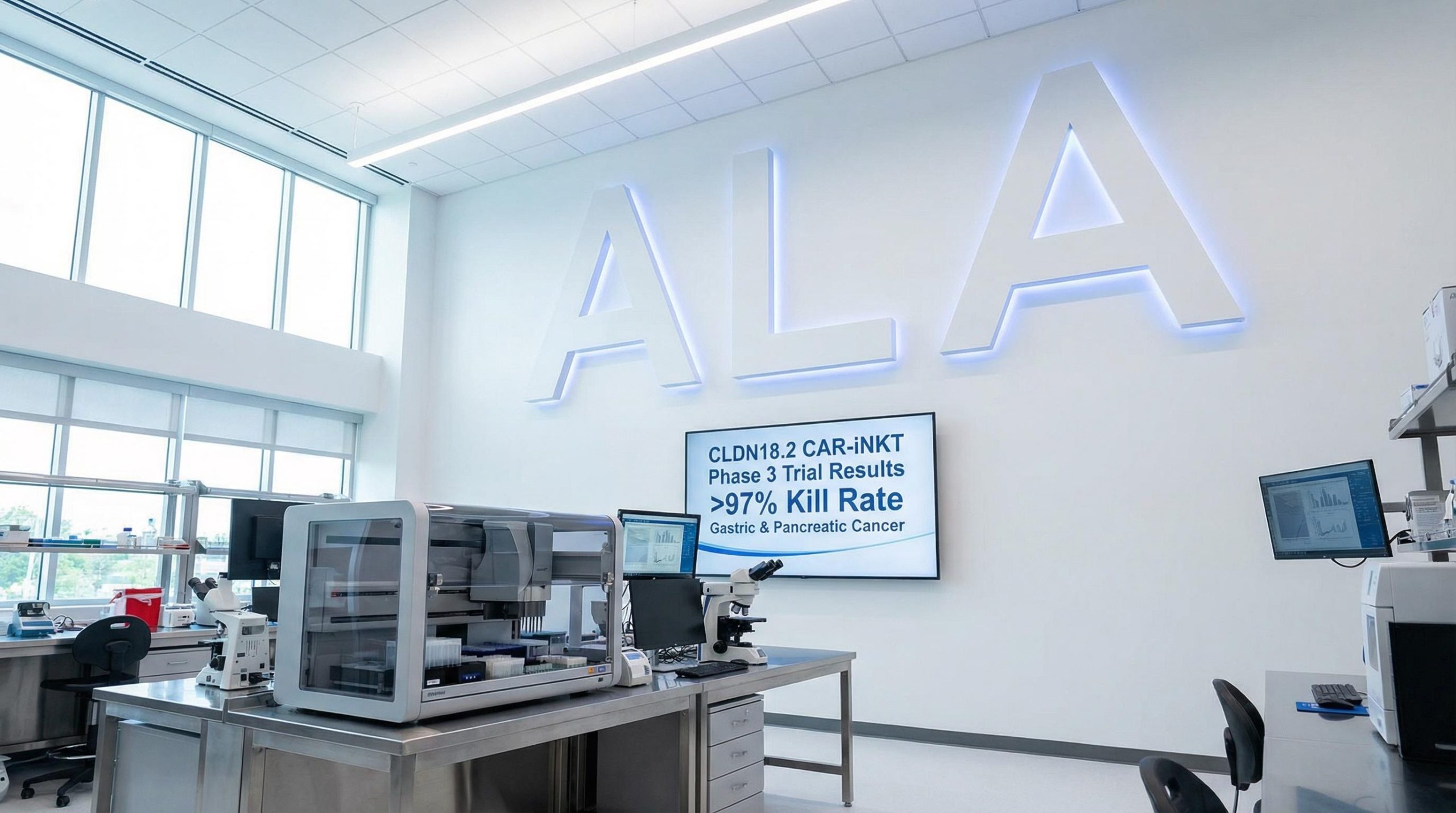
Arovella confirms CLDN18.2 CAR-iNKT cells eliminate pancreatic and gastric cancer cells in preclinical testing
Arovella Therapeutics (ASX: ALA) has confirmed the functionality of its novel CLDN18.2-targeting chimeric antigen receptor (CAR) in invariant natural killer T (iNKT) cells, marking the company’s expansion into solid tumour treatment beyond its blood cancer programmes. The Arovella CLDN18.2 CAR-iNKT data demonstrates that the addition of IL-12-TM armouring technology enhanced tumour-killing effectiveness across both pancreatic and gastric cancer cell lines.
The preclinical studies were conducted at the University of North Carolina under the guidance of Professor Gianpietro Dotti. CLDN18.2 is expressed in approximately 40-70% of gastric cancers and up to 60% of pancreatic ductal adenocarcinomas. Gastric cancer ranks as the 5th most common cancer globally, whilst pancreatic cancer is 7th in mortality despite lower incidence rates.
When big ASX news breaks, our subscribers know first
Understanding CLDN18.2 as a cancer target
CLDN18.2 (claudin 18.2) is a protein naturally found in the cells lining the gastric tract. In healthy tissue, CLDN18.2 sits within tight junctions between cells, where it maintains tissue structure and remains inaccessible to immune system targeting. When cells become cancerous, CLDN18.2 expression becomes dysregulated and the protein migrates to the cell surface, where it can be accessed by engineered immune cells.
This accessible positioning makes CLDN18.2 an effective therapeutic target. In the pancreas, CLDN18.2 is not normally expressed at all but can be switched on when cells turn cancerous, creating the same targetable surface exposure.
Commercial validation of CLDN18.2 as a drug target came in 2024, when Zolbetuximab became the first CLDN18.2-targeting therapy approved in Japan and the United States. Astellas had acquired the drug’s developer, Ganymed Pharmaceuticals, for €422 million. The CLDN18.2 therapeutic market is predicted to exceed $800 million by 2030.
With approximately 1 million gastric cancer cases and 500,000 pancreatic cancer cases diagnosed annually worldwide, many of which are HER2-negative and CLDN18.2-positive, the addressable patient population for CLDN18.2-targeting therapies represents a substantial commercial opportunity.
What makes iNKT cells different from conventional CAR-T approaches
Invariant natural killer T cells are a distinct immune cell type that differs from the conventional T cells used in most CAR-T therapies. Arovella’s platform is allogeneic, meaning the cells are derived from healthy donors and manufactured as an off-the-shelf product, rather than being extracted and modified from each individual patient.
This allogeneic approach offers potential manufacturing and scalability advantages over autologous (patient-specific) cell therapies, which require individual cell collection, modification, and reinfusion for every treatment. iNKT cells also possess dual targeting capability through both the engineered CAR and their invariant T cell receptor, which naturally recognises glycolipid-bound CD1d antigens on cancer cells.
Preclinical results demonstrate potent and durable tumour killing
The efficacy studies utilised a serial tumour challenge assay, a rigorous testing methodology designed to assess both killing potency and cellular persistence. CAR-iNKT cells were co-cultured with cancer cells, then challenged with fresh tumour cells every three days across four successive rounds.
This repeated challenge protocol intentionally pushes the engineered cells to their functional limits, providing a more stringent measure of durability than single-timepoint assays. The methodology assesses whether CAR-iNKT cells can maintain their tumour-killing activity and continue to expand in number when faced with persistent tumour burden.
| Cancer Type | Cell Line | Kill Rate (Round 4 with IL-12-TM) | Donors Tested |
|---|---|---|---|
| Pancreatic | PaTu8988S | >97% | 4 |
| Gastric | NUGC4-CLDN18.2 | >82% | 3 |
Key experimental parameters included:
- Effector-to-target ratio of 1:1 for pancreatic cancer, 1:2 for gastric cancer
- Four serial tumour challenges conducted over the testing period
- CAR-iNKT cells without IL-12-TM maintained tumour control for two challenges
- CAR-iNKT cells with IL-12-TM sustained tumour control through all four challenges
IL-12-TM armouring enhances CAR-iNKT cell expansion and persistence
Armouring refers to the modification of immune cells to produce membrane-bound interleukin-12 (IL-12-TM), a cytokine that enhances cellular function. The preclinical data showed that IL-12-TM armouring enhanced both CAR-iNKT cell expansion and sustained killing activity across multiple tumour challenges.
Cells without IL-12-TM demonstrated potent initial activity but began to lose tumour control after the second challenge. Armoured cells maintained cytotoxic function through all four challenges whilst simultaneously expanding in number, indicating improved proliferative capacity under high tumour stress conditions.
Critically, the IL-12-TM armouring technology is not programme-specific. It can be incorporated across Arovella’s CAR-iNKT platform with various CARs, potentially amplifying the value of the company’s broader pipeline as the technology is validated in additional targets.
CEO outlines significance for solid tumour expansion
Dr Michael Baker, CEO and Managing Director
“It is terrific to see the potent and durable activity of iNKT cells incorporating our novel and proprietary CLDN18.2-targeting CAR combined with IL-12-TM cytokine armouring technology against both gastric and pancreatic cancer cells. This is an important milestone for the company as we expand our pipeline to target difficult to treat solid tumours. We are highly encouraged by the durability of the CLDN18.2 CAR-iNKT cells expressing IL-12-TM in controlling tumour cells, particularly after multiple serial tumour challenges. These studies intentionally push the cells to the limit, and we are excited by the data.”
The next major ASX story will hit our subscribers first
Next steps for CLDN18.2 programme development
Arovella has outlined a clear development pathway for the CLDN18.2 programme following this proof-of-concept data. The company will generate additional CLDN18.2-targeting CAR-iNKT cells, both with and without IL-12-TM armouring, for in vivo testing in mouse models of gastric and pancreatic cancer.
Animal models for each cancer type are currently being established. Upcoming development milestones include:
- Generation of additional CLDN18.2-targeting CAR-iNKT cells
- In vivo testing in gastric cancer mouse model
- In vivo testing in pancreatic cancer mouse model
These animal studies will assess whether the tumour-killing activity observed in cell culture translates to efficacy in living systems, where factors such as tumour microenvironment, immune suppression, and cell trafficking come into play. Positive in vivo data would support progression towards regulatory toxicology studies and eventual clinical development.
Arovella’s broader pipeline context
The CLDN18.2 programme represents pipeline expansion and platform validation for Arovella, demonstrating that its CAR-iNKT technology can be applied to solid tumours beyond the company’s initial blood cancer focus. The lead product, ALA-101, consists of CAR19-iNKT cells targeting CD19-positive blood cancers and has had its Investigational New Drug (IND) application accepted by the US Food and Drug Administration.
ALA-101 is being developed as an allogeneic cell therapy for B-cell malignancies. The CLDN18.2-targeting technology was licensed from Sparx Group, and Arovella plans to incorporate its IL-12-TM armouring technology into solid tumour programmes.
The ability to apply a common platform technology across multiple cancer targets, combined with the potential manufacturing advantages of an off-the-shelf allogeneic approach, positions Arovella as a multi-asset biotechnology company rather than a single-programme developer. This diversification reduces reliance on any individual clinical candidate and provides multiple pathways to potential commercialisation.
Want the Next Biotech Breakthrough in Your Inbox?
Join 20,000+ investors receiving FREE ASX breaking news and analysis within minutes of release. Big News Blast delivers real-time alerts the moment market-moving announcements drop, with expert coverage already included. Click the “Free Alerts” button to never miss another biotech development.