
Algorae Pharmaceuticals Secures Second Peter Mac Collaboration for AI Validation
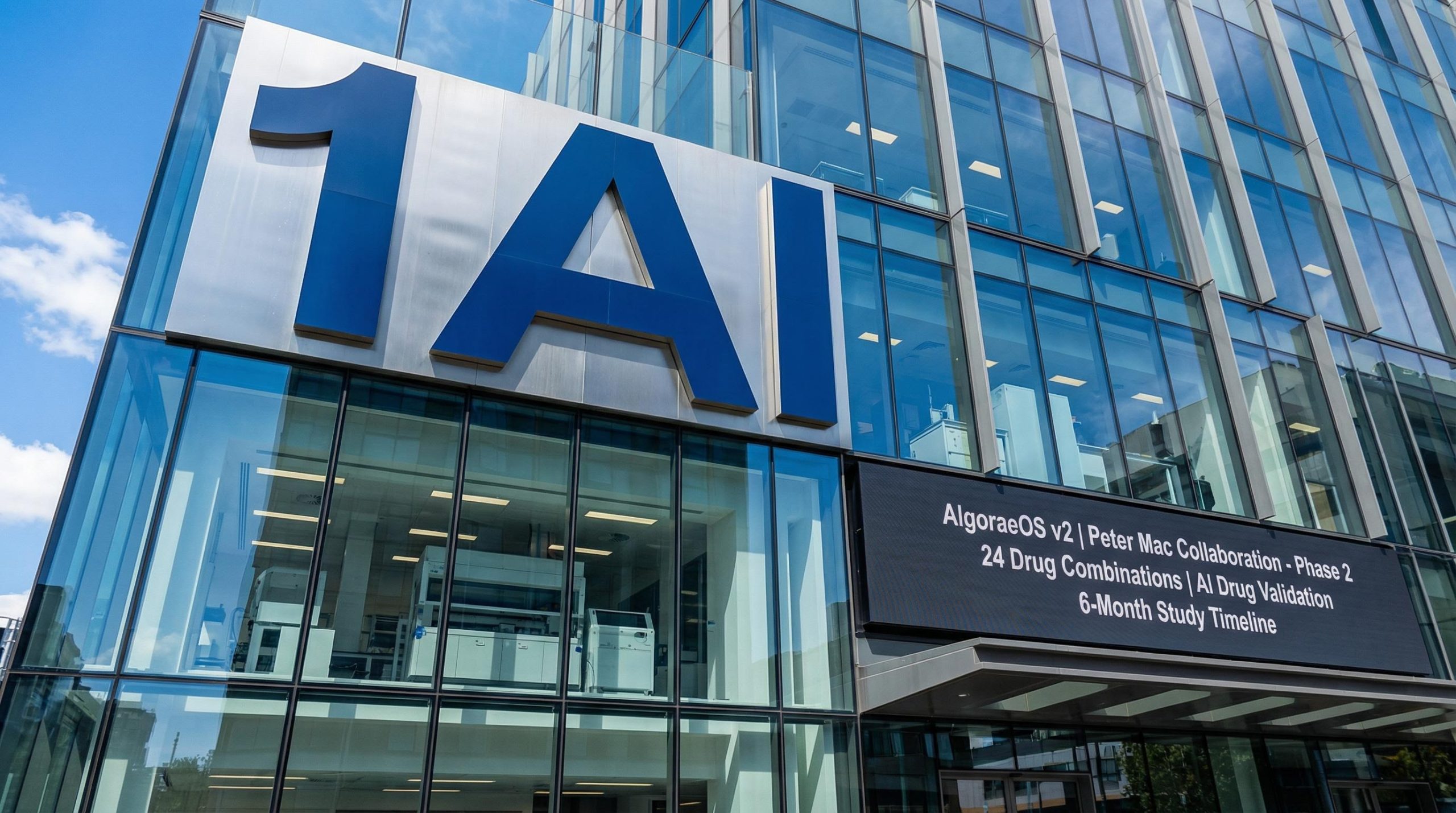
Algorae Pharmaceuticals (ASX: 1AI) has entered into a second collaboration with the Victorian Centre for Functional Genomics (VCFG) at Peter MacCallum Cancer Centre to validate predictions from its AlgoraeOS v2 platform. The Algorae Peter Mac AI validation programme will screen 24 high-priority drug combination candidates across four cancer cell lines, with key preclinical data expected within six months.
Algorae Pharmaceuticals secures second Peter Mac collaboration for AI drug validation
The return engagement with Peter Mac signals institutional confidence in Algorae’s AI-driven drug discovery platform. Following a preliminary examination of the AlgoraeOS v2 (AOS2) prediction set announced in December 2025, the company identified 90 potential drug combination candidates using pre-specified prioritisation thresholds. After analysis of commercial and intellectual property considerations, this list was narrowed to 24 high-priority candidates for preclinical validation.
VCFG will perform compound synergy interaction screens using high-throughput technologies and synergy assessment methodologies. The collaboration targets four distinct cancer cell lines: glioblastoma, rhabdomyosarcoma, melanoma, and chronic myelogenous leukaemia. This screening programme represents a critical step between computational prediction and biological confirmation, providing empirical data to support regulatory and commercial pathways.
The six-month timeline for full dataset completion offers near-term visibility on validation outcomes. Data analysis will be completed within three weeks of each screen run, with key decision points integrated throughout the study to ensure data quality. For investors monitoring pipeline development, successful validation could de-risk further advancement of these AI-predicted combinations.
Executive Chairman David Hainsworth
“This second agreement with Peter Mac marks another significant milestone for Algorae. AlgoraeOS v2 represents a major advancement in our AI prediction capabilities, and we are delighted to collaborate again with Australia’s premier cancer research institution on this validation program.”
The strategic significance extends beyond this specific programme. Independent validation by a recognised cancer research institution provides third-party credibility that supports future licensing discussions, regulatory submissions, and partnership opportunities. The collaboration also demonstrates the practical application of AI in pharmaceutical discovery, where computational predictions must be empirically tested before clinical advancement.
When big ASX news breaks, our subscribers know first
How AI-driven drug synergy screening works
Drug synergy screening evaluates whether combining two or more medicines produces a therapeutic effect greater than the sum of their individual effects. This approach matters because combining existing approved drugs can potentially reduce development timelines and costs compared to discovering entirely new molecules. Many cancer treatments already use combination therapy, but identifying which combinations work synergistically requires extensive testing.
AlgoraeOS v2 predicts which drug combinations are likely to show synergy before laboratory testing begins. The platform analyses how cannabidiol (CBD) interacts with other approved and investigational drugs across different cancer cell types. Rather than testing every possible combination in the laboratory (which would be prohibitively expensive and time-consuming), the AI model prioritises the most promising candidates for experimental validation.
Laboratory validation at VCFG translates these computational predictions into biological data. The process involves:
- AI prediction: AlgoraeOS v2 generates synergy predictions with confidence-weighted outputs that quantify uncertainty
- Candidate selection: Algorae applies pre-specified prioritisation thresholds balancing predicted synergy magnitude, uncertainty reduction, and biological generalisability
- Laboratory validation: VCFG tests selected combinations using high-throughput screening technologies and measures actual synergistic effects
This workflow reduces the cost and time of traditional drug discovery by focusing laboratory resources on AI-predicted candidates rather than testing combinations randomly or sequentially. Successful validation confirms the predictive accuracy of the AI model and provides data supporting regulatory submissions for promising combinations.
AlgoraeOS v2 outperforms industry benchmarks
The AOS2 prediction set comprises CBD in combination with more than 3,000 approved and investigational drugs, evaluated across 170 cell lines. This represents in aggregate more than 500,000 potential CBD-drug-cell line combinations. According to company announcements from November and December 2025, AOS2 outperformed representative state-of-the-art models, including those from Google DeepMind, and demonstrated stronger calibration across biologically diverse, clinically relevant synergy regions.
AOS2 predictions span the full spectrum of interaction from strong agonism to strong synergy. The platform provides granularity across four recognised synergy metrics: ZIP, Bliss, HSA, and Loewe. Each prediction includes confidence-weighted outputs that quantify both data-driven and model-driven uncertainty, enabling risk-aware prioritisation of every synergy prediction.
| Metric | Detail |
|---|---|
| Drug combinations evaluated | 3,000+ |
| Cell lines | 170 |
| Total potential combinations | 500,000+ |
| Synergy metrics used | ZIP, Bliss, HSA, Loewe |
The competitive positioning matters for investors evaluating Algorae’s technology platform. Outperformance of recognised AI models from established technology companies supports the differentiation of AlgoraeOS as a specialised pharmaceutical discovery tool. The confidence-weighted outputs provide additional analytical tools to scrutinise and refine candidate selection, potentially reducing false positives that would waste laboratory validation resources.
Study design and validation pathway
The screening process at VCFG follows a structured methodology designed to confirm predicted synergistic effects. The workflow includes:
- Optimising cell growth conditions for high-throughput drug screening
- Quantifying treatment effects using microscopy and chemiluminescence viability assays
- Generating single-agent dose-response curves across four cancer cell lines
- Conducting synergy screens using selected dose ranges
Data analysis follows a defined timeline. Results will be completed within three weeks of each screen run, providing regular feedback on validation progress. The full dataset is expected within six months from programme commencement. Key decision points are integrated throughout the study to ensure data quality and optimise further testing if early results warrant adjustment.
This structured approach balances speed with scientific rigour. The three-week turnaround for data analysis enables iterative refinement if initial screening runs reveal opportunities to adjust testing parameters. For investors, the defined timeline provides visibility on when validation outcomes will inform decisions about clinical advancement, out-licensing, or expansion into additional therapeutic areas.
Commercial pathways from successful validation
Positive outcomes from the Peter Mac collaboration could significantly de-risk further development of validated drug combinations. The company has outlined three potential commercial routes following successful validation:
- Internal advancement towards clinical studies: Algorae could progress validated combinations through preclinical development and into human trials
- Out-licensing or partnership with other pharmaceutical companies: Validated combinations could be licensed to larger pharmaceutical firms with established clinical trial infrastructure
- Expansion into additional therapeutic areas: Successful validation supports applying the AlgoraeOS platform to predict synergies in other disease types beyond the four cancer cell lines in this programme
The AlgoraeOS platform was developed in collaboration with the UNSW AI Institute and supported by CSIRO funding. These institutional partnerships provide credibility that supports future licensing discussions with pharmaceutical companies evaluating externally developed assets. Multiple exit routes provide optionality depending on validation results and market conditions.
Chief Scientific Officer Dr James McKenna
“We are excited to be building on the foundations of our initial work with the VCFG team at the Peter MacCallum Cancer Centre. This program represents an important step in the development of AOS2 as we continue to bridge the gap between in silico prediction and biological validation.”
The commercial implications extend beyond individual drug combinations. Successful validation demonstrates the practical utility of AI-driven pharmaceutical discovery, potentially positioning Algorae as a platform company rather than a single-asset developer. If the validation programme confirms AOS2’s predictive accuracy across multiple cancer types, the technology could be applied to larger prediction sets or different drug classes.
The next major ASX story will hit our subscribers first
What comes next for Algorae
The company expects the full dataset within six months from programme commencement. Data analysis will be completed within three weeks of each screen run, providing regular inflection points for pipeline advancement decisions. Key decision points integrated throughout the study allow for quality control and potential adjustment of testing parameters based on interim results.
For investors, this timeline provides clarity on when validation outcomes will inform strategic decisions. Successful validation would support regulatory pathways for clinical advancement and strengthen the company’s position in licensing discussions with pharmaceutical partners. The structured approach with built-in decision points allows management to respond to emerging data rather than waiting for complete dataset before making advancement decisions.
This second collaboration with Peter MacCallum Cancer Centre represents a critical validation milestone for Algorae’s AI-driven drug discovery platform. The combination of computational prediction and biological validation creates a risk-managed pathway from algorithm to preclinical data, with multiple commercial options following successful outcomes.
Get AI-Predicted Biotech News Before Clinical Catalysts Hit
Join 20,000+ investors receiving FREE breaking ASX healthcare and biotech alerts within minutes of release, complete with expert analysis on AI drug discovery, clinical trials, and commercialisation pathways. Click the “Free Alerts” button at Big News Blast to receive real-time alerts the moment market-moving announcements break.