
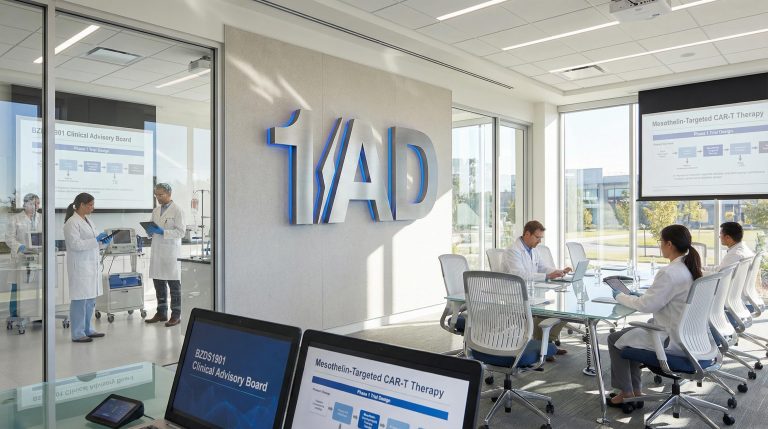
AdAlta strengthens BZDS1901 clinical advisory board with oncology and CAR-T leaders
AdAlta Limited (ASX: 1AD) has appointed two additional clinicians to the AdAlta BZDS1901 Clinical Advisory Board through its subsidiary AdCella, strengthening expertise ahead of the planned Phase 1 trial for its mesothelin-targeted armoured CAR-T cell therapy. The expanded board now represents five potential Australian clinical trial sites, each already administering commercial CAR-T products, positioning the company to accelerate its domestic clinical programme for BZDS1901 in mesothelioma and other solid cancers including lung and gynaecological malignancies.
Join thousands of readers who start here
Our best articles, sent straight to your inbox. You can unsubscribe anytime.
What is a clinical advisory board and why does it matter?
A clinical advisory board comprises external experts who guide trial design, patient selection criteria, and regulatory positioning for investigational therapies. For AdCella’s BZDS1901 programme, the board’s remit includes reviewing clinical trial design, advising on current and emerging treatment standards to position BZDS1901 within the mesothelioma treatment algorithm, identifying new knowledge in target tumour types, and providing insights into leading international clinical institutes and thought leaders for subsequent development stages.
For pre-revenue biotechnology companies like AdAlta (ASX: 1AD), the calibre of advisory board members signals clinical programme credibility and reduces execution risk. Strong advisory boards accelerate trial timelines by optimising protocol design and patient recruitment strategies, factors that directly influence the probability of achieving key clinical milestones and subsequent partnering opportunities.
New advisory board members bring deep expertise across key disciplines
The two appointments expand AdCella’s clinical advisory capabilities across oncology, mesothelioma, CAR-T cell therapies, haematology and immunology. Prof Nick Pavlakis joins from Royal North Shore Hospital in Sydney, where he serves as Senior Staff Specialist in Medical Oncology with experience in thoracic and gastrointestinal cancers including mesothelioma. He contributed to Australian clinical practice guidelines for lung cancer and mesothelioma, served as faculty for the International Association for the Study of Lung Cancer (IASLC) World Conference on Lung Cancer and its Mesothelioma task force, and currently co-chairs the IASLC Continuing Medical Education Committee. Prof Pavlakis previously chaired the Thoracic Oncology Group of Australasia Board.
Prof Mark Shackleton brings precision oncology and immunotherapy expertise from his roles as Director of Oncology at Alfred Care Group within Bayside Health, Professor and Head of the Department of Cancer Medicine at Monash University, and Co-Director of the Monash Partners Comprehensive Cancer Consortium. His research interests span cancer biology, developmental biology, oncogenic signalling and clinical trials. Prof Shackleton received the 2012 Australian Science Minister’s Prize for Life Scientist of the Year.
| Advisory Board Member | Institution | Clinical Focus | Key Credentials |
|---|---|---|---|
| Prof Nick Pavlakis | Royal North Shore Hospital, Sydney | Mesothelioma, thoracic and gastrointestinal cancers | IASLC faculty, Mesothelioma task force member, former TOGA Board Chair |
| Prof Mark Shackleton | Alfred Care Group/Monash University, Melbourne | Precision oncology, immunotherapy, melanoma | Monash Partners Comprehensive Cancer Consortium Co-Director, 2012 Science Minister’s Prize recipient |
The appointments connect AdCella to established oncology networks in Sydney and Melbourne, Australia’s two largest metropolitan healthcare markets, which is strategically significant for trial recruitment and future commercialisation pathways.
Five potential Australian clinical trial sites now represented
The expanded clinical advisory board now covers five hospital systems in Australia that already administer commercial CAR-T products, providing AdCella with access to infrastructure capable of manufacturing, handling and delivering advanced cellular therapies. This established CAR-T capability reduces potential site activation timelines and regulatory friction for the planned BZDS1901 Phase 1 trial, as these institutions possess the necessary cold chain logistics, specialised nursing staff, and patient monitoring protocols required for CAR-T administration. Access to experienced CAR-T treatment centres improves both trial execution speed and data quality, factors that influence investor confidence in clinical programme timelines.
BZDS1901 positioned as first-in-class armoured CAR-T for solid tumours
BZDS1901 is a mesothelin-targeted CAR-T cell therapy differentiated by its ability to secrete its own immune checkpoint inhibitor, a design feature referred to as “armouring” that helps overcome tumour immune suppression in solid cancers. The therapy is manufactured in less than two days without expensive viral vectors, addressing cost and production timeline challenges that have limited CAR-T commercialisation beyond haematological malignancies. Clinical validation has been established in China, where BZDS1901 demonstrated complete responses in patients with advanced mesothelioma.
Key BZDS1901 attributes:
- Target: Mesothelin, expressed in mesothelioma, lung and gynaecological cancers
- Armouring mechanism: Self-secreted checkpoint inhibitor to counter tumour immune suppression
- Manufacturing: Sub-two-day process without viral vectors
- Clinical evidence: Complete responses observed in advanced mesothelioma patients in Chinese trials
Solid tumours account for 90% of cancers yet remain underserved by current cellular immunotherapies, which have demonstrated greater efficacy in blood cancers. BZDS1901’s targeting of this segment positions AdAlta (ASX: 1AD) in a high-growth market, with the cellular immunotherapy sector projected to reach US$20.3 billion by 2028, growing at a compound annual growth rate of 34%.
Enjoyed this article?
We publish high-impact stories like this a few times a week. No spam.
CEO commentary and next steps
Management highlighted the strategic value of the expanded clinical advisory expertise in supporting both ongoing development activities and future trial planning.
Dr Tim Oldham, CEO and Managing Director
“The appointments of Nick Pavlakis and Mark Shackleton strengthens the expertise of our advisory board in clinical oncology, mesothelioma, solid cancer CAR-T cell therapies, haematology and immunology, disciplines that are all necessary to safely and efficiently deliver BZDS1901 to patients with solid tumours. We are grateful for the insights and value the advisory Board is already adding to ongoing BZDS1901 clinical trials in China and our planned Australian clinical program.”
The advisory board is actively contributing insights to current BZDS1901 clinical trials underway in China whilst informing design parameters for the planned Australian Phase 1 programme. This dual engagement model allows AdCella to incorporate real-world clinical data from the Chinese programme into Australian protocol optimisation, potentially accelerating regulatory approval pathways and reducing trial execution risks.
For investors, the strategic expansion of the AdAlta BZDS1901 Clinical Advisory Board represents progress towards Australian clinical readiness, with access to established CAR-T infrastructure and expertise supporting the company’s pathway to key development milestones in the solid tumour immunotherapy segment.
Want the Next Healthcare Breakthrough in Your Inbox?
Join 20,000+ investors receiving FREE breaking ASX healthcare news within minutes of release, complete with expert analysis. Big News Blast delivers market-moving announcements directly to your inbox the moment they drop. Click the “Free Alerts” button to stay ahead on breakthrough therapies and clinical trial developments.