
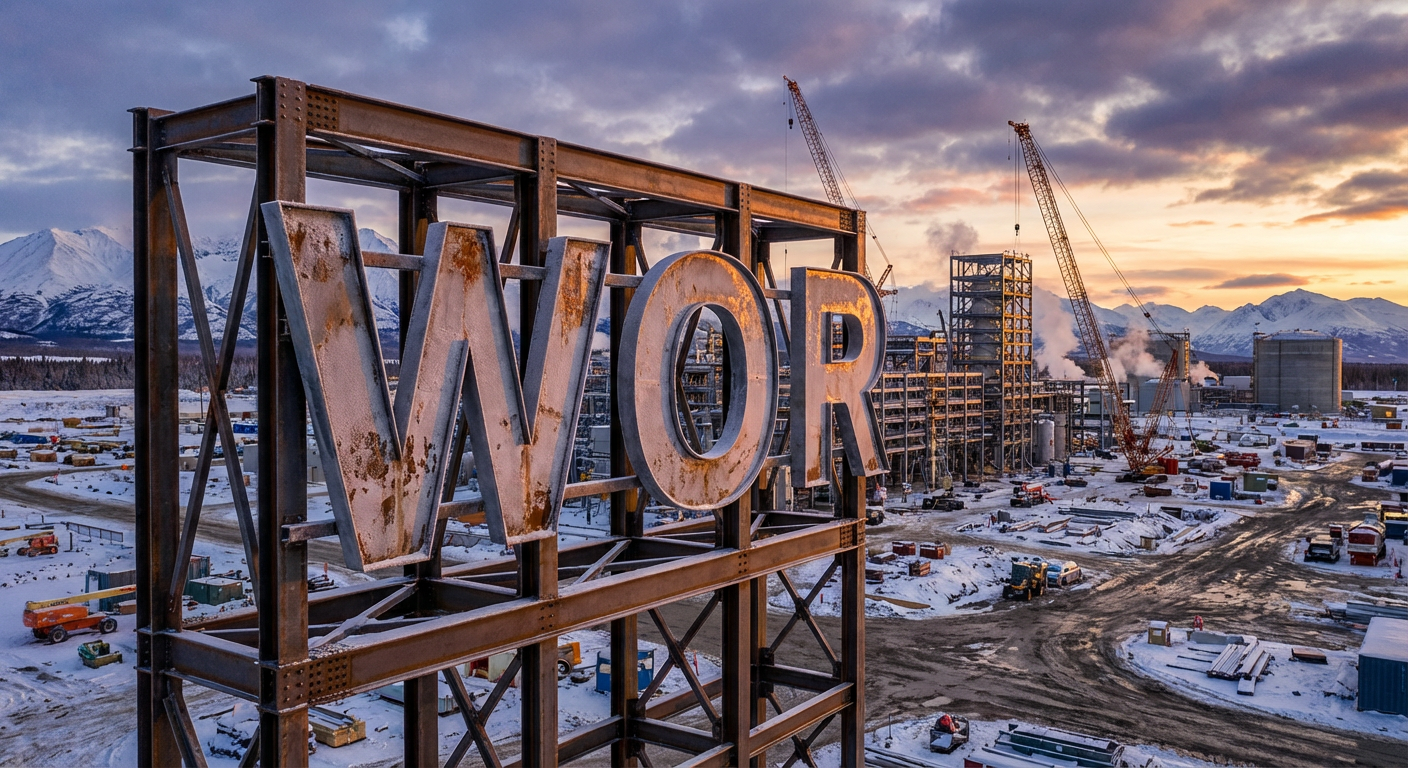
Worley Limited (ASX: WOR) has been provisionally named by Glenfarne Alaska LNG, LLC to provide Engineering, Procurement, and Construction Management (EPCM) services for Phase One of Glenfarne’s Alaska LNG project. The conditional award, announced on 23 January 2026, remains subject to a definitive agreement but represents a significant step forward following Worley’s successful completion of Phase One Front-End Engineering Design (FEED) work at the end of 2025. This progression from design consultant to execution partner positions Worley for sustained involvement in one of North America’s major liquefied natural gas infrastructure developments.
The announcement builds on Worley’s 6 June 2025 FEED contract award, demonstrating client confidence in the company’s technical capabilities and project execution track record. “We are pleased to support Glenfarne on this important project, following the success of our work to date,” said Chris Ashton, Worley CEO. For investors, this transition from FEED to EPCM signals potential multi-year revenue visibility in a high-value energy infrastructure segment, aligning with Worley’s strategy of securing lower-risk, margin-accretive service contracts.
Alaska LNG Project Scale and Strategic Context
The Alaska LNG project represents a strategic addition to North America’s LNG export capacity, with Glenfarne Alaska LNG, LLC (a subsidiary of Glenfarne Group, LLC) developing the facility in phases. Phase One alone constitutes significant infrastructure investment, positioning Alaska as a key supplier to Pacific Rim markets where demand for cleaner-burning natural gas continues to grow as countries transition away from coal-fired power generation.
LNG plays a complex role in the global energy transition narrative. Whilst not a renewable energy source, natural gas produces approximately 50% less carbon dioxide than coal when combusted for electricity generation, making it a “bridging fuel” as economies build out wind, solar, and hydrogen infrastructure. Alaska’s geographic proximity to Asian markets provides logistical advantages over Gulf Coast export terminals, potentially offering Glenfarne competitive shipping economics to Japan, South Korea, and emerging Southeast Asian LNG importers.
What EPCM Services Entail
EPCM contracts differ substantially from traditional Engineering, Procurement, and Construction (EPC) models in risk profile and revenue characteristics:
-
Detailed Engineering: Expanding FEED deliverables into construction-ready specifications, equipment sizing, and vendor technical requirements across process units, utilities, and marine facilities.
-
Procurement Strategy and Vendor Management: Coordinating major equipment purchases, managing supplier qualification processes, and overseeing contract negotiations whilst the client retains final purchasing authority.
-
Construction Management Oversight: Providing site supervision, quality assurance, safety compliance monitoring, and progress reporting without assuming direct construction execution risk.
-
Commissioning Support: Guiding pre-startup testing, system integration verification, and performance demonstration to support handover to operations.
EPCM models typically operate on reimbursable fee structures rather than lump-sum pricing, providing more predictable margins and reducing execution risk compared to fixed-price EPC contracts. For engineering consultancies like Worley, EPCM awards represent sustained revenue streams over 3-5 year project lifecycles with clearer earnings visibility than shorter-duration advisory engagements.
When big ASX news breaks, our subscribers know first
From FEED Success to Execution Partner
Competitive Positioning Through Continuity
Worley’s progression from FEED provider to provisional EPCM contractor demonstrates competitive strength in two critical dimensions: technical capability and client relationship management. FEED completion by the end of 2025 delivered the foundational engineering basis that Phase One construction will depend upon, including process design verification, equipment specifications, cost estimates, and project execution strategies.
The continuity from design to execution offers substantial advantages. Worley’s engineering teams possess intimate knowledge of the project’s technical challenges, site constraints, and design philosophy developed during FEED. This institutional knowledge reduces remobilisation costs, accelerates detailed engineering, and minimises the coordination inefficiencies that often arise when separate firms handle design and construction management phases.
“We are pleased to support Glenfarne on this important project, following the success of our work to date,” said Chris Ashton, Worley CEO. His statement, whilst measured in tone, signals confidence born from proven delivery. In project development, client selection of the FEED provider for subsequent EPCM work represents a strong endorsement, particularly on capital-intensive infrastructure where execution certainty carries premium value.
What “Provisional” Means for Timeline
The conditional nature of Worley’s appointment requires context to assess investment implications. “Provisional” designation pending definitive agreement execution is standard industry practice for projects of this scale, reflecting the complexity of finalising commercial terms, scope definitions, insurance arrangements, and performance guarantees in multi-hundred-million-dollar service contracts.
Typical timelines see provisional appointments converted to binding contracts within 2-4 months as legal and commercial teams negotiate detailed terms. Glenfarne’s public announcement naming Worley specifically reduces conversion risk substantially compared to provisional shortlists featuring multiple bidders. The announcement signals Worley as the preferred partner with commercial discussions focused on contract mechanics rather than competitive selection.
For investors, the key risk mitigation factor lies in Glenfarne’s concurrent announcements regarding construction line pipe supply agreements and in-state gas arrangements, indicating the project is advancing across multiple workstreams. This coordinated progress suggests Alaska LNG Phase One has achieved sufficient development milestones and financing confidence to proceed with execution-phase commitments.
Revenue and Strategic Implications
Financial Profile of EPCM Contracts
EPCM contracts carry distinct financial characteristics compared to other engineering service models, with implications for Worley’s margin profile and cash flow predictability:
| Contract Type | Risk Profile | Revenue Recognition | Margin Characteristics | Strategic Fit |
|---|---|---|---|---|
| FEED | Low | Milestone-based | Higher margin (15-20%) | Capability demonstration |
| EPCM | Moderate | Progressive reimbursement | Steady margin (10-15%) | Multi-year visibility |
| Lump-sum EPC | High | Percentage completion | Variable margin (5-15%) | Higher execution risk |
EPCM models provide steadier cash flow and lower execution risk than traditional EPC, aligning with Worley’s strategic pivot toward consultancy and project management services rather than construction risk assumption. Reimbursable fee structures (cost-plus arrangements) protect margins from material cost escalation and labour productivity variables whilst still delivering substantial absolute revenue given Alaska LNG’s infrastructure scale.
For investors tracking Worley’s backlog composition, EPCM contracts enhance earnings quality through reduced volatility compared to fixed-price work. The multi-year revenue recognition profile supports guidance visibility into FY27 and beyond, particularly valuable as energy transition projects (hydrogen, carbon capture) remain in earlier development stages with less certain commercialisation timelines.
Sustainability Strategy Alignment
Worley’s involvement in LNG infrastructure reflects the company’s “bridging two worlds” positioning, supporting existing energy systems whilst building capability in decarbonisation technologies. This dual mandate addresses investor ESG considerations around fossil fuel exposure whilst acknowledging energy transition realities.
The company’s strategic positioning encompasses:
- Operational excellence in traditional energy: Maintaining competitiveness in oil, gas, and LNG sectors that continue generating substantial global demand.
- Energy transition enablement: Building expertise in hydrogen production, carbon capture utilisation and storage (CCUS), renewable energy integration, and industrial decarbonisation.
- Technology-agnostic service model: Providing engineering services across energy value chains without dependence on single technology pathways or fuel sources.
- LNG as transitional infrastructure: Supporting natural gas adoption in Asian markets transitioning from coal, delivering immediate emissions reductions whilst renewable capacity scales.
This approach recognises that energy transition unfolds over decades rather than years, requiring continued investment in existing energy infrastructure alongside renewable development. For Worley, LNG projects like Alaska provide near-term revenue and cash generation that funds capability building in emerging decarbonisation sectors where commercial returns remain less certain.
Outlook and Next Steps
Worley’s progression toward definitive agreement execution on Alaska LNG EPCM services follows a predictable pathway for projects of this complexity:
-
Q1 2026: Definitive agreement negotiation covering detailed scope, commercial terms, key personnel commitments, and performance guarantees.
-
Q2 2026: Contract execution and project mobilisation, including detailed engineering team establishment and procurement strategy finalisation.
-
2026-2028: Phase One engineering and procurement peak activity as process units, compression facilities, and marine infrastructure advance through detailed design and equipment ordering.
-
2028-2029: Construction management phase intensification as fabricated equipment arrives on site and installation activities accelerate.
-
Post-2029: Potential Phase Two EPCM consideration depending on Phase One execution success and Glenfarne’s development timeline for additional LNG production capacity.
The conditional nature of the current award means investors should monitor for definitive agreement announcement as the next material milestone, likely accompanied by contract value disclosure (currently undisclosed given provisional status) and updated backlog figures in Worley’s next quarterly reporting.
Successful conversion to binding contract would represent a meaningful addition to Worley’s order book in its Energy & Resources segment, supporting multi-year revenue visibility in high-margin services. The project also positions Worley for potential follow-on Phase Two work, as clients typically prefer continuity with proven execution partners on multi-phase developments.
Broader context includes Worley’s existing North American LNG exposure through various Gulf Coast and Canadian projects, with Alaska adding geographic diversification and Pacific Rim market access. As global LNG demand growth remains concentrated in Asia-Pacific markets through 2030, Alaska’s strategic positioning could support additional project opportunities beyond Glenfarne’s development.
For investors, this announcement reinforces Worley’s competitive positioning in energy infrastructure EPCM services whilst advancing the company’s stated strategy of securing long-duration, lower-risk contracts that enhance earnings visibility and cash flow predictability.
Want More Industrial Sector News and Analysis?
The Alaska LNG project represents exactly the type of major infrastructure development that shapes the industrial services landscape for years to come. For investors tracking Worley and the broader ASX industrial sector, understanding these contract awards early—with comprehensive analysis of their strategic and financial implications—can provide crucial investment insight before market consensus forms.
Over 20,000+ investors receive free breaking news alerts covering ASX Tech, Biotech, Healthcare, Finance, and Industrial stocks through StockWire X Big News Blasts. These email alerts deliver not just headlines, but detailed analysis examining revenue implications, competitive positioning, and strategic context across non-resource sectors. To ensure alerts covering the next major industrial contract award or sector-moving announcement reach you immediately, click the “Free Alerts” button at the top of this page to join thousands of investors staying ahead of ASX industrial developments.