
For a top-bracket Australian homeowner with spare cash, the superannuation route now requires a return above negative 0.66% to beat paying down a 6% mortgage. That is not a typo. Almost any positive return inside super wins, and it wins by a margin that should make you uncomfortable about where your surplus cash is sitting right now.
The reason the maths shifted so dramatically is the Treasury Laws Amendment (Tax Reform No. 1) Act 2026, which passed Parliament in June 2026 and takes effect from 1 July 2027. This is not a marginal tweak. It removes the 50% capital gains tax discount for individuals and introduces a 30% minimum rate on real gains, fundamentally repricing the after-tax return of every taxable share portfolio in the country. Superannuation funds are explicitly excluded from the new rules.
Here are the hurdle rates across all three strategies, broken down by tax bracket, so you can see which option the numbers actually favour for your situation before the 2027 commencement date arrives.
The guaranteed return hiding in your mortgage
Every extra dollar you direct toward your owner-occupied mortgage, whether as a lump-sum principal payment or into an offset account, generates a return approximately equal to your loan interest rate. On a 6% home loan, that is a 6% per annum return, risk-free and after-tax. No market exposure. No sequencing risk. No capital gains event.
That makes the mortgage the benchmark every alternative strategy must clear on an after-tax basis, not a gross-return basis.
Three characteristics define this return:
- Guaranteed rate: the return equals the loan interest rate, with zero volatility
- No CGT liability: there is no taxable event on the saving
- No sequencing risk: the benefit accrues regardless of what markets do in any given year
Illustrative figure: On a $1 million mortgage at 6% with 30 years remaining, a lump-sum prepayment of $10,000 produces total interest savings of roughly $45,560 across the full loan term. Realised savings will be lower if the property is sold before the term concludes.
In the early years of a standard 30-year mortgage, roughly 80% of each scheduled payment is interest. On a standard 30-year term, the crossover point where more than half of each payment is directed to principal does not arrive until around the 19th year. Extra repayments bypass that schedule entirely, going straight to principal and accelerating the amortisation curve.
The mortgage benchmark is more formidable than it looks. A 6% guaranteed, after-tax, risk-free return requires any competing strategy to clear a meaningful bar before it wins on pure mathematics.
When big ASX news breaks, our subscribers know first
What the new CGT rules actually changed (and what they did not)
Under the old regime, individuals who held an asset for more than 12 months could reduce the capital gain by 50% before applying their marginal tax rate. For a top-bracket investor paying 47% (including the Medicare levy), the effective tax on a long-term capital gain was approximately 23.5% of the nominal gain.
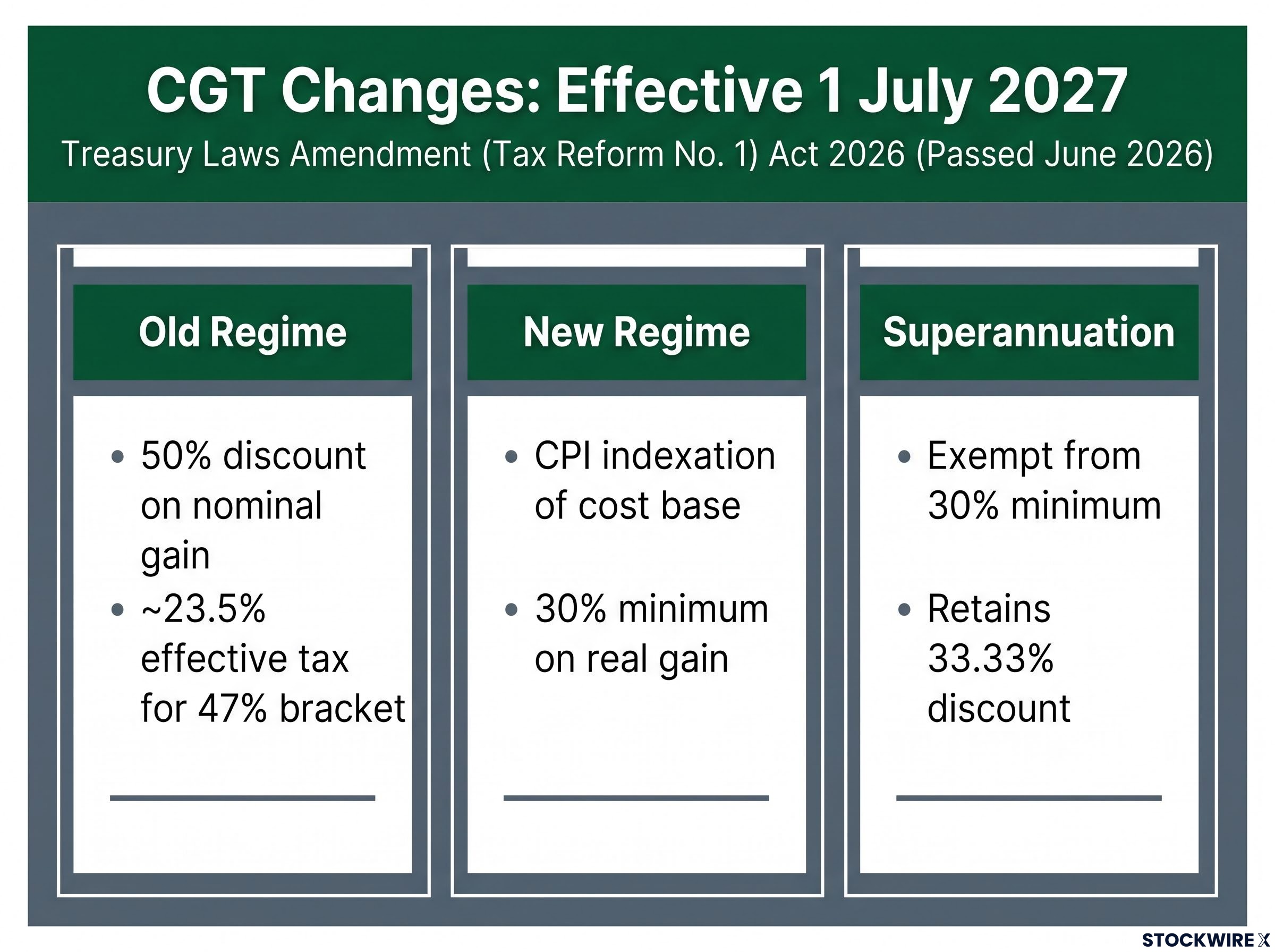
Under the new regime, effective from 1 July 2027, the 50% discount is gone. Instead, the cost base is indexed by CPI, so only the real gain (above inflation) is taxed. A 30% minimum tax rate applies to that real gain for affected individuals and trusts. The legislation is the Treasury Laws Amendment (Tax Reform No. 1) Act 2026, passed in June 2026. A transitional rule preserves prior treatment for gains accrued before 1 July 2027, though assets already held at the commencement date face grandfathering complexity in splitting pre- and post-2027 gains.
| Regime | Discount applied | Tax rate on gain | Applies to |
|---|---|---|---|
| Old regime (individuals) | 50% of nominal gain | Marginal rate on remaining 50% | Individuals holding 12+ months |
| New regime (individuals) | CPI indexation of cost base | 30% minimum on real gain | Individuals, trusts (from 1 July 2027) |
| Superannuation fund | 33.33% CGT discount retained | 15% on two-thirds of eligible gains | Complying super funds (exempt from 30% minimum) |
Why super escapes entirely
Complying superannuation funds are explicitly excluded from the 30% minimum. They retain their 33.33% CGT discount, meaning eligible long-term gains are taxed on two-thirds of the gain at 15%. Concessional contributions continue to be taxed at 15% flat, rather than the contributor’s marginal rate.
For you, the grandfathering rule is the detail that demands attention. If you already hold a taxable share portfolio, any gains crystallised from 1 July 2027 onwards face the new regime regardless of when you bought the asset. The clock on your post-2027 gain exposure started the moment the law passed.
Super contributions: why the hurdle is almost impossibly low to miss
Concessional contributions (salary sacrifice or personal deductible contributions) are taxed at 15% inside the fund. For most working Australians on marginal rates of 32.5% to 47%, that creates an immediate tax saving on the contribution itself, effectively subsidising the investment before it earns a single dollar of return.
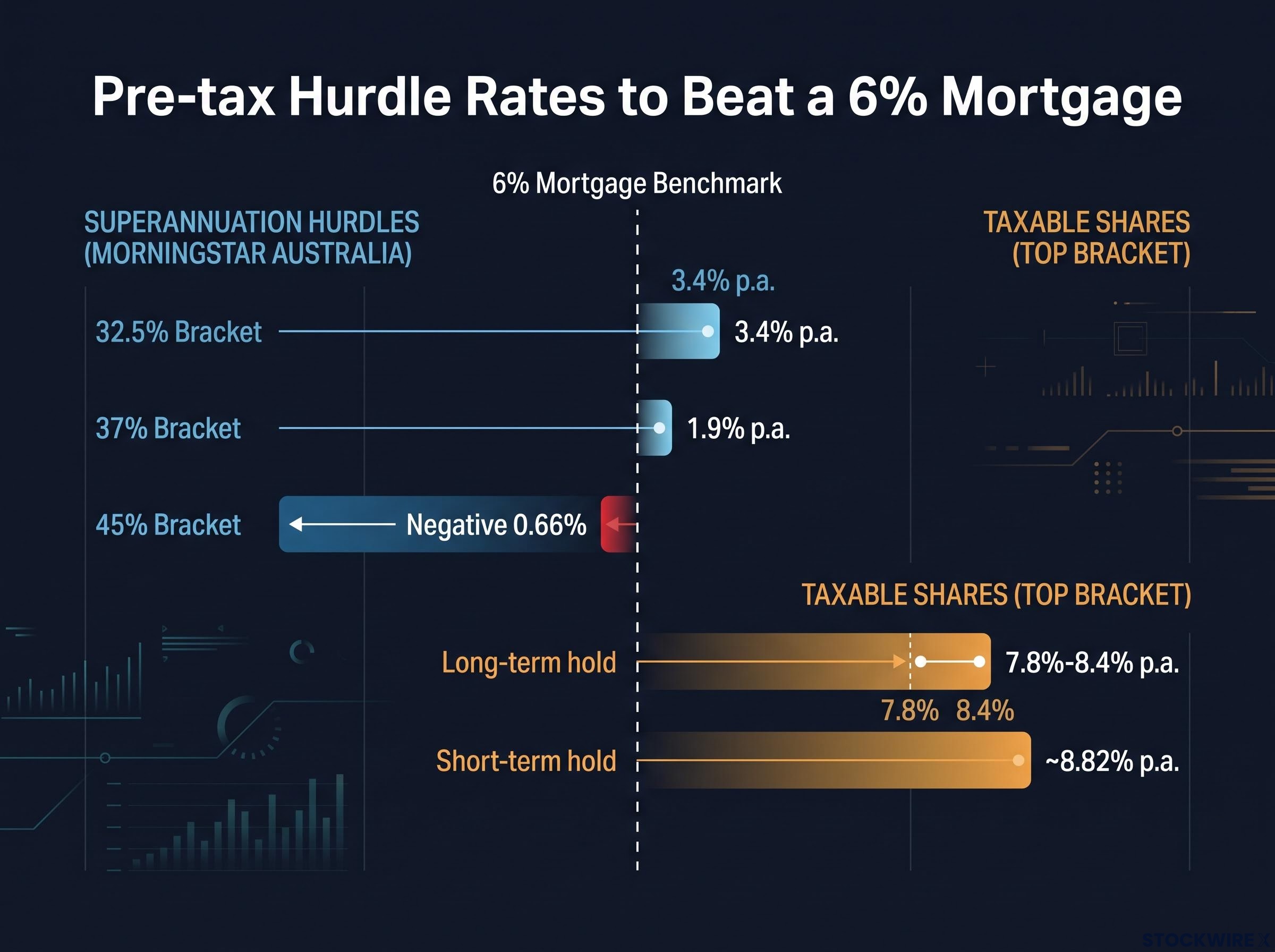
The question is how much the investment inside super needs to earn to beat the 6% mortgage benchmark. Based on modelling by Morningstar Australia (assuming a 6% mortgage rate, 11-year property holding period, and 7.1% annual housing price appreciation), the pre-tax hurdle rates are:
| Marginal tax bracket | Pre-tax hurdle rate to beat 6% mortgage | What this means |
|---|---|---|
| 32.5% | 3.4% per annum | A conservative balanced fund likely clears this |
| 37% | 1.9% per annum | Even a defensive allocation is likely sufficient |
| 45% | Negative 0.66% | Any positive return inside super wins |
At the top bracket, the hurdle is negative. A top-bracket earner would need to invest in something that actively loses money inside super before the mortgage prepayment alternative comes out ahead. That is a structural advantage almost no other legal tax strategy can match. Source: Morningstar Australia; Mark LaMonica CFA, Investing Compass podcast, 11 July 2026.
The trade-off is liquidity. Concessional contributions are generally preserved until preservation age, which is 60 for most Australians (ranging from 55 to 60 depending on date of birth). Annual concessional contribution caps apply, though carry-forward provisions under current legislation allow some investors to make larger one-time contributions if they have not maximised in prior years.
For middle- and high-income earners with the capacity to lock funds away, the super maths is not close. The risk is illiquidity, not investment performance.
Taxable share investing: higher hurdles, harder maths
Under the old rules, a top-bracket investor paying 47% (including the Medicare levy) on 50% of the gain faced an effective CGT rate of approximately 23.5%. Under the new regime, the 30% minimum on real gains pushes that effective rate substantially higher, particularly for investors who do not commit to long holding periods.
Based on modelling by Mark LaMonica CFA and Shani Jayamanne at Morningstar Australia (Investing Compass podcast, 11 July 2026), the pre-tax hurdle rates to beat a 6% mortgage under the new rules are:
| Investor profile | Pre-tax hurdle rate (new regime) | Pre-tax hurdle rate (old regime) |
|---|---|---|
| Lower income (≤30% marginal rate) | 6.6%-7.2% p.a. | Lower (benefited from low marginal rate) |
| Middle income (>30% marginal rate) | 7.2%-7.5% p.a. | Lower (50% discount applied) |
| Top bracket, long-term hold | 7.8%-8.4% p.a. | ~7.8% (50% discount + 47% marginal) |
| Top bracket, short-term hold | ~8.82% p.a. | Higher (no discount applied) |
The direction is clear. A top-bracket investor who does not commit to long-term holding now needs the share market to deliver close to 9% annually before tax just to match the guaranteed return of paying down a 6% mortgage. That bar has never been higher under modern Australian CGT law.
What this means for lower-income investors
The 30% minimum pushes investors whose marginal rates sit below 30% up to a new floor they did not previously face. Under the old rules, a lower-income investor with a 19% or 25% marginal rate paid substantially less CGT on long-term gains. That advantage is now capped. Their hurdle rates have risen accordingly.
Working out the effective tax rate under the new regime requires investors to project both their anticipated holding period and annual inflation across that period, making precise self-modelling considerably more demanding than it was under the straightforward 50% discount.
Why shares still belong in the conversation
The hurdle rates above compare a single dollar directed to shares against a single dollar directed to the mortgage. That framing is useful, but it is incomplete. For most Australian homeowners, the real question is not which option wins on a per-dollar basis but whether their current asset mix is leaving a structural gap.
An owner-occupied property is typically the largest single asset on an Australian household balance sheet, and it is leveraged. If your only non-super investment is your home, you are carrying a concentrated, undiversified bet on domestic residential property. Taxable share investing provides exposure to different sectors, geographies, and currencies that your property cannot replicate.
The liquidity comparison reinforces the point:
- Taxable shares: realisable at any time (with a CGT event on sale)
- Mortgage equity: accessible only via refinancing or property sale
- Superannuation: locked until preservation age (generally 60)
Three reasons taxable shares remain relevant despite the new CGT regime:
- Diversification: reduces concentration in a single leveraged property position
- Liquidity flexibility: accessible before preservation age without refinancing
- Expected long-run equity premium: equities may still deliver pre-tax returns above the hurdle over long holding periods (five or more years), though with volatility and no guarantee
If your only non-super investment is your home, adding taxable shares is not primarily a tax decision. It is a portfolio construction decision, and the higher CGT hurdle is a cost of diversification you may reasonably choose to pay.
Running the numbers for your situation: key variables and where professional advice fits
The hierarchy above is a general framework. Where you sit within it depends on personal variables, ordered here from most to least influential for most Australians:
- Marginal tax rate (including Medicare levy): determines the size of the super tax saving and the effective CGT rate on taxable gains
- Loan interest rate: sets the hurdle every alternative must clear
- Proximity to preservation age: determines how costly the super lock-in actually is
- Holding period: shorter periods produce materially higher effective tax rates on taxable investments
- Existing concentration in residential property: determines how strong the diversification argument is for shares
- Available concessional contribution cap (current year plus carry-forward): determines how much can be redirected to super in the near term
- Near-term liquidity needs: emergency buffer, upcoming major expenses, renovation plans
General hierarchy for most working Australians: Super first (strongest long-term, tax-efficient option where caps allow); mortgage second (risk-free benchmark, certain return); taxable shares third (diversification and liquidity, but higher tax hurdle). This ordering depends on individual circumstances and is not a universal rule.
Under the new regime, investors must forecast both future CPI and the likely holding period for each asset in order to estimate their effective capital gains tax rate, a materially more involved exercise than applying the old flat discount. For sizeable decisions, a qualified adviser who can factor in your loan rate, tax bracket, age, super balances, contribution caps, and investment horizon adds genuine value. The grandfathering rules for assets already held at 1 July 2027 introduce further complexity that self-modelling struggles to capture accurately.
This article is for informational purposes only and should not be considered financial advice. Investors should conduct their own research and consult with financial professionals before making investment decisions.
The calculation that will matter most before 1 July 2027
The legislation has passed. The commencement date is fixed. For most middle- and high-income earners, the super route wins by a wide margin: a negative hurdle rate at the top bracket means virtually any positive return beats the mortgage. The mortgage itself delivers approximately 6% guaranteed with no CGT. Taxable shares, at roughly 7.8%-8.4% pre-tax for top-bracket long-term holders, require higher conviction and a genuine diversification rationale.
The group whose calculus shifted most dramatically: top-bracket investors who were using the 50% discount to run large taxable share portfolios as their primary wealth-building vehicle outside super. That strategy just became materially more expensive in tax terms.
- Super: best long-run option for most working Australians; strongest where concessional cap space is available
- Mortgage: guaranteed benchmark; the risk-free fallback that requires no modelling
- Taxable shares: higher hurdle under the new regime; valid where diversification or pre-preservation-age liquidity is genuinely needed
If you have unused concessional contribution cap space, a home loan, and investable cash sitting in an offset or high-interest savings account, the question of where it goes next is no longer a preference decision. The hurdle rates are now clearly established. Carry-forward rules may allow a larger one-time contribution for investors who have not maximised in prior years, making the 11 months before the 1 July 2027 commencement date a particularly high-value window to act.
Past performance does not guarantee future results. Financial projections are subject to market conditions and various risk factors.