ASIC‘s financial reporting surveillance programme reviewed 254 company financial reports in the year to 30 June 2025, and 18 entities changed their numbers as a result. Viva Energy Group Limited (ASX: VEA) was one of them. The change, confirmed in ASIC media release 26-075MR on 13 April 2026, cost the company an additional $25 million in impairment charges after the regulator identified a cash-generating unit (CGU) methodology that did not meet the requirements of Australian Accounting Standard AASB 136.
The case is more than a single corporate correction. It is a direct illustration of how ASIC’s surveillance programme operates in practice: identifying specific accounting methodology failures, naming them, and expecting companies to correct the record with measurable financial consequences. What follows unpacks the regulatory mechanics behind the programme, explains why Viva Energy‘s CGU approach was found wanting, traces the accounting correction, and draws out what the outcome signals for investors reading ASX financial statements.
ASIC’s surveillance programme is bigger and more active than most investors realise
ASIC’s financial reporting surveillance programme is a risk-based system that selects entities for review based on assessed compliance risk, not a blanket audit of every filing lodged on the ASX. The programme covers three categories of entities:
- Listed entities on the ASX
- Large proprietary companies
- Registrable superannuation entities
Selection carries weight precisely because it is targeted. When ASIC chooses to review a company’s financial statements, that review reflects a specific regulatory judgment about where accounting risk is most likely to sit.
Report 819 (REP 819), published 31 October 2025, documents the programme’s outcomes for the 2024-25 period with verified statistics rather than general commentary. The numbers are specific: 254 company financial reports reviewed, 22 targeted surveillances conducted, and 18 entities making 19 changes to their financial reports as a direct result.
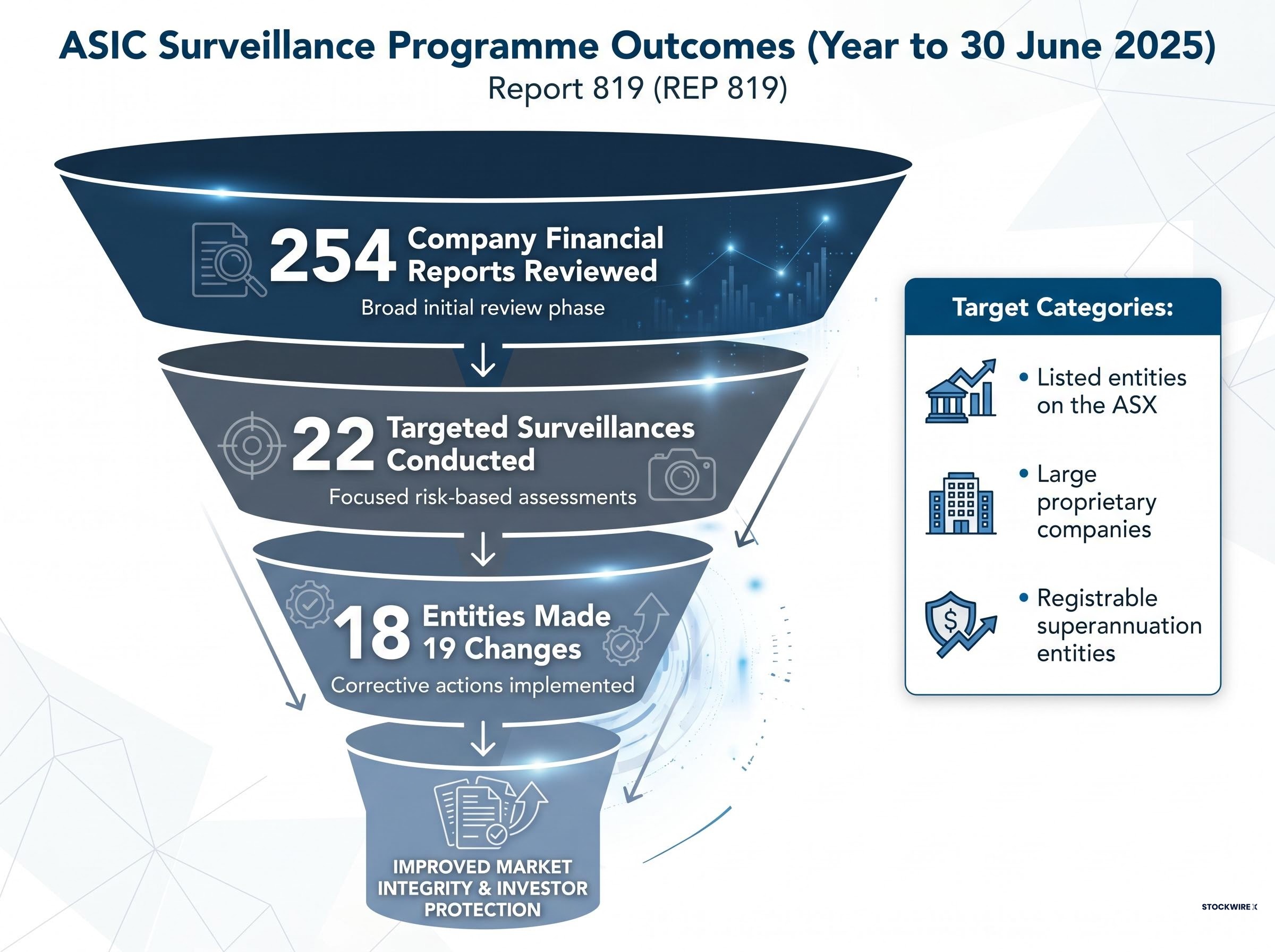
“18 entities made 19 changes to their financial reports as a result of ASIC’s 2024-25 surveillance programme.”
ASIC’s stated objective is to enhance financial reporting standards and strengthen investor confidence in Australian capital markets. For investors, the practical implication is straightforward: when a company discloses an ASIC-prompted accounting change, it is not routine housekeeping. It is a specific regulatory finding with financial consequences.
What kinds of changes does surveillance actually produce?
The range of outcomes spans from enhanced disclosures at the lighter end, through revised accounting estimates, to formal restatements at the most consequential. Enhanced disclosures are the most frequent outcome; formal restatements are rarer but carry the greatest financial impact.
ASIC’s persistent focus areas for both 31 December 2024 and FY2025-26 reporting cycles include asset values and impairment. That consistency signals this remains an active priority, not a one-off concern that has been addressed and moved past.
When big ASX news breaks, our subscribers know first
What AASB 136 actually requires when companies test assets for impairment
Before the specifics of the Viva Energy case can land properly, the accounting standard at its centre needs to be clear. AASB 136 governs how companies assess whether the assets on their balance sheet are worth what the books say they are worth. When an asset’s recoverable amount (what it could be sold for, or the cash flows it will generate) falls below its carrying value, the company must recognise an impairment, a write-down that reduces reported profit.
A cash-generating unit is the smallest identifiable group of assets that generates cash inflows largely independent of other assets. AASB 136 requires impairment assessment at the individual asset level wherever feasible. Group-level CGU assessment is only permitted where individual recoverable amounts genuinely cannot be determined.
Impairment charges flow directly into the balance sheet as a reduction in carrying value, and investors who are comfortable with ASX balance sheet analysis, including how to track asset values across consecutive reporting periods, are better placed to spot when a headline figure has shifted and interrogate the accounting methodology behind it.
The standard also imposes a ceiling: a CGU cannot be larger than an operating segment as identified under AASB 8. This constraint exists to prevent companies from grouping underperforming assets into a healthier aggregated pool, effectively masking the impairment that would be visible at a more granular level.
| Area | Permitted CGU approach | What ASIC challenges |
|---|---|---|
| Scope | Smallest group of assets generating independent cash flows | CGUs spanning multiple business lines or geographic regions |
| Asset boundaries | Individual asset assessment where recoverable amounts can be determined | Convenience groupings where individual assessment is feasible but not performed |
| Disclosure expectations | Transparent assumptions, sensitivities, and methodology | Inadequate sensitivity disclosure or unsupported modelling assumptions |
The current compiled version of AASB 136, updated January 2026, retains the existing framework with no substantive amendments to CGU identification rules. ASIC’s enforcement approach is based on applying existing requirements more rigorously, not on new legislative authority.
Where companies commonly go wrong
ASIC’s surveillance findings, supported by professional commentary from CA ANZ and CPA Australia, identify three recurring problem areas: CGU identification and goodwill allocation; impairment modelling assumptions including discount rates and growth rates; and inadequate sensitivity disclosure.
Sectors facing structural change, including retail and energy, attract heightened scrutiny. In these industries, impairment indicators are more likely to exist but are also easier to obscure within aggregated CGUs where stronger-performing assets offset weaker ones.
The Viva Energy case: how a CGU grouping decision became a $25 million problem
ASIC examined Viva Energy‘s financial statements for the period ending 31 December 2024 and identified a specific concern: the company had grouped its convenience retail locations within a single Shell Card CGU rather than assessing each site independently.
The regulator’s objection was precise. Viva Energy had the capability to assess each individual retail location’s recoverable amount separately. Under AASB 136, that capability made the aggregated approach inappropriate. Grouping the sites together was a methodology of convenience, not necessity, and it had the effect of potentially masking underperformance at individual locations within the broader pool.
Viva Energy had the capability to assess each individual retail location’s recoverable amount separately, making aggregated CGU treatment inappropriate under AASB 136.
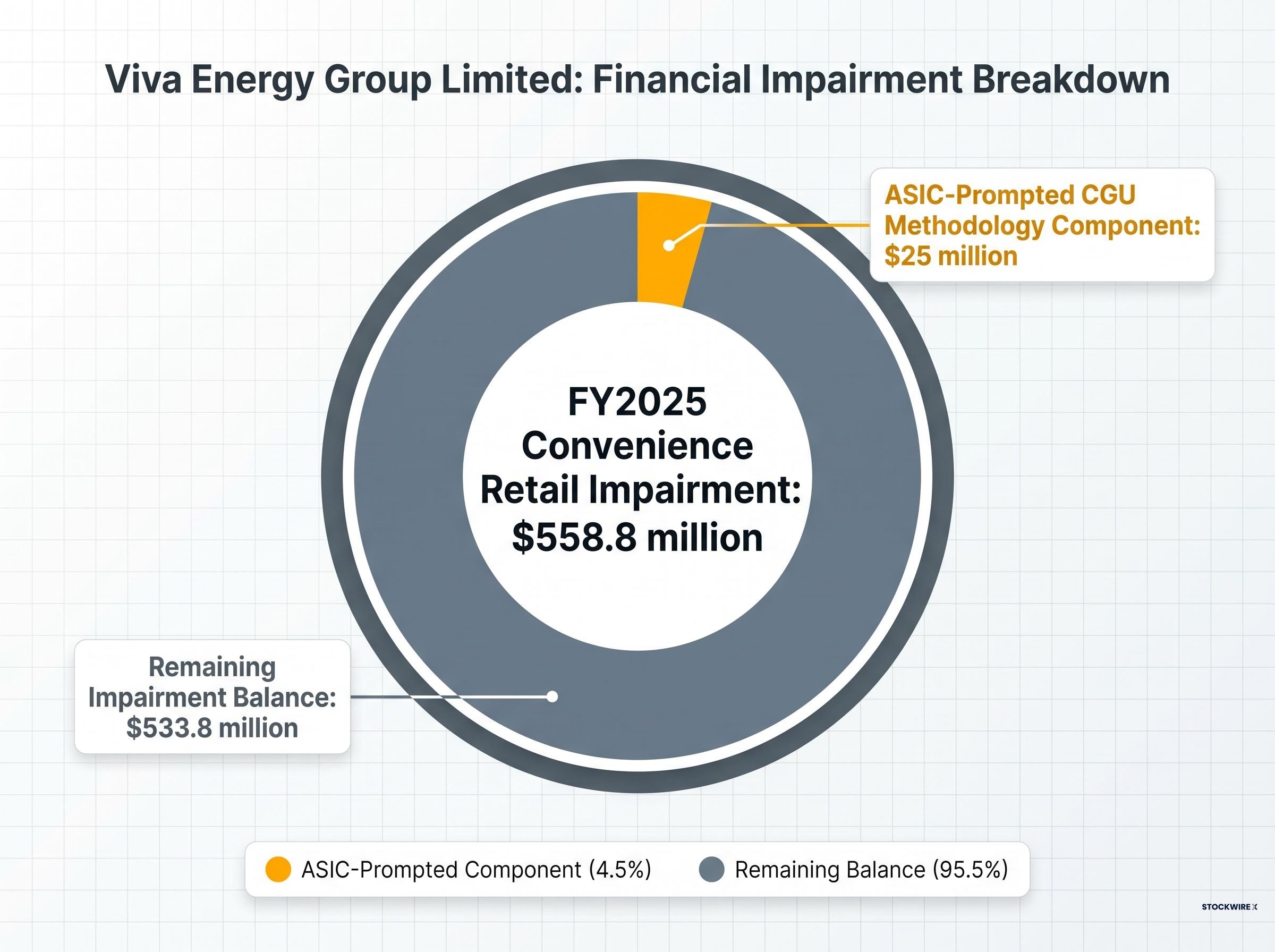
Viva Energy subsequently updated its approach in its FY2025 financial statements (year ending 31 December 2025), applying individual asset-level assessments consistently across all convenience retail locations. The financial consequences were quantifiable:
- Total FY2025 convenience retail impairment charge: $558.8 million
- ASIC-prompted CGU methodology component of that charge: $25 million (approximately 4.5% of the total)
- Viva Energy‘s own assessment: retrospective application to prior periods would not have been material
The FY2025 results announcement was made on 24 February 2026. ASIC confirmed the findings in media release 26-075MR on 13 April 2026.
The $25 million figure demonstrates that ASIC’s surveillance produces quantifiable financial consequences, not just disclosure improvements. It also raises a question that prior-period financial statements cannot retrospectively answer with certainty: what would a more granular CGU structure have shown in earlier reporting periods?
What the $25 million figure actually tells investors about hidden impairment risk
The $25 million attributable to the ASIC-prompted methodology change represents approximately 4.5% of the $558.8 million total impairment. On its face, that is a modest share. The more revealing question is what the aggregated CGU structure may have been obscuring in prior periods, even if the retrospective effect was assessed as immaterial by the company.
If ASIC’s surveillance is identifying CGU methodology failures at a company as closely scrutinised as a large ASX energy retailer, similar methodology choices at less-scrutinised entities may be producing similar or larger distortions without triggering regulatory review. Professional commentary from CA ANZ and CPA Australia has highlighted CGU identification as a persistent failure area across Australian reporting. Industry advisory commentary indicates that ASIC’s interventions are prompting some ASX issuers to re-baseline their CGU structures and, in some cases, record higher impairment charges when more granular CGUs are applied.
The Viva Energy case raises three questions investors can apply to any company carrying material impairment disclosures:
- How is this company’s CGU structured, and does it align with the smallest identifiable group of assets generating independent cash flows?
- Does the company have the capability to assess assets individually, and if so, is it doing so?
- What sensitivity disclosures accompany the impairment figure, and do they test meaningful variations in the key assumptions?
Why sensitivity disclosures matter as much as the impairment number itself
ASIC expects transparent disclosure of the assumptions underpinning impairment testing and the sensitivities around those assumptions, particularly in energy and retail sectors facing structural change. A headline impairment figure without accompanying sensitivity analysis tells investors what the company concluded but not how fragile that conclusion is.
Inadequate sensitivity disclosure sits alongside CGU identification and modelling assumptions as one of ASIC’s three primary surveillance concerns. Investors reading impairment notes should assess whether the company has disclosed what would happen to the impairment figure if discount rates, growth rates, or terminal values shifted by reasonable margins.
ASIC’s surveillance programme as a leading indicator for investors
ASIC publishes its surveillance focus areas ahead of each reporting cycle, and those announcements are publicly available. Across three consecutive periods, asset values and impairment has appeared as a recurring focus area.
| Reporting period | Release date | Key focus areas |
|---|---|---|
| 31 December 2023 | November 2023 | Asset values and impairment, revenue recognition, provisions, material business risks |
| 31 December 2024 | December 2024 | Asset values and impairment (continued focus) |
| FY2025-26 | May 2025 | Asset values and impairment (continued focus) |
That consistency is itself a signal. When ASIC keeps the same focus area active across multiple cycles, it indicates the regulator is continuing to find problems in that area. The Viva Energy outcome is a direct product of that sustained attention.
ASIC’s FY2026-27 reporting priorities extend that sustained focus, designating revenue recognition, asset impairment, and financial instrument measurement as the three core scrutiny areas for the current cycle, with a new accountability mechanism requiring audit firms to publicly demonstrate implementation of remedial measures from prior findings.
Three sectors carry elevated impairment scrutiny under ASIC’s current surveillance posture:
- Retail
- Energy
- Financial services
Investors who cross-reference ASIC’s publicly announced focus areas against a company’s sector and asset intensity have a structural advantage. ASIC’s surveillance calendar is public information. Treating it as a risk-mapping tool, rather than background regulatory noise, allows investors to anticipate where accounting corrections are most likely to emerge before they surface as restatements.
Financial report lodgement failures represent a parallel enforcement track within ASIC’s 2026 regulatory priorities: three ASX-listed companies were collectively fined $1,170,000 at Downing Centre Local Court in March 2026 for failing to lodge annual reports across multiple consecutive years, illustrating that ASIC’s enforcement reach extends beyond methodology corrections into the foundational obligation to report at all.
What regulators catching one accounting error signals about the next one
The Viva Energy case illustrates three analytical moves that can be applied beyond a single company. The first is understanding CGU methodology: how a company groups its assets for impairment testing determines whether the resulting figure reflects reality or a convenient aggregation. The second is reading ASIC surveillance findings as market intelligence rather than compliance footnotes. The third is applying sensitivity scrutiny to impairment disclosures, asking not just what the company concluded but how stable that conclusion is under different assumptions.
The 18 entities that changed their financial reports in 2024-25 represent a fraction of the 254 reviewed. Surveillance findings are not rare, but they are not uniform across sectors or company sizes either. The concentration of scrutiny around asset values and impairment, sustained across three consecutive reporting cycles, points to where accounting risk remains most active.
Three concrete actions follow from this analysis:
- Locate ASIC’s current surveillance focus areas, published ahead of each reporting cycle, and note which sectors and accounting areas are flagged
- Check the CGU structure disclosed in the notes to accounts for companies in sectors with elevated impairment risk, particularly retail, energy, and financial services
- Assess whether sensitivity disclosures accompany the headline impairment figure, and whether they test meaningful variations in discount rates, growth rates, and terminal values
For investors wanting to understand how ASIC’s enforcement culture extends beyond financial reporting into market integrity, our full explainer on ASIC’s insider trading enforcement posture covers the dedicated insider trading team established in late 2024, the Rodney Forrest prosecution outcome, and the deterrence logic that shapes how Australia defends its ranking among the world’s cleanest equity markets.
This article is for informational purposes only and should not be considered financial advice. Investors should conduct their own research and consult with financial professionals before making investment decisions.