
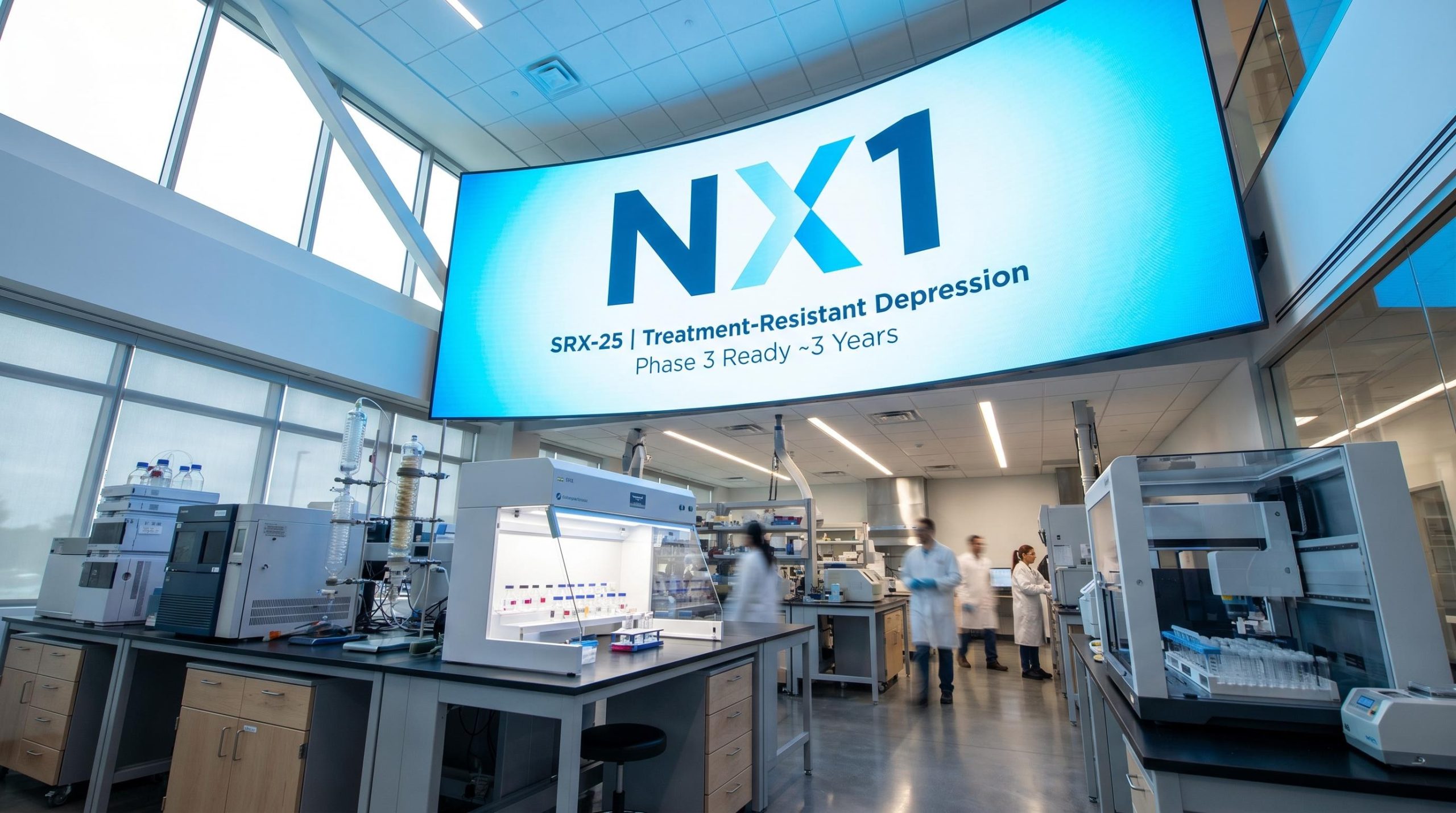
U.S. policy shift creates pathway acceleration for Nexalis’ oral esketamine candidate
Nexalis Therapeutics (ASX: NX1) has highlighted a regulatory tailwind for its SRX-25 programme, an oral esketamine therapy targeting treatment-resistant depression (TRD). An Executive Order signed on 18 April 2026 is designed to accelerate access to treatments for serious mental illness, creating potential pathway advantages for differentiated therapies pursuing FDA approval.
SRX-25 is being advanced via the FDA 505(b)(2) regulatory pathway, which enables faster and more cost-efficient development by leveraging existing safety data. Clinical development costs are fully funded under Nexalis’ existing funding facility of up to $52.3 million, with potential Phase 3 readiness projected within approximately three years.
The policy shift coincides with increased capital markets activity across psychedelic and central nervous system (CNS)-focused assets. Psychedelic-focused exchange-traded funds (ETFs) reached multi-month trading volume highs in April 2026, reflecting renewed institutional and retail inflows into mental health innovation.
For investors, the combination of regulatory momentum, funded development, and sector re-rating reduces execution risk for a company pursuing a large addressable market. SRX-25’s differentiated oral formulation targets accessibility and tolerability gaps in existing TRD therapies.
When big ASX news breaks, our subscribers know first
What is treatment-resistant depression and why does it matter?
Treatment-resistant depression refers to depression that does not respond adequately to standard treatments such as antidepressants or psychological therapy. Patients with TRD often cycle through multiple treatment attempts without achieving remission, creating substantial clinical and economic burden.
Current FDA-approved therapies for TRD include Spravato (intranasal esketamine), which requires supervised administration in certified healthcare settings due to dissociative side effects and abuse potential. This supervision requirement limits patient access and scalability outside clinical environments. Tolerability challenges and the need for in-clinic dosing constrain adoption despite demonstrated efficacy.
SRX-25 is designed to address these limitations through an oral formulation that combines esketamine with a CYP-450 inhibitor to optimise pharmacokinetics. The aim is to replicate Spravato’s efficacy while improving convenience, patient adherence, and scalability for home-based dosing. If clinical trials demonstrate comparable efficacy with improved tolerability, SRX-25 could expand treatment access beyond the subset of patients willing or able to attend supervised clinic visits.
Accessibility gaps in the existing market create commercial opportunity for therapies that reduce administration barriers. Spravato generated over US$1 billion in annual revenue despite access constraints, validating demand for effective TRD treatments and suggesting whitespace for differentiated products.
Executive Order initiatives and capital market momentum
The 18 April 2026 Executive Order introduced five key initiatives relevant to mental health therapeutics development:
- Accelerated FDA pathways for high-impact therapies
- Expanded Right to Try access for patients with limited treatment alternatives
- US$50 million ARPA-H funding allocated for mental health innovation
- Increased clinical trial participation, with a focus on veteran populations
- Proactive DEA scheduling reviews to reduce approval-to-market delays
These measures are intended to streamline regulatory processes and increase funding support for CNS drug development. For companies pursuing novel mental health therapies, the policy framework may translate into shorter review timelines and improved access to patient populations for clinical trials.
Capital markets activity reflected immediate sector response. A leading psychedelic ETF recorded multi-month volume highs in April 2026, aligning with the Executive Order timing. The trading spike indicates renewed institutional and retail capital inflows into mental health innovation, strengthening sentiment toward regulatory acceleration in this category.
The sector-wide re-rating signals broader investor recognition of commercial opportunity in CNS therapeutics. For Nexalis, this momentum may improve partnering and commercialisation prospects as the SRX-25 programme advances through clinical development.
SRX-25 product profile
SRX-25 combines esketamine with a CYP-450 inhibitor to optimise how the drug is processed in the body. This formulation is designed to replicate the therapeutic effects of Spravato while improving patient convenience through oral administration.
| Feature | SRX-25 Approach | Current Therapy Limitation |
|---|---|---|
| Administration | Oral dosing | Intranasal spray requiring supervised clinic visits |
| Patient Adherence | Home-based dosing potential | In-clinic supervision requirement limits accessibility |
| Pharmacokinetics | CYP-450 inhibitor optimises drug exposure | Variable absorption with intranasal delivery |
| Tolerability | Designed to reduce dissociative effects | Dissociation and sedation require post-dose monitoring |
| Scalability | Potential for broader prescriber base | Restricted to certified healthcare facilities |
The oral formulation targets improved scalability outside clinic settings, potentially expanding the treatable patient population. If SRX-25 demonstrates comparable efficacy to Spravato with improved convenience and tolerability in clinical trials, it could capture market share from patients deterred by current access barriers.
Market opportunity in treatment-resistant depression
The U.S. TRD market presents substantial commercial opportunity:
- ~US$4 billion estimated market by 2030
- ~2.8 million TRD patients in the U.S.
- U.S. represents over 50% of the global market
- Existing therapies generate over US$1 billion annually despite access constraints
Spravato’s commercial success validates demand for effective TRD treatments, despite tolerability challenges and the requirement for supervised administration. The therapy’s revenue trajectory demonstrates payer willingness to reimburse novel mechanisms in this indication, provided clinical efficacy is established.
SRX-25’s differentiated profile targets the subset of patients for whom access barriers or tolerability concerns limit current treatment options. If the oral formulation demonstrates non-inferior efficacy to intranasal esketamine with improved convenience, the addressable market could expand beyond patients currently willing or able to access supervised clinic dosing.
The U.S. market dominance (over 50% of global TRD market) positions FDA approval as the primary commercial gateway. Nexalis’ 505(b)(2) regulatory strategy aims to accelerate this pathway by leveraging existing safety data from approved esketamine products, reducing both development timelines and capital requirements relative to traditional new drug applications.
Management outlook
Darryl Davies, CEO
“We are seeing a clear convergence of regulatory momentum and capital market interest in next-generation mental health therapies. The recent surge in psychedelic sector activity reinforces investor recognition of the scale of opportunity in this space. SRX-25 is uniquely positioned to capitalise on these tailwinds, offering a more accessible and patient-friendly approach to esketamine therapy for treatment-resistant depression.”
Development pathway and funding position
The 505(b)(2) regulatory pathway enables Nexalis to leverage existing safety and efficacy data from approved esketamine products, reducing both development costs and timelines. This pathway allows the company to reference prior clinical work while focusing new studies on the differentiated aspects of SRX-25’s oral formulation and pharmacokinetic profile.
Clinical development costs for the SRX-25 programme are fully funded under Nexalis’ existing funding facility of up to $52.3 million. This funding coverage removes near-term dilution risk and provides capital certainty through Phase 3 readiness, projected within approximately three years.
The funded pathway with accelerated regulatory route shortens time to potential value inflection points. Phase 2 data demonstrating proof-of-concept efficacy and tolerability would position SRX-25 for either partnership discussions with larger pharmaceutical companies or direct advancement into pivotal Phase 3 trials.
Nexalis has stated it will provide updates as the SRX-25 programme advances through clinical development. The company’s strategy combines regulatory pathway efficiency with policy tailwinds to de-risk execution in a market validated by existing therapy revenues exceeding US$1 billion annually.
Want the Next Healthcare Breakthrough in Your Inbox?
Join 20,000+ investors receiving FREE breaking ASX news within minutes of release, complete with in-depth analysis. Click the “Free Alerts” button at Big News Blast to get market-moving healthcare announcements delivered the moment they break, before the broader market reacts.