

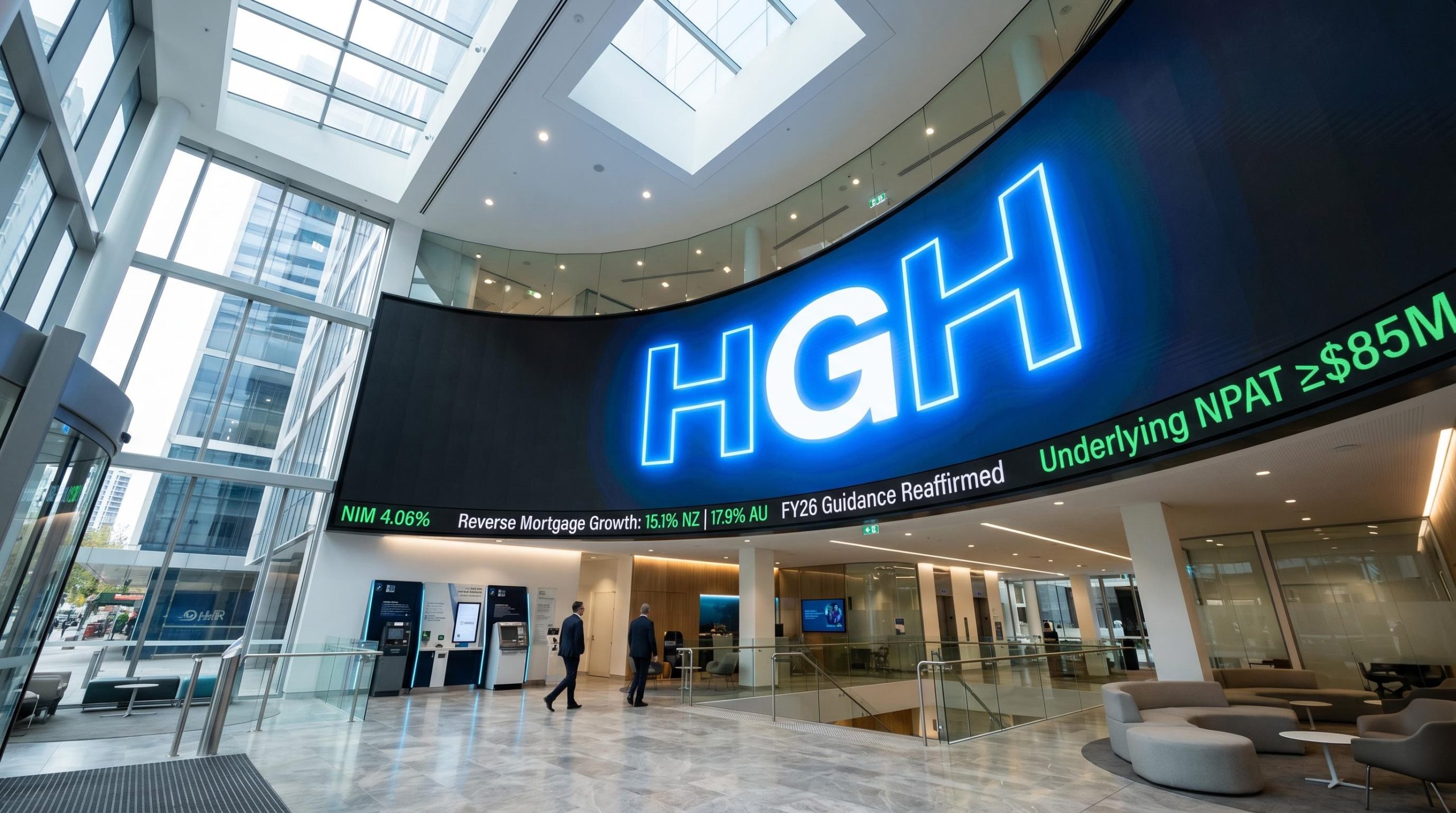
Heartland Group reaffirms FY2026 guidance as Q3 delivers margin expansion and portfolio growth
In its Q3 FY26 trading update covering the quarter ended 31 March 2026, Heartland Group Holdings (ASX: HGH) has reaffirmed full-year guidance while reporting net interest margin expansion and a return to growth across several core lending portfolios. The company expects to deliver underlying return on equity of at least 7% and underlying net profit after tax of at least $85 million for FY2026.
The quarter’s underlying NPAT came in at $21.4 million, bringing year-to-date earnings to $67.5 million. Average net interest margin expanded to 4.06% in Q3, up from 3.96% in Q2 and 3.89% in Q1, while the group’s cost-to-income ratio improved to 54.6%. Total receivables reached $7,585 million as at 31 March 2026.
Management highlighted the return to growth in Motor Finance and Asset Finance across New Zealand operations, alongside continued strong performance in Reverse Mortgages in both geographies. The update noted, however, that ongoing uncertainty in the Gulf region requires close monitoring of potential impacts on customer demand and credit quality.
When big ASX news breaks, our subscribers know first
Net interest margin continues upward trajectory
Heartland Bank Australia’s margin expansion drove the group’s Q3 NIM performance, with the Australian operations reporting average NIM of 3.99% — up 25 basis points quarter-on-quarter. The improvement reflects the early repayment of the final medium-term note in October 2025, which reduced funding costs.
The group’s exit NIM stood at 4.01% as at 31 March 2026, remaining above FY26 guidance of more than 3.95%. Management expects some compression in Q4 FY26 but maintains that full-year average NIM will exceed the 3.90% guidance threshold.
| Metric | Q1 FY26 | Q2 FY26 | Q3 FY26 | FY26 Guidance |
|---|---|---|---|---|
| Group Average NIM | 3.89% | 3.96% | 4.06% | >3.90% |
| Group Exit NIM | 3.85% | 4.06% | 4.01% | >3.95% |
| HBL Average NIM | 4.06% | 4.12% | 4.09% | >4.10% |
| HBAL Average NIM | 3.62% | 3.74% | 3.99% | >3.70% |
The NZ banking division’s average NIM came in slightly below guidance at 4.09% in Q3, down 3 basis points from Q2, driven by portfolio mix. Exit NIM for Heartland Bank declined 9 basis points to 4.02%, though management expects this metric to recover in Q4 as funding cost benefits continue to flow through.
What is net interest margin and why does it matter?
Net interest margin measures the difference between interest earned on loans and interest paid on deposits and funding, expressed as a percentage of interest-earning assets. For banks, NIM is a core profitability metric — higher margins generally translate to more profit per dollar lent.
Heartland’s NIM expansion in Australia directly reflects the early repayment of its medium-term note in October 2025. By eliminating that higher-cost funding source and replacing it with lower-cost deposits, the bank reduced its funding expenses while maintaining loan yields. This improved the spread between what it earns and what it pays, expanding the margin without requiring aggressive lending growth or higher interest rates charged to customers.
Sustainable NIM expansion above guidance levels indicates improving unit economics and supports earnings quality, particularly when achieved through funding cost management rather than riskier lending strategies.
Reverse Mortgages drive growth across both markets
Reverse Mortgages delivered the standout growth performance across both New Zealand and Australian operations during Q3. The portfolio’s expansion demonstrates Heartland’s strategic focus on structural demographic trends in both markets.
In New Zealand, Reverse Mortgage receivables increased $49.4 million during the quarter (representing 15.1% annualised growth) to reach $1,377.3 million as at 31 March 2026. Australian Reverse Mortgages grew even faster, with receivables up AU$95.9 million (17.9% annualised) to AU$2,264.4 million.
Management’s FY26 outlook calls for Reverse Mortgage growth exceeding 18% in New Zealand and 19% in Australia. The presentation noted that ongoing investment in market awareness continues to support a strong pipeline of new business.
The combined Reverse Mortgage portfolio now represents a significant portion of total receivables, validating management’s strategic allocation to this product line. With ageing demographics in both New Zealand and Australia creating structural tailwinds, the double-digit growth trajectory positions Reverse Mortgages as a core earnings driver for the group.
Motor Finance returns to growth as EV lending surges
After several subdued quarters, Heartland Bank’s Motor Finance portfolio returned to growth in Q3. Receivables increased $40.6 million (9.9% annualised) to $1,693.9 million as at 31 March 2026.
The growth acceleration was particularly pronounced in electric vehicle lending. In March 2026, EV lending volume reached three times the monthly average recorded year-to-date, signalling a potential inflection point in Heartland’s positioning within the evolving vehicle finance market.
Management attributed the return to growth partly to a strategic shift toward higher quality franchise business. Asset Finance also reversed its contraction, with receivables up $7.0 million (5.1% annualised) to $558.4 million during the quarter.
The Motor Finance reversal addresses one of the key headwinds from earlier in FY26. While full-year guidance remains for flat Motor Finance receivables, the Q3 momentum suggests Heartland has successfully stabilised this portfolio after earlier challenges.
Asset quality improves despite elevated impairment expense
Heartland Bank’s overall non-performing loan ratio declined 23 basis points to 2.81% as at 31 March 2026, down from 3.04% at 31 December 2025. The core portfolio NPL ratio (excluding non-strategic assets and Unsecured Lending) remained stable at 2.06%.
Q3 impairment expense of $10.8 million was elevated but reflected deliberate credit management rather than emerging stress. Of the total, $3.8 million related to non-strategic asset provisioning and $5.6 million to Motor Finance write-offs as the bank clears NPLs between 180 and 364 days past due.
Motor Finance arrears performance continued to outperform the broader market. As at February 2026, Heartland’s Motor Finance arrears rate stood at 4.1%, materially below the industry average of 5.6% reported by Centrix. This validates the portfolio quality despite the write-off activity.
Management remains on track to clear all Motor Finance NPLs between 180 and 364 days past due by 30 June 2026 (excluding cases where vehicles are held pending customer redemption or disposal).
The improving NPL ratios alongside proactive write-offs indicate management is actively de-risking the balance sheet rather than allowing problem loans to age. Asset Finance lending remains on watch due to recent fuel price spikes placing additional pressure on those borrowers, though no material credit deterioration has yet emerged.
Non-strategic asset realisation on track for FY26 completion
The wind-down of Heartland’s non-strategic asset portfolio advanced significantly in Q3, with the outstanding balance declining $35.6 million to $139.3 million as at 31 March 2026. The quarter’s realisation activity released $5.3 million of available capital for redeployment into higher-returning core portfolios.
Management expects the remaining NSA balance to reach approximately $88 million by FY26 year-end, comprising:
- $40 million in Home Loans scheduled to run down naturally
- Approximately $32 million in Rural and Business receivables ($16 million on confirmed exit pathways, with the remaining $16 million actively managed and well provisioned)
- $16 million in property and equity investments (no longer material, though realisation efforts continue)
The NSA reduction trajectory demonstrates execution discipline in clearing legacy positions. Since June 2025, the total NSA balance has declined from $364.8 million to $139.3 million, with capital requirements falling from $47.6 million to $21.1 million over the same period.
With the NSA wind-down approaching completion, capital previously tied up in non-core assets will become available for redeployment into Reverse Mortgages, Rural Finance, and other portfolios delivering returns above Heartland’s threshold ROE.
Australian Livestock Finance outlook revised amid headwinds
Heartland Bank Australia has revised its FY26 growth outlook for Australian Livestock Finance, now expecting flat receivables compared to FY25 (previously targeting growth exceeding 20%). The downgrade reflects two specific headwinds: extreme weather events affecting pastoral regions and a single large customer adjusting its funding strategy.
Australian Livestock receivables contracted AU$26.2 million during Q3 (representing -38.9% annualised decline) to AU$246.7 million as at 31 March 2026. While the portfolio represents a relatively small proportion of overall Australian receivables, the concentration risk from the single large customer withdrawal became evident during the quarter.
The update noted that geopolitical developments impacting Australian Livestock customers continue to be actively monitored. Management has not yet observed material credit quality deterioration but remains cautious given ongoing uncertainty in global agricultural markets.
The Australian Livestock headwind appears isolated to this specific portfolio and does not materially impact group-level FY26 guidance, given the portfolio’s relatively modest size within the overall receivables base of AU$2,531 million.
Outlook and guidance summary
Heartland Group reaffirmed all key FY26 financial targets in the Q3 update. The company expects to deliver underlying NPAT of at least $85 million and underlying ROE of at least 7%, with year-to-date underlying NPAT of $67.5 million tracking toward the full-year target with one quarter remaining.
Operating expense guidance remains unchanged at less than $195 million for the group, with New Zealand operations targeting less than $127 million and Australian operations less than AU$58 million. The group’s cost-to-income ratio guidance of less than 56% remains achievable following the Q3 result of 54.6%.
Management flagged two areas of caution in the outlook commentary. Ongoing uncertainty in the Gulf region requires close monitoring of potential impacts on customer demand and credit quality across both New Zealand and Australian operations. Additionally, Heartland Bank expects to consider an increase to its geopolitical provisioning overlay at year-end, depending on how regional developments evolve.
| Metric | YTD Actual (9 months) | FY26 Guidance | Status | Commentary |
|---|---|---|---|---|
| Underlying NPAT | $67.5m | ≥$85m | On track | 79% of minimum target achieved with Q4 remaining |
| Underlying ROE | 7.1% | ≥7% | On track | YTD performance exceeds minimum threshold |
| Average NIM | 3.97% | >3.90% | Exceeded | Q4 compression expected but FY26 target secured |
| Exit NIM | 4.01% | >3.95% | Exceeded | Currently 6 bps above guidance threshold |
| CTI Ratio | 54.6% | <56% | On track | Q3 improvement supports full-year target |
| Group OPEX | $143.1m | <$195m | On track | 73% of ceiling utilised with one quarter remaining |
The guidance reaffirmation mid-way through the second half provides visibility on Heartland’s earnings trajectory. With NIM expansion demonstrating that funding cost benefits are flowing through to margins, and core portfolios returning to growth, the group appears well positioned to deliver on its FY26 commitments despite the cautious tone regarding external uncertainties.
Stay Ahead on Financial Services Deals
Join 20,000+ investors receiving FREE breaking ASX news within minutes of release, complete with in-depth analysis. Click the “Free Alerts” button at StockWire X to get market-moving financial services announcements delivered straight to your inbox before the market reacts.