

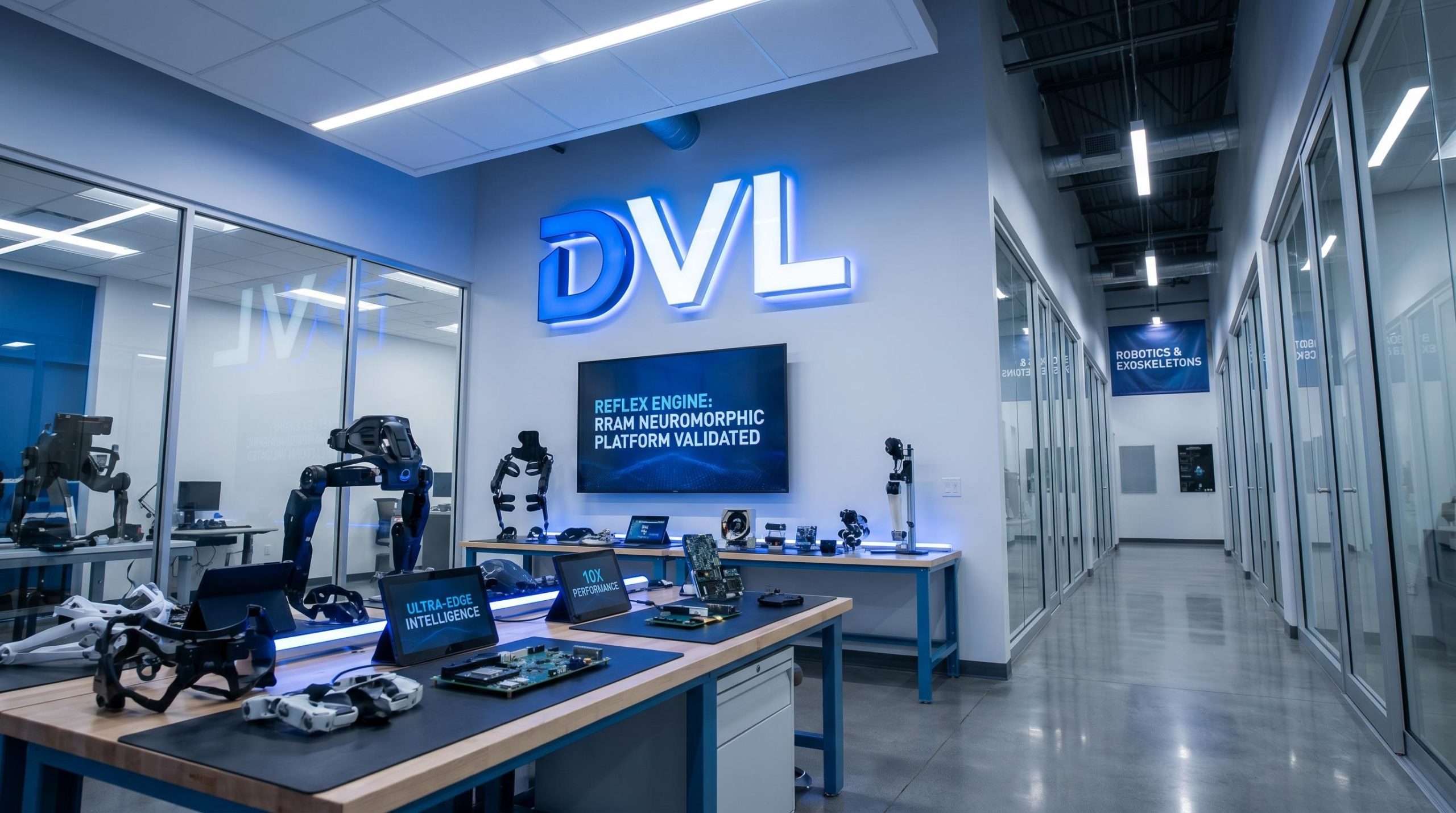
dorsaVi validates RRAM-neuromorphic platform for robotics and exoskeleton applications
dorsaVi Limited has completed technical validation confirming its proprietary RRAM memory technology and neuromorphic processing IP work effectively together, establishing a credible pathway toward intelligent, low-power hardware for robotics, exoskeletons and advanced wearable devices. The validated architecture is projected to deliver up to 10x performance gains by bringing memory, signal conversion and selected compute functions closer together, positioning the platform for ultra-edge deployment where devices sense, decide and act locally without cloud connectivity.
The validation examined how dorsaVi’s two core hardware technologies — RRAM memory and neuromorphic processing IP — operate as a coherent system ready for real-world development and commercialisation. This architectural achievement addresses a key requirement for the next generation of robots and exoskeletons: the ability to process information at the point of capture, inside the device itself, reducing delays and energy costs associated with cloud-based processing.
The platform targets applications requiring fast local decision-making, low power consumption and on-device adaptation, including prosthetics, exoskeletons, robotic motion control and smart sensing systems. The Company is positioned to address the transition toward autonomous, battery-powered robotic systems across markets that have attracted significant investment and demonstrate strong growth trajectories.
The global exoskeleton market was valued at US$590 million in 2025 and is projected to reach US$1.79 billion by 2033, growing at 14.48% CAGR, driven by adoption across healthcare, defence, industrial and rehabilitation applications. The broader humanoid robotics market has attracted over US$5 billion in investment since 2020 and is projected to reach US$38 billion by 2035. More than 5 million industrial robots are installed globally, with the collaborative robotics segment expected to exceed US$13 billion by 2030.
When big ASX news breaks, our subscribers know first
What is neuromorphic computing and why does it matter for robotics?
Neuromorphic computing refers to a processing architecture inspired by how the brain works, designed to make decisions quickly and efficiently at the edge of a network without needing a data centre. RRAM (Resistive Random-Access Memory) is a new class of memory that stores information without power, is highly durable, and operates at very low energy levels.
Combining these technologies brings memory and inference closer together, reducing data movement and enabling faster, lower-power intelligent systems. This architectural approach addresses a critical bottleneck in current robotic and exoskeleton systems: the need to shuttle data between separate memory and processor components, which consumes power and introduces latency.
The investment relevance centres on the market shift toward autonomous, battery-powered robotic systems already underway and accelerating. By processing information locally, on the device itself, the platform reduces reliance on cloud connectivity whilst improving response times and battery life.
The fusion creates a proprietary ultra-edge architecture that is difficult and expensive to replicate. By enabling high-speed, brain-inspired decision-making without the power requirements or latency of centralised data centres, dorsaVi is positioned to capture value in markets where local intelligence delivers measurable performance advantages over cloud-dependent systems.
Four performance advantages for exoskeletons and robotics
The technical review identified four distinct performance advantages for exoskeleton and robotics applications. Each capability addresses a specific requirement for intelligent, battery-powered devices operating in real-world environments without constant cloud connectivity.
| Key Feature | What Drives It | Why It Matters |
|---|---|---|
| Exoskeleton power management | Adaptive neural ADC architectures | Supports efficient signal conversion, helping manage power use in wearable and robotic systems |
| Reflex-speed response | In-memory adaptive processing engine | Enables low-latency adaptive control and reduced data movement, supporting compact EMG processing |
| Muscle signal to movement | Delta-sigma neuron architecture | Converts EMG and bio-signals into usable control outputs with robust local inference |
| Ultra-low-power decision making | RRAM memory + neuromorphic processing engine | Reduces data movement, supporting efficient local decision-making at the edge |
These four capabilities work together to make robots and exoskeletons faster, smarter and longer-lasting without cloud connectivity. Battery-efficient operation extends device runtime in field deployments. Reflex-speed response enables real-time adaptive control, allowing systems to respond to changing conditions without latency penalties. Muscle signal interpretation translates biological inputs into mechanical outputs with robust local inference. Ultra-low-power decision making brings intelligence to the edge without requiring powerful processors or constant connectivity.
For robotics and exoskeleton manufacturers, this addresses key bottlenecks in current systems: power consumption limiting deployment duration, latency constraining real-time responsiveness, and cloud dependency introducing reliability and privacy concerns in healthcare and industrial settings.
How the Reflex Engine and RRAM work together
dorsaVi’s neuromorphic IP portfolio is structured into two broad groups. Group 1 – Neuromorphic Processing-in-Memory (“Reflex Engine”) serves as the processing core that makes decisions directly inside the memory chip, the brain of the system. Group 2 – Adaptive Interface Layer (“Sensory Nerve Endings”) functions as the interface layer converting signals from sensors, muscles and environment into actionable data.
This validation focused on Group 1 synergies with RRAM. The Reflex Engine is designed to make decisions inside the memory itself rather than shuttling data back and forth between separate components, delivering efficiency, speed and reduced power consumption. The validation confirms dorsaVi’s RRAM memory technology is a strong fit for this architecture.
The component synergies operate as follows:
- RRAM programmable substrate provides persistent, power-efficient memory foundation enabling local learning and decision-making without cloud connectivity
- Delta-sigma neuron architecture makes the combined system more reliable in real-world conditions (factories, hospitals, outdoors)
- In-memory learning engine enables fast, adaptive responses allowing exoskeletons or robots to adjust to movement in real time
- Adaptive neural ADC architectures brings intelligence to the sensing layer, interpreting the world at the point of contact
In plain terms, the platform enables devices that clean and interpret sensor data on the spot, identify what matters in real time, make fast on-device decisions without cloud, and adapt and improve from real-world use without sending sensitive data off-device.
This is not a platform targeting large-scale data centre workloads. It is purpose-built for compact, real-time intelligent devices that need to sense, decide and act on the spot, with no cloud in the loop. For exoskeleton and robotics applications, this matters because local intelligence improves responsiveness, reduces system complexity and lowers power consumption across the deployment cycle.
Strategic roadmap and next steps
The validation supports dorsaVi’s broader roadmap to combine its existing sensor business, RRAM memory platform and neuromorphic IP portfolio into an integrated ultra-edge intelligence stack. DVL’s sensor operations provide real-world data and a test bed for next-generation edge hardware development, positioning the Company to validate platform capabilities in commercial deployments.
The next phase extends validation to Group 2 neuromorphic IP assets, the “Sensory Nerve Endings” interface technologies that translate real-world signals into actionable data. These sit at the front end of the platform, converting signals from the body and environment into data the system can act on. That validation is expected to further strengthen the case for the combined platform across exoskeleton, robotics and wearable applications.
The Company is actively evaluating strategic IP and technology acquisitions for safety control and data acquisition layers required for human-robot collaboration and exoskeleton deployment. These would sit above the RRAM-neuromorphic hardware foundation, providing the control and safety infrastructure required for real-world deployment where humans and robots operate in proximity.
Shareholders can expect updates in coming months as the Company progresses validation work and evaluates strategic opportunities to expand the platform’s commercial applicability.
Mathew Regan, Group Chief Executive Officer
“This validation shows our RRAM platform, together with our neuromorphic Reflex Engine, can support a credible path to ultra-edge intelligence in robotics and exoskeletons. We believe bringing memory, inference and adaptive control closer together is key to faster, lower-power intelligent systems. This is the performance foundation the next generation of exoskeletons and collaborative robots is going to be built on — and we are building it deliberately, layer by layer.”
The technical foundation provides the hardware layer upon which a complete robotics intelligence stack can be built, with the Company signalling clear differentiation opportunity in the emerging ultra-edge intelligence market. FDA-cleared EMG and motion sensors combined with over a decade of enterprise deployment data positions dorsaVi at the intersection of converging exoskeleton, robotics and wearable markets where intelligent edge hardware delivers measurable performance advantages.
Get Healthcare and Tech News Before the Market Reacts
Join 20,000+ investors receiving FREE breaking ASX announcements within minutes of release, complete with expert analysis. Click the “Free Alerts” button at StockWire X to get real-time coverage of Healthcare, Technology and other high-growth sectors delivered straight to your inbox.