
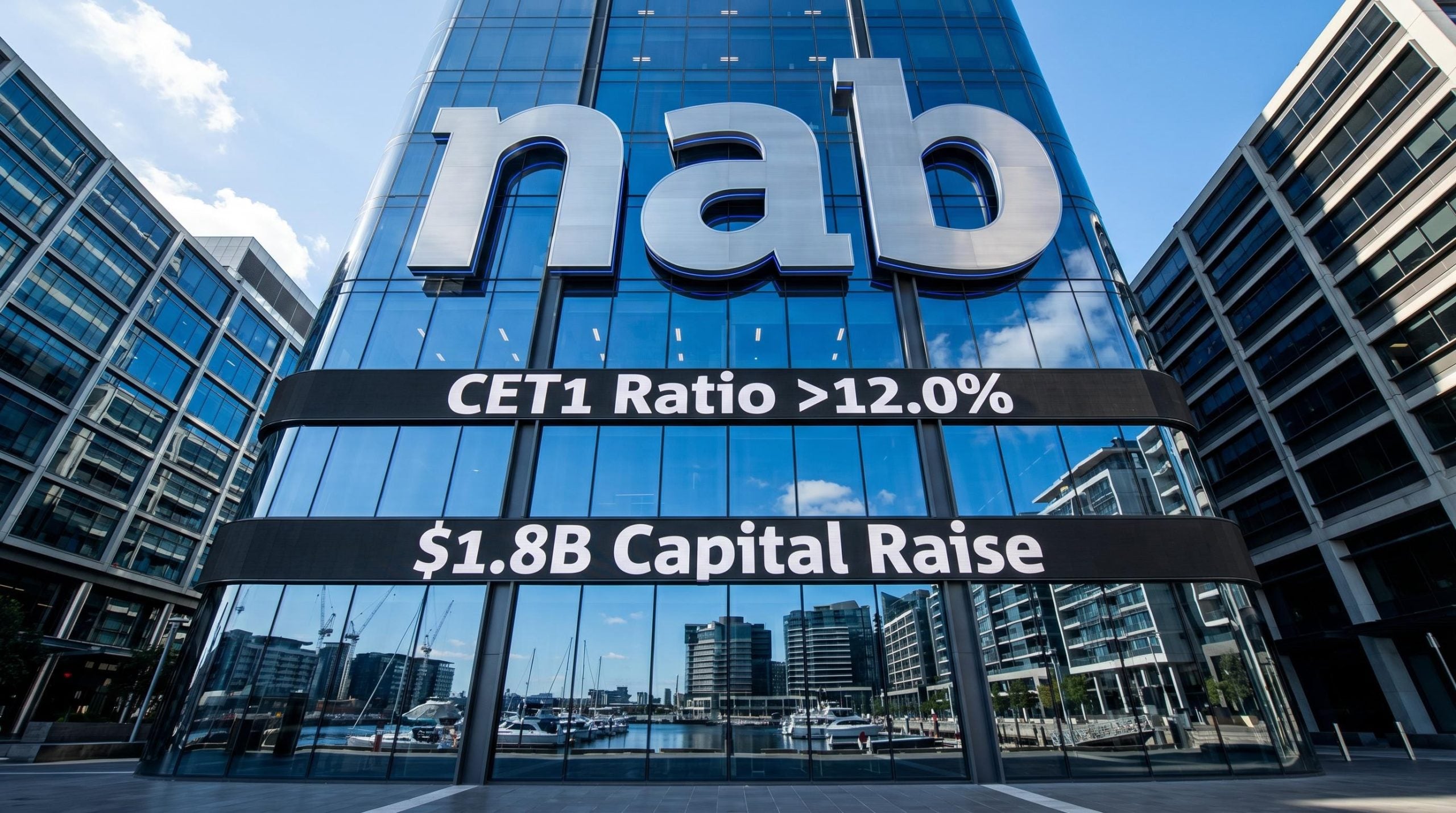
NAB bolsters balance sheet with $1.8 billion capital raise amid Middle East conflict uncertainty
National Australia Bank has announced proactive balance sheet strengthening measures following market volatility triggered by the Middle East conflict, implementing up to $1.8 billion in capital initiatives and increasing forward-looking credit provisions by $300 million. The bank expects to maintain a pro forma Common Equity Tier 1 (CET1) ratio greater than 12.0% at 31 March 2026, underpinning resilience during a period of heightened geopolitical and economic uncertainty.
The capital raise comprises a 1.5% discount to the 1H26 Dividend Reinvestment Plan (DRP) and a partial underwrite, expected to contribute up to approximately 40 basis points to the Group’s CET1 ratio in 2H26. These measures respond to multiple balance sheet pressures, including interest rate volatility, New Zealand Dollar weakness, and increased provisioning for potential sector stress linked to fuel supply disruptions.
NAB’s provisioning adjustments reflect a forward-looking assessment of sectors vulnerable to geopolitical stress, while the capital initiatives position the bank to absorb potential credit deterioration without compromising regulatory buffers. Management’s decision to front-run uncertainty rather than react to materialised losses signals a defensive posture appropriate to the elevated macro environment.
When big ASX news breaks, our subscribers know first
Credit provisions rise $300 million as NAB prepares for potential fuel supply disruptions
NAB’s 1H26 credit impairment charge is expected to reach $706 million, driven by a $300 million increase in forward-looking collective provisions as the bank prepares for potential economic stress from Middle East conflict-related fuel supply and cost pressures. The provision build comprises three components: a $152 million increase in the Economic Adjustment reflecting updates to the Base economic forecast and a 2.5% weighting increase to the Australian Downside scenario (now 45%), $201 million in new Forward Looking Adjustments (FLAs) for sectors exposed to fuel-related stress, and $53 million in FLA releases where expected risks have not eventuated or are now reflected in underlying provisioning.
The targeted sector overlays apply to Agriculture, Transport & Storage, and Manufacturing (new overlays), with increased overlays for Construction and Commercial Real Estate. These sectors face heightened vulnerability to energy cost inflation and supply chain disruption if Middle East conflict escalates or prolongs. The collective provision ratio is expected to rise to 1.35% of credit risk weighted assets from 1.31% at December 2025, reinforcing balance sheet buffers ahead of potential deterioration.
Underlying provision charges of $406 million reflect a more benign credit quality picture. Individual Assessed provision charges totalled $541 million, partially offset by a $135 million write-back in the underlying collective provision as portfolio-level credit metrics remained stable. The divergence between rising forward-looking provisions and improving underlying charges indicates NAB is provisioning for risks not yet visible in current loan performance.
| Component | 2H25 ($m) | 1H26 ($m) |
|---|---|---|
| Individually assessed charges | 574 | 541 |
| Underlying collective charges/(write-back) | 0 | (135) |
| Total underlying charges | 574 | 406 |
| Net FLA movement | (89) | 300 |
| Total credit impairment charge | 485 | 706 |
The provisioning strategy reveals management’s assessment of where geopolitical stress may crystallise, whilst current asset quality metrics suggest the Australian loan book remains resilient. For investors, the question is whether the $300 million provision build adequately reflects downside risks, or whether further charges could emerge if fuel supply disruptions materialise and economic conditions deteriorate beyond the modelled Downside scenario.
What are forward looking provisions and why do they matter?
Banks hold provisions as financial buffers against loans that may not be repaid in the future. These provisions are divided into two categories: individual provisions set aside for specific problem loans where the borrower is already in difficulty, and collective provisions which create portfolio-level buffers for future stress that has not yet materialised in individual loans.
Forward Looking Adjustments allow banks to provision for risks not yet reflected in historical data or current loan performance. This might include expected economic downturns, sector-specific stress, or geopolitical events that could impact borrowers’ ability to repay. When a bank increases forward-looking provisions, it reduces reported profit today but strengthens the balance sheet for potential future losses.
Understanding provisioning helps investors assess whether a bank is being prudent or aggressive in its earnings presentation, and whether balance sheet buffers are adequate for the risk environment. Higher provisions today mean lower earnings now, but potentially fewer surprises and less volatility in future periods if economic conditions deteriorate.
Software capitalisation overhaul triggers $1.35 billion accelerated amortisation charge
NAB has overhauled its software capitalisation policy to align with rapid technological change and peer sector practice, resulting in a $1,347 million pre-tax ($949 million after tax) accelerated amortisation charge that will be reported as a Large Notable Item in 1H26. The policy changes comprise three key adjustments: a reduction in the useful life of capitalised software assets to reflect faster obsolescence, a change in the nature of assets capitalised to focus on core systems, and an increase in the capitalisation threshold from $5 million to $20 million to introduce greater management discipline and align to sector peers.
The accounting change has no impact on the Group’s CET1 capital ratio, as capitalised software balances are already deducted from CET1 capital under regulatory rules. The charge is non-cash and accelerates expense recognition that would have occurred over future periods, effectively bringing forward amortisation that would otherwise have been spread across multiple years.
For 2H26, the policy introduces offsetting expense dynamics:
-
Higher proportion of investment expensed: Approximately 50% of 2H26 investment spend is expected to be expensed immediately due to the $20 million threshold, compared to an average of 38% in FY24 and FY25. NAB expects annual investment spend of approximately $1.8 billion, with investment typically skewed to the second half (for example, 57% of FY25 investment spend occurred in 2H25).
-
Amortisation impacts broadly offsetting: The accelerated charge reduces the capitalised software balance at 31 March 2026 by $1,347 million, resulting in lower amortisation charges from the reduced base. However, remaining assets will be subject to accelerated amortisation over a shorter average useful life, increasing amortisation charges. These impacts are expected to broadly offset each other in 2H26.
Whilst the headline charge appears significant, it is a non-cash accounting reclassification that improves transparency around technology investment and aligns NAB’s approach to sector standards. The change introduces discipline by requiring smaller projects to demonstrate immediate operational benefit rather than being capitalised, and it reduces the risk of carrying obsolete assets on the balance sheet in a fast-moving technology environment.
NZ dollar weakness creates $81 million revenue headwind
Foreign currency translation from New Zealand Dollar depreciation resulted in an $81 million decline in 1H26 Net Operating Income, net of gains realised on associated hedges. This was partially offset by a benefit to Operating Expenses from the same currency movement, reducing the net earnings impact.
NAB confirms FY26 expense guidance despite policy changes
NAB has reaffirmed its previously announced FY26 cash operating expense growth guidance of less than 4.6%, despite absorbing the software capitalisation policy changes in 2H26. The guidance excludes the impact of Large Notable Items, but includes the operational impact of the software policy changes on 2H26 operating expenses as described above.
FY26 Expense Guidance
Cash operating expense growth expected to remain less than 4.6%, excluding Large Notable Items but including software policy impacts on 2H26.
Management’s ability to maintain expense guidance whilst absorbing both the immediate increase in expensed technology investment and the broader operational impacts of the policy change signals underlying cost discipline. This provides earnings visibility for investors and suggests the bank has identified offsetting efficiencies elsewhere in the cost base to accommodate the structural shift in technology accounting.
NAB’s 1H26 results remain subject to finalisation, auditor review, and Board approval of dividend settings, with the full results scheduled for release on Monday 4 May 2026. The matters outlined in this announcement, including the application of a discount to the 1H26 DRP and any underwrite arrangement, are subject to Board approval.
Get Finance Sector News Before the Market Moves
Join 20,000+ investors receiving FREE breaking ASX finance news within minutes of release, complete with in-depth analysis. Click the “Free Alerts” button at Big News Blast to receive real-time alerts the moment major banks and financial institutions announce market-moving updates.