Fidelity’s Succession Question: Who Leads After Abigail Johnson?

Key Takeaways
- Fidelity Investments manages $15.1 trillion in assets under administration and reported record revenue of $32.7 billion in 2024, making its leadership succession a matter of broad financial significance for the approximately one in five American adults who entrust retirement savings to the firm.
- No public successor has been identified for 64-year-old Chairman and CEO Abigail Johnson, consistent with Fidelity's private family ownership model that allows leadership transitions to occur without external disclosure.
- The 2005 succession crisis — in which Abigail was removed from a senior role via a board intermediary dispatched by her own father — demonstrates that Fidelity has navigated disruptive leadership conflicts before without operational collapse.
- Roughly half of Fidelity's current customers joined within the last five years, and operating income rose 21% in 2024, signalling institutional strength that extends beyond any individual leader.
- Investors should monitor Fidelity leadership succession as a governance consideration but evaluate the firm primarily on execution and financial results, as succession transparency is unlikely from a privately held company.
When approximately one in five American adults entrust their retirement savings to a single firm, leadership decisions matter. Fidelity Investments oversees $15.1 trillion in assets under administration, reported $32.7 billion in revenue for 2024, and remains privately held by the Johnson family after three generations. At 64 years old, Abigail Johnson serves as Chairman and CEO, yet no successor has been publicly identified.
Her path to this role was neither inevitable nor smooth. A spring 2005 confrontation nearly ended her career at the family firm, delivered on a Sunday morning by an intermediary rather than her father directly. Understanding how Fidelity navigates Fidelity leadership succession becomes essential for anyone with money in the firm.
Understanding Family Business Succession in Financial Services
Fidelity operates differently from publicly traded competitors like BlackRock or Charles Schwab. The firm remains privately held and family-controlled across three generations of Johnsons. This structure eliminates external shareholder pressure for succession transparency or governance disclosures.
Private family control enables patient, long-term strategic thinking unconstrained by quarterly earnings expectations. Decisions prioritise multi-decade institutional stability over short-term market reactions. However, this same structure means succession decisions happen behind closed doors, with customers and employees having limited visibility into who might lead their savings next.
Fidelity’s past succession events provide the clearest window into how the firm handles these transitions. The 2005 crisis involving Abigail Johnson reveals both the dysfunction and resilience within the family governance model, offering context for understanding current succession uncertainty.
When big ASX news breaks, our subscribers know first
The 2005 Succession Crisis: A Sunday Morning Ambush
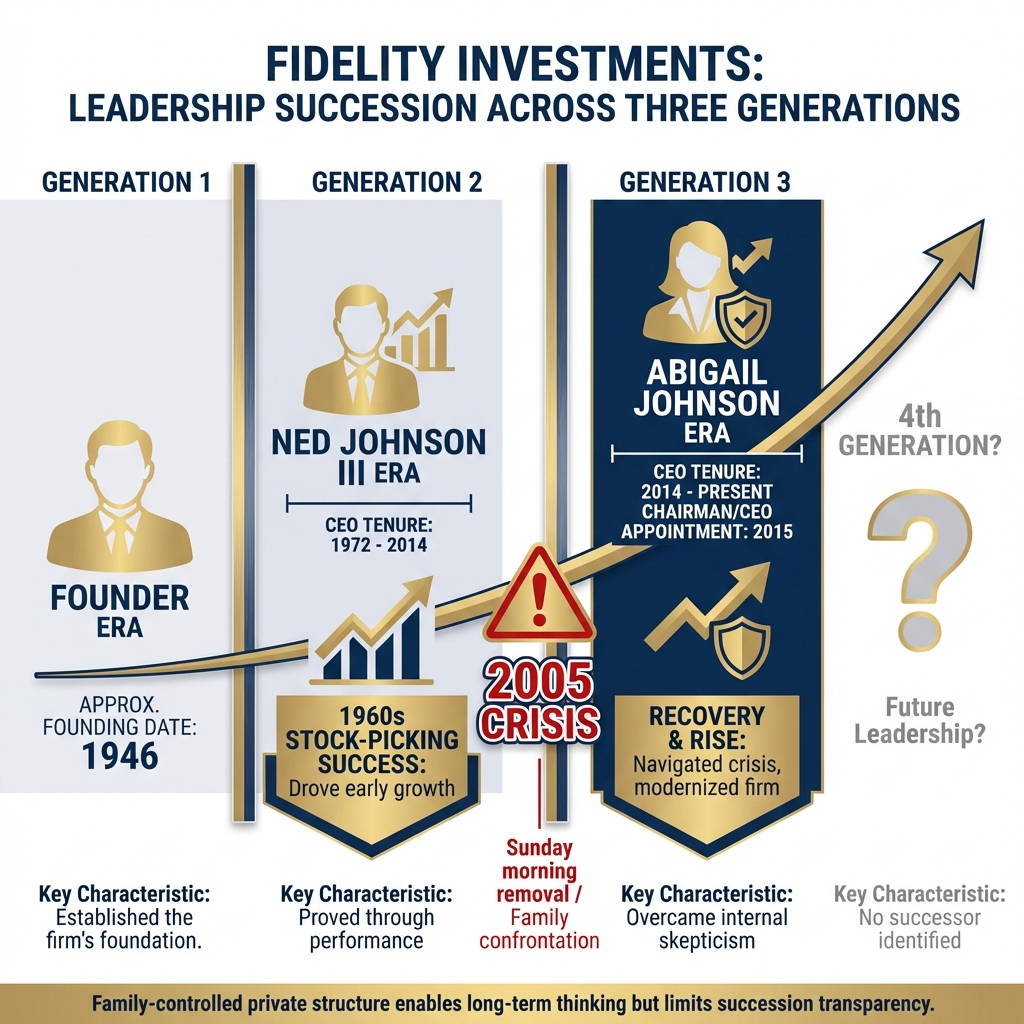
On a Sunday morning in spring 2005, board trustee Marvin Mann arrived at Abigail Johnson’s home in Milton, Massachusetts. He came bearing news from her father, then-CEO Edward ‘Ned’ Johnson III. She was being removed from a senior role. Ned had dispatched an intermediary rather than delivering the message himself.
Abigail had risen through Fidelity’s ranks with her father’s initial endorsement, but she had not replicated his legendary stock-picking performance from the early 1960s. Her tenure as an executive was described as inconsistent. Internal critics had grown increasingly vocal, refusing to accept her advancement as inevitable simply because of her surname.
The 2005 episode triggered what has been characterised as one of the most disruptive periods in Fidelity’s roughly 80-year corporate history. The family dynamics, the professional stakes, and the firm’s future all collided in a moment that could have permanently sidelined the eventual heir. A father using a board intermediary to deliver career-altering news to his daughter on a Sunday morning captured the intersection of family dysfunction and corporate governance unique to dynasty businesses.
From Crisis to Chairman: Abigail Johnson’s Path to Power
Despite the 2005 crisis, Abigail Johnson persisted within the firm and ultimately succeeded her father as chairman approximately a decade later. The path required overcoming not just family tension but sustained internal scepticism about her qualifications. The recovery arc demonstrates institutional capacity to navigate disruptive leadership conflicts.
Under her leadership, Fidelity’s 2024 results showed significant strength. These numbers matter because they provide objective validation separate from family lineage. According to company reporting, roughly half of Fidelity’s current customers joined within the last five years, indicating growth during her tenure.
Reuters verification of Fidelity’s 2024 financial results provides independent confirmation of the record revenue and asset growth reported by the privately held firm.
Key 2024 Performance Metrics:
- Revenue of $32.7 billion (up 16% from 2023)
- Operating income of $10.3 billion (up 21%)
- Assets under administration of $15.1 trillion (up 20%)
- Discretionary assets of $5.9 trillion (up 21%)
The firm’s investments in employee development during this period included skills-based career pathing launched in 2024 and expanded Fidelity Cares initiatives. Management discussions emphasised team structures to support client services, signalling operational stability independent of succession questions.
The next major ASX story will hit our subscribers first
The Fourth Generation Question: Who Comes After Abigail?
At 64, Abigail Johnson’s eventual succession is a legitimate planning consideration, yet no public information exists about fourth-generation Johnson family members being groomed for leadership or non-family executives positioned as potential successors. The firm has historically affirmed that internal succession plans exist while declining to share details.
While planned CEO transitions at public companies typically involve multi-month notice periods and identified successors, Fidelity has provided no such roadmap despite Abigail Johnson being 64 years old.
This opacity is consistent with private company norms but creates uncertainty for the millions of Americans whose retirement depends on the firm’s continued competent management. External stakeholders must rely on historical patterns and firm performance rather than announced plans. No reporting from 2025 or 2026 has surfaced regarding succession discussions or candidate development.
Each of the three Johnson generational transitions brought distinct challenges and varying levels of internal confidence. Ned Johnson overcame early scepticism through demonstrated stock-picking performance. Abigail overcame scepticism through operational results after the 2005 crisis. Future transitions may follow similar prove-it-first patterns, with leaders earning credibility through performance rather than inheriting unquestioned authority.
What Fidelity’s Succession Approach Means for Investors
When a single firm manages retirement savings for one in five American adults, leadership continuity is not merely a corporate governance curiosity but a matter of broad financial stability. The lack of succession transparency is a real limitation of the private ownership model. Investors accustomed to public company disclosures receive minimal advance notice of leadership changes.
Unlike publicly traded exchanges where public company succession transparency includes formal announcements and transition timelines, Fidelity’s private ownership model allows the Johnson family to manage leadership changes behind closed doors.
Investment Company Institute retirement market data tracks the total universe of U.S. retirement assets across 401(k), IRA, and pension accounts, providing the industry benchmark against which Fidelity’s market share is measured.
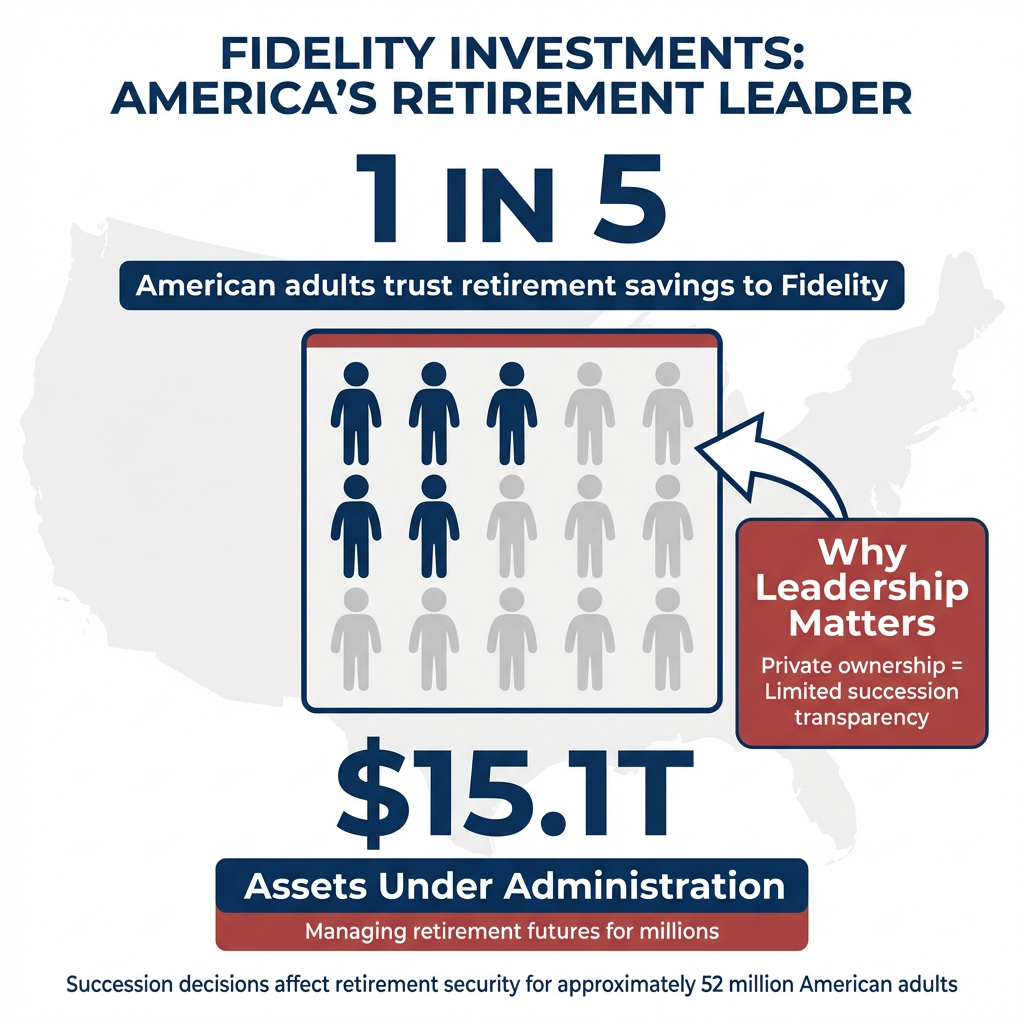
Fidelity’s track record across three generations suggests institutional resilience that transcends individual leaders. The firm’s continued growth (50% of customers joining in the past five years), strong recent performance, and investments in employee development signal operational stability independent of the CEO’s identity. Annual revenue exceeds BlackRock’s, positioning Fidelity competitively despite private ownership constraints.
For investors, Fidelity leadership succession is worth monitoring but not worth panicking about. The 2005 crisis showed the firm can navigate disruptive leadership transitions without operational collapse. The current performance shows the firm is well-positioned regardless of when that next transition occurs. Customers should assess Fidelity on execution and results rather than succession transparency they will not receive from a private company.
> This article is for informational purposes only and should not be considered financial advice. Investors should conduct their own research and consult with financial professionals before making investment decisions.
Frequently Asked Questions
What is Fidelity's succession plan for after Abigail Johnson?
Fidelity has not publicly identified a successor to Abigail Johnson, who is currently 64. The firm has historically confirmed that internal succession plans exist but declines to share details, consistent with its private ownership model.
How did Abigail Johnson become CEO of Fidelity Investments?
Abigail Johnson rose through Fidelity's ranks despite a 2005 crisis in which she was removed from a senior role, ultimately succeeding her father Ned Johnson as chairman approximately a decade later by demonstrating operational results rather than relying on family lineage.
How much money does Fidelity Investments manage?
As of 2024, Fidelity Investments oversees $15.1 trillion in assets under administration and $5.9 trillion in discretionary assets, with annual revenue of $32.7 billion — up 16% from 2023.
Should investors be worried about Fidelity leadership succession risk?
While the lack of succession transparency is a real limitation of Fidelity's private ownership model, the firm's strong 2024 performance, 50% customer growth over five years, and demonstrated resilience during the disruptive 2005 leadership crisis suggest operational stability independent of any single leader.
How does Fidelity's private ownership affect succession transparency compared to public companies?
Unlike publicly traded firms required to disclose leadership transitions and successor plans, Fidelity's private family ownership allows the Johnson family to manage succession entirely behind closed doors, giving customers and employees minimal advance visibility into future leadership changes.