State Street Beats Q1 Earnings as Fee Revenue Hits Record

Key Takeaways
- State Street delivered an 8.4% adjusted EPS beat of $2.84 versus the $2.62 consensus estimate, sending shares up 2.18% in pre-market trading.
- Record quarterly revenue of $3.8 billion represented 16% year-on-year growth, driven by record fee revenue of $3.0 billion and net interest income of $835 million.
- The company generated 616 basis points of total operating leverage on an adjusted basis, with pre-tax margin reaching 29.0% excluding notable items.
- State Street returned $633 million to shareholders through $400 million in buybacks and $233 million in dividends, demonstrating sustained capital return commitment.
- Assets under custody and administration grew 17% year-on-year to $54.5 trillion, while assets under management rose 20% to $5.6 trillion.
State Street Corporation delivered a strong start to 2026, reporting adjusted earnings per share of $2.84 for the first quarter, surpassing the analyst consensus estimate of $2.62 by $0.22. The 8.4% earnings beat sent shares up 2.18% in pre-market trading, reflecting investor confidence in the custody banking giant’s execution. GAAP earnings came in at $2.49 per share.
The Boston-based financial services firm posted record quarterly revenue of $3.8 billion, marking a 16% year-on-year increase from $3.3 billion in Q1 2025. Chief Executive Officer Ron O’Hanley attributed the outperformance to operational strength across the company’s diversified business lines, with both fee income and net interest income contributing to the record-setting quarter.
> This marks State Street’s highest quarterly revenue on record, with both fee income and net interest income contributing to the outperformance.
What State Street does: Understanding the custody banking giant
State Street operates as a custody bank, a business model distinct from traditional commercial banking. Rather than primarily making loans to consumers or businesses, custody banks safeguard and administer assets for institutional clients such as pension funds, mutual funds, and exchange-traded funds. This structure makes fee revenue the primary growth driver rather than net interest income from lending activities.
The OCC Comptroller’s Handbook defining custody banking operations provides the authoritative regulatory framework explaining how custody banks safeguard and administer institutional assets, distinguishing their business model from traditional commercial lending operations.
State Street generates revenue through three main channels:
- Custody and servicing fees for holding and administering client assets
- Asset management fees from its investment management division
- Net interest income from securities lending and treasury operations
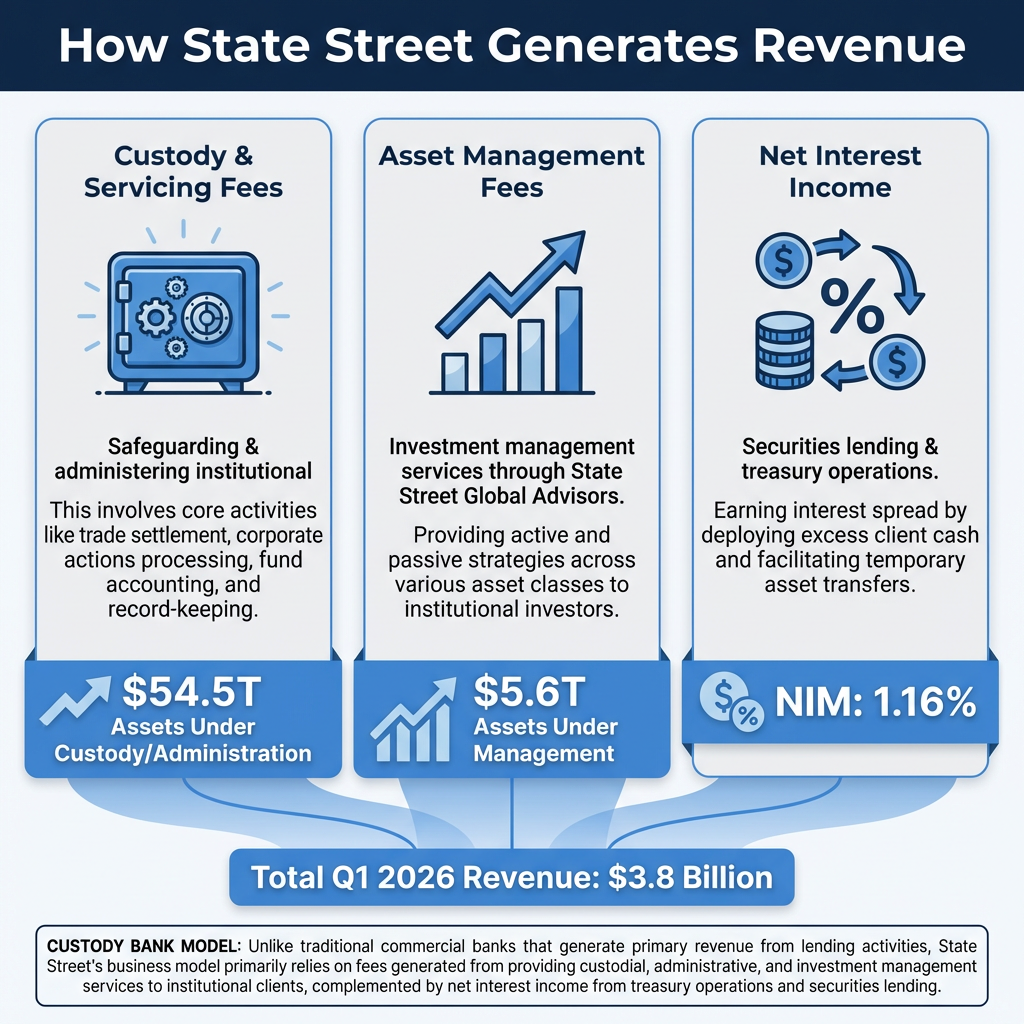
With $54.5 trillion in assets under custody and administration as of Q1 2026, State Street ranks among the world’s largest custody banks alongside BNY Mellon and JPMorgan’s custody operations. The firm also manages $5.6 trillion in assets through its investment management arm, providing a diversified revenue base across both custody and active management services.
State Street’s asset management division, with $5.6 trillion under management, operates in a competitive landscape where firms are securing debt facilities to fund growth initiatives, strategic acquisitions, and platform investments.
When big ASX news breaks, our subscribers know first
Record fee revenue drives Q1 outperformance
Quarterly fee revenue reached a record $3.0 billion, representing 15% year-on-year growth from the prior year period. The expansion was fuelled by growth in both custody/administration assets and managed assets, reflecting favourable equity market conditions and net client asset inflows during the quarter.
| Metric | Q1 2025 | Q1 2026 | Change |
|---|---|---|---|
| Fee Revenue | $2.6B | $3.0B | +15% |
| Net Interest Income | $714M | $835M | +17% |
| Total Revenue | $3.3B | $3.8B | +16% |
| AUC/A | $46.6T | $54.5T | +17% |
| AUM | $4.7T | $5.6T | +20% |
Net interest income performance strengthened significantly, climbing 17% year-on-year to $835 million. The company’s net interest margin expanded 16 basis points to 1.16%, reflecting the benefit of elevated interest rates on State Street’s securities portfolio and treasury operations. This margin expansion demonstrates the company’s ability to generate returns on its balance sheet whilst managing interest rate risk.
State Street’s net interest margin expansion of 16 basis points demonstrates effective balance sheet management in elevated rate environments, a strategy that has also driven profitability improvements across regional banking institutions managing similar interest rate dynamics.
Expense management and operating leverage analysis
Total expenses rose 15% to $2.8 billion in Q1 2026, though this headline figure includes $130 million in notable items related to repositioning charges and client rescoping adjustments. These one-off costs temporarily inflated the expense base relative to underlying operational spending patterns.
Excluding these notable items, adjusted expense growth was 9%, primarily driven by revenue-linked compensation costs and strategic technology investments. The more modest underlying expense growth against 16% revenue expansion demonstrates disciplined cost management alongside business scaling.
State Street’s strategic technology investments contributed to adjusted expense growth of 9%, mirroring broader financial services trends where institutions are partnering with technology providers to achieve operational efficiency gains and improve cost-to-income ratios.
> State Street generated 616 basis points of total operating leverage on an adjusted basis, with pre-tax margin reaching 29.0% excluding notable items.
The company’s GAAP pre-tax margin stood at 25.5%, with the 350 basis point gap to the adjusted 29.0% margin reflecting the impact of notable items. For a custody bank operating on relatively compressed margins compared to traditional commercial banks, this level of margin expansion represents meaningful profitability improvement whilst maintaining competitive pricing for institutional clients.
Capital returns: $633 million to shareholders
State Street returned $633 million to shareholders during Q1 2026, maintaining its commitment to capital distribution alongside business investment and regulatory capital requirements. The capital return programme reflects the company’s strong capital position and confidence in sustainable earnings generation.
The quarterly capital deployment broke down as follows:
- Share repurchases of $400 million (63% of total capital returns)
- Quarterly dividend payments of $233 million (37% of total capital returns)
The $400 million buyback pace represents approximately 1% of State Street’s $39.5 billion pre-earnings market capitalisation executed in a single quarter. This buyback-heavy capital return mix signals management confidence in the company’s intrinsic value relative to its current share price.
Whilst State Street focuses on organic capital deployment through share buybacks and dividends, other financial institutions are exploring alternative capital allocation strategies including transformational partnerships to unlock shareholder value through balance sheet optimization.
The next major ASX story will hit our subscribers first
Key takeaways for investors
State Street’s Q1 2026 results validate Chief Executive Officer Ron O’Hanley’s strategic emphasis on business diversification and operational execution. The combination of record revenue, substantial operating leverage, and consistent capital returns positions the custody bank favourably entering the remainder of 2026.
Key takeaways from the quarterly results include:
- Adjusted earnings beat of $0.22 demonstrates execution exceeding market expectations across revenue and expense management
- Record fee revenue of $3.0 billion suggests strong competitive positioning in custody and asset servicing markets
- Operating leverage of 616 basis points validates cost discipline whilst investing for growth
- Capital returns totalling $633 million continue uninterrupted, supporting shareholder value
- Management’s conference call scheduled for 11:00 a.m. ET will provide forward guidance and strategic updates
Investors should monitor State Street’s earnings conference call for management commentary on forward outlook, market share trends in custody banking, and any updates to strategic initiatives or technology investments. The call will provide additional context on sustainability of fee revenue growth and expectations for the remainder of fiscal 2026.
Investors can independently verify all Q1 2026 financial metrics and forward guidance through the SEC EDGAR database for State Street Corporation filings, where 10-Q quarterly reports and 8-K current reports provide comprehensive breakdowns of revenue components, expense categories, and management commentary.
Frequently Asked Questions
Did State Street beat earnings estimates in Q1 2026?
State Street exceeded analyst expectations with adjusted earnings per share of $2.84, beating the consensus estimate of $2.62 by $0.22, representing an 8.4% earnings beat. GAAP earnings per share were $2.49. Total revenue of $3.8 billion also surpassed analyst projections, driven by record fee revenue and strong net interest income performance.
What drove State Street’s record revenue in Q1 2026?
The record quarterly revenue of $3.8 billion was driven by two primary factors: record fee revenue of $3.0 billion (up 15% year-on-year) from growth in assets under custody/administration and assets under management, and net interest income of $835 million (up 17% year-on-year) from net interest margin expansion of 16 basis points to 1.16%. Both custody servicing fees and treasury operations contributed to the outperformance.
How much did State Street return to shareholders in Q1 2026?
State Street returned $633 million to shareholders during the first quarter, consisting of $400 million in share repurchases and $233 million in dividend payments. The capital return programme reflects the company’s strong capital position and commitment to shareholder value whilst maintaining regulatory capital requirements.
What are State Street’s assets under custody and management?
As of Q1 2026, State Street reported assets under custody and administration of $54.5 trillion, representing 17% year-on-year growth from $46.6 trillion in Q1 2025. Assets under management totalled $5.6 trillion, up 20% from $4.7 trillion in the prior year period. The growth reflects both market appreciation and net client asset inflows across the custody and investment management businesses.
This article is for informational purposes only and should not be considered financial advice. Investors should conduct their own research and consult with financial professionals before making investment decisions.
Frequently Asked Questions
Did State Street beat earnings estimates in Q1 2026?
Yes, State Street reported adjusted earnings per share of $2.84, beating the analyst consensus estimate of $2.62 by $0.22, representing an 8.4% earnings beat. GAAP earnings per share came in at $2.49.
What is a custody bank and how does State Street make money?
A custody bank safeguards and administers assets for institutional clients such as pension funds and ETFs, rather than primarily making consumer loans. State Street generates revenue through custody and servicing fees, asset management fees, and net interest income from securities lending and treasury operations.
What drove State Street's record Q1 2026 revenue?
State Street's record quarterly revenue of $3.8 billion was driven by record fee revenue of $3.0 billion, up 15% year-on-year, and net interest income of $835 million, up 17% year-on-year, supported by net interest margin expansion of 16 basis points to 1.16%.
How much did State Street return to shareholders in Q1 2026?
State Street returned $633 million to shareholders in Q1 2026, comprising $400 million in share repurchases and $233 million in dividend payments, reflecting the company's strong capital position and commitment to shareholder value.
How much does State Street have in assets under custody and management?
As of Q1 2026, State Street reported $54.5 trillion in assets under custody and administration, up 17% year-on-year, and $5.6 trillion in assets under management, up 20% from $4.7 trillion in Q1 2025.