
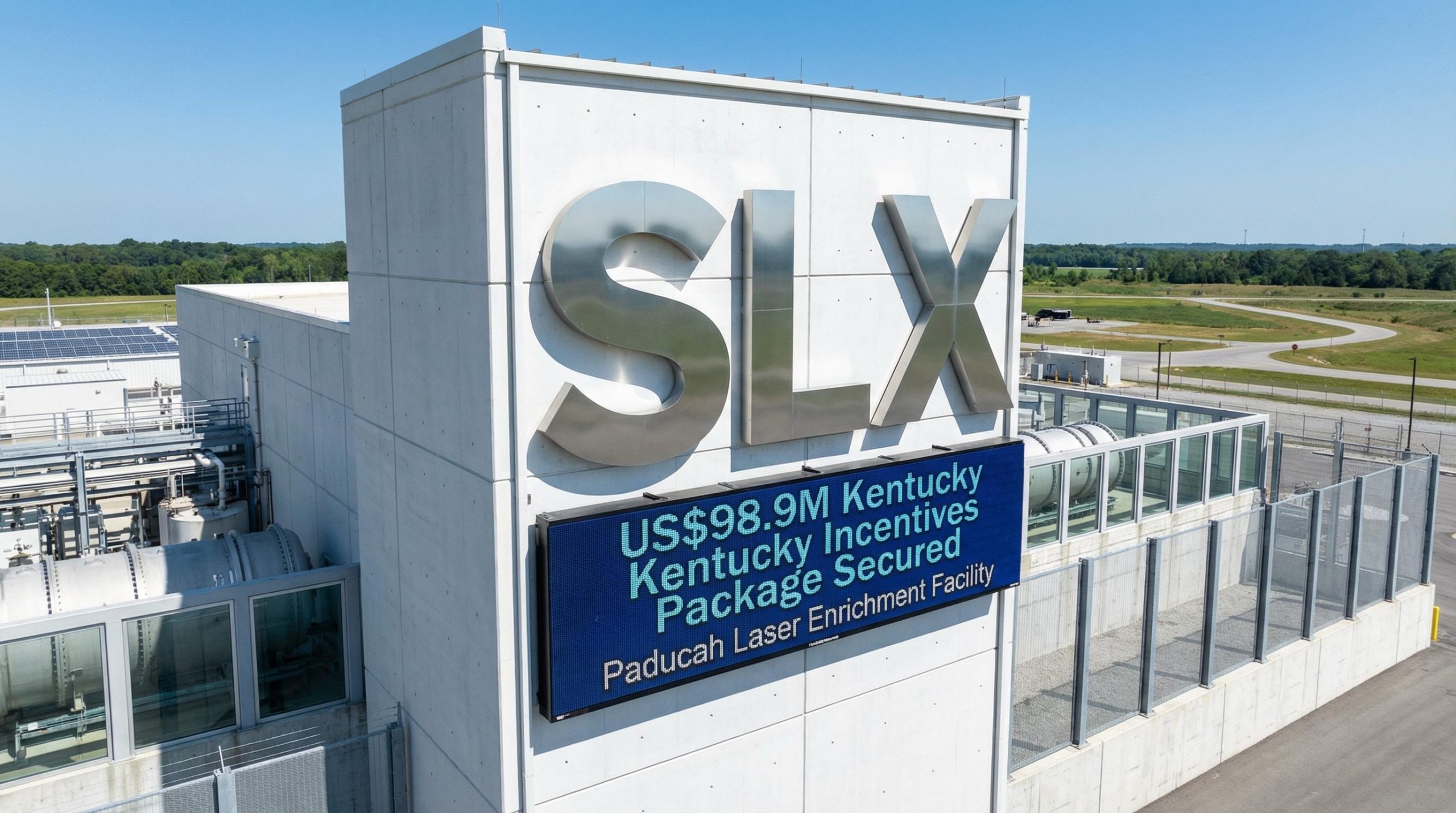
Silex Systems (ASX: SLX) has announced that Global Laser Enrichment (GLE), the exclusive licensee of its SILEX uranium enrichment technology, has received preliminary approval for a US$98.9 million incentives package from the Commonwealth of Kentucky and McCracken County. This performance-based package supports the development of the planned Paducah Laser Enrichment Facility (PLEF), which represents the single largest capital investment in Western Kentucky’s history.
The Silex PLEF Kentucky Incentives Package comprises tax and economic incentives contingent on GLE reaching agreed investment and job creation thresholds. This state and local support comes in addition to a recent US$28.5 million award from the US Department of Energy (DOE) to advance next-generation laser-based uranium enrichment technology. Combined with approximately US$600 million in privately funded development across North Carolina and Kentucky, GLE’s PLEF programme now benefits from multiple layers of federal, state, and local backing.
GLE receives preliminary approval for US$98.9 million incentives package for Paducah uranium enrichment facility
The preliminary approval from Kentucky and McCracken County provides up to US$98.9 million in performance-based incentives tied to specific investment and employment milestones. This financial support reinforces GLE’s position as it advances the PLEF, a facility expected to be transformational for the greater Paducah region.
GLE has invested approximately US$600 million in privately funded engineering, design, manufacturing, and licensing investments across its North Carolina and Kentucky operations. The recent US$28.5 million DOE award further strengthens the technology development pathway, supporting the maturation of laser-based uranium enrichment for commercial deployment in the nuclear fuel cycle.
Michael Goldsworthy, CEO/Managing Director
“We are greatly appreciative of the support for GLE’s PLEF from the Commonwealth of Kentucky and McCracken County. With an advanced Nuclear Regulatory Commission (NRC) licensing effort underway, ongoing focus on technology and manufacturing maturation programs (TRL-7 / MRL-7) and full-scale preliminary detailed design for the PLEF, we welcome the support for the PLEF from US federal, state, and local partners as we progress towards the commercial deployment of the world’s first laser-based uranium enrichment plant.”
The incentives package represents a significant de-risking element for the PLEF commercialisation pathway. By securing state and local government commitment alongside federal DOE funding, GLE has positioned the project within a multi-layered support framework that reduces reliance on any single funding source.
When big ASX news breaks, our subscribers know first
What is laser uranium enrichment and why does it matter?
Uranium enrichment increases the concentration of uranium-235 (U-235), the isotope required for nuclear fuel, from its natural level of approximately 0.7% to the higher levels needed for reactor operation. Most commercial reactors require enrichment levels between 3% and 5%.
The SILEX technology represents a laser-based approach to uranium enrichment, differentiating it from the second-generation centrifuge technology used by most current enrichment facilities. According to GLE, the laser method offers significantly higher enrichment efficiency and throughput compared to centrifuge-based systems, potentially providing a competitive advantage in nuclear fuel production.
Key advantages of laser enrichment over centrifuge technology:
- Higher enrichment efficiency reduces the energy and time required to reach target U-235 concentrations
- Increased throughput capacity enables processing of larger volumes within a given facility footprint
- Modular scalability supports phased capacity expansion aligned with market demand
- Technology differentiation positions GLE as a potential disruptor in a market dominated by centrifuge systems
The nuclear fuel supply chain remains concentrated among a small number of global suppliers. Laser enrichment technology, if successfully commercialised, could diversify supply sources and enhance energy security for countries seeking domestic fuel production capability.
Strategic role in rebuilding US domestic uranium supply
GLE operates under a contract with the DOE to re-enrich the department’s Paducah inventory of depleted uranium tails, with operations targeted to commence by 2030. This contract provides both a foundational revenue stream and strategic alignment with US government objectives to rebuild domestic nuclear fuel supply infrastructure.
The approximately 700-acre Paducah site is strategically located adjacent to the DOE’s former Paducah Gaseous Diffusion Plant, where the legacy depleted uranium tails (PLEF feedstock) are stored. By re-enriching this material, GLE would support cleanup efforts from DOE legacy activities while simultaneously producing enriched uranium for commercial nuclear reactors.
This dual benefit addresses two policy priorities: environmental remediation of historical nuclear sites and reduction of dependence on foreign fuel sources. The location adjacent to existing DOE infrastructure reduces capital expenditure on site preparation and provides access to established regulatory frameworks for nuclear materials handling.
Paducah historically played a central role in the US nuclear energy ecosystem during the Cold War era. The PLEF represents an opportunity to re-establish the region as a hub for nuclear fuel production using next-generation technology.
PLEF development milestones and future production potential
GLE has advanced the SILEX technology to Technology Readiness Level 7 (TRL-7) and Manufacturing Readiness Level 7 (MRL-7), indicating the technology has been demonstrated in an operational environment and manufacturing processes are capable of producing systems at scale. Full-scale preliminary detailed design for the PLEF is underway alongside an advanced Nuclear Regulatory Commission (NRC) licensing effort.
Subject to a feasibility study, supportive market conditions, and continued industry and government backing, the PLEF could produce uranium in multiple forms:
- Natural grade uranium as UF6 for further processing in the nuclear fuel cycle
- Low Enriched Uranium (LEU) at standard enrichment levels (3-5% U-235) for commercial light water reactors
- LEU+ at intermediate enrichment levels for specific reactor designs
- High-Assay LEU (HALEU) enriched above 5% but below 20% U-235 for next-generation advanced reactors, including small modular reactors (SMRs)
HALEU production capability is particularly significant given the emerging SMR market. Many advanced reactor designs under development require HALEU fuel, and current global production capacity remains limited. The PLEF’s potential to supply HALEU positions GLE within a growing segment of the nuclear fuel market.
| Milestone | Status | Target/Notes |
|---|---|---|
| Technology Maturation | TRL-7 / MRL-7 achieved | Operational environment demonstration complete |
| NRC Licensing | Advanced stage | Regulatory approval process underway |
| Preliminary Detailed Design | Full-scale in progress | Engineering specifications development |
| DOE Contract Commencement | On track | Re-enrichment operations targeted for 2030 |
| State Incentives Package | Preliminary approval | Performance-based, subject to thresholds |
The feasibility study and market assessment remain critical gating factors for final investment decisions. GLE’s progress towards commercialisation depends on successful completion of the technology maturation programme, favourable nuclear fuel market conditions, and continued support from industry stakeholders and government partners.
Investment thesis: government backing strengthens commercial pathway
The layered financial support structure provides multiple validation points for the PLEF’s strategic importance and commercial viability:
- Federal validation: The US$28.5 million DOE award signals government confidence in the technology’s potential and alignment with national energy security objectives
- State and local commitment: The US$98.9 million Kentucky incentives package demonstrates regional economic development priorities and reduces project capital requirements
- Private sector confidence: Approximately US$600 million in privately funded investment across GLE’s operations indicates commercial stakeholder belief in the technology’s market potential
- Technology advantage: The claimed efficiency and throughput superiority over centrifuge methods positions GLE competitively if commercialisation succeeds
- Strategic timing: US policy focus on domestic nuclear fuel security and SMR development creates favourable market conditions for new enrichment capacity
For Silex Systems (ASX: SLX), the GLE licensing relationship provides exposure to the PLEF commercialisation opportunity without direct capital deployment. The company’s revenue model is tied to GLE’s commercial success through technology licensing fees and royalty arrangements.
Key investment considerations:
- Technology risk: Commercial-scale deployment of laser enrichment remains unproven at full facility scale
- Regulatory pathway: NRC licensing completion is required before commercial operations can commence
- Market conditions: Nuclear fuel demand and pricing dynamics will influence project economics
- Execution risk: Construction, commissioning, and ramp-up to commercial production carry typical project delivery risks
- Incentive conditionality: The US$98.9 million package is performance-based and contingent on meeting investment and employment thresholds
The PLEF represents a long-term commercialisation opportunity with significant capital intensity and extended development timelines. The current announcement provides evidence of growing institutional support for the project but does not eliminate the fundamental execution and market risks associated with first-of-kind nuclear fuel facility development.
The feasibility study outcomes, expected to be completed before final investment decisions, will be critical in determining whether the technical, economic, and regulatory conditions support proceeding to full commercial development.
Don’t Miss the Next Industrial Breakthrough
Join 20,000+ investors getting FREE breaking ASX news delivered to your inbox within minutes, complete with in-depth analysis. Click the “Free Alerts” button at StockWire X to start receiving alerts the moment market-moving announcements hit the ASX.