

Nanoveu showcases EMASS semiconductor strategy at Pitt Street Research conference
Nanoveu Limited (ASX: NVU) presented its semiconductor business strategy at the Pitt Street Research Semiconductor Conference 2026 on 25 March 2025. Dr Mohamed Sabry, the company’s Director and EMASS founder, outlined Nanoveu’s approach to progressing its EMASS semiconductor operations. The technology innovator operates across advanced semiconductor, visualisation, and materials science, with dual listing on the ASX and OTCQB (NNVUF). The company held $1.8 million in cash as at Q4 2025 and completed a $7.5 million capital raise in January 2026, with 1,080.4 million shares on issue and a market capitalisation of $68.07 million.
When big ASX news breaks, our subscribers know first
What is edge AI and why it matters for semiconductor investors
Edge AI refers to artificial intelligence processing that occurs directly on devices rather than in remote cloud servers. This approach enables real-time decision-making without relying on internet connectivity, making it particularly valuable for battery-constrained applications. Ultra-low-power chips capable of running AI models locally address critical limitations in devices such as drones, wearables, and Internet of Things (IoT) sensors, where battery life and response time are essential performance factors.
The system-on-chip (SoC) market is projected to reach $325.7 billion by 2030, driven by an 8.5% compound annual growth rate globally. This expansion reflects increasing demand from AI applications, 5G networks, and smart devices requiring continuous sensing, context awareness, and real-time processing capabilities. Nanoveu’s positioning in this market aligns with structural tailwinds from edge computing adoption, where local processing solves latency and power consumption challenges that cloud-based AI cannot effectively address.
EMASS chip delivers up to 20x energy efficiency advantage
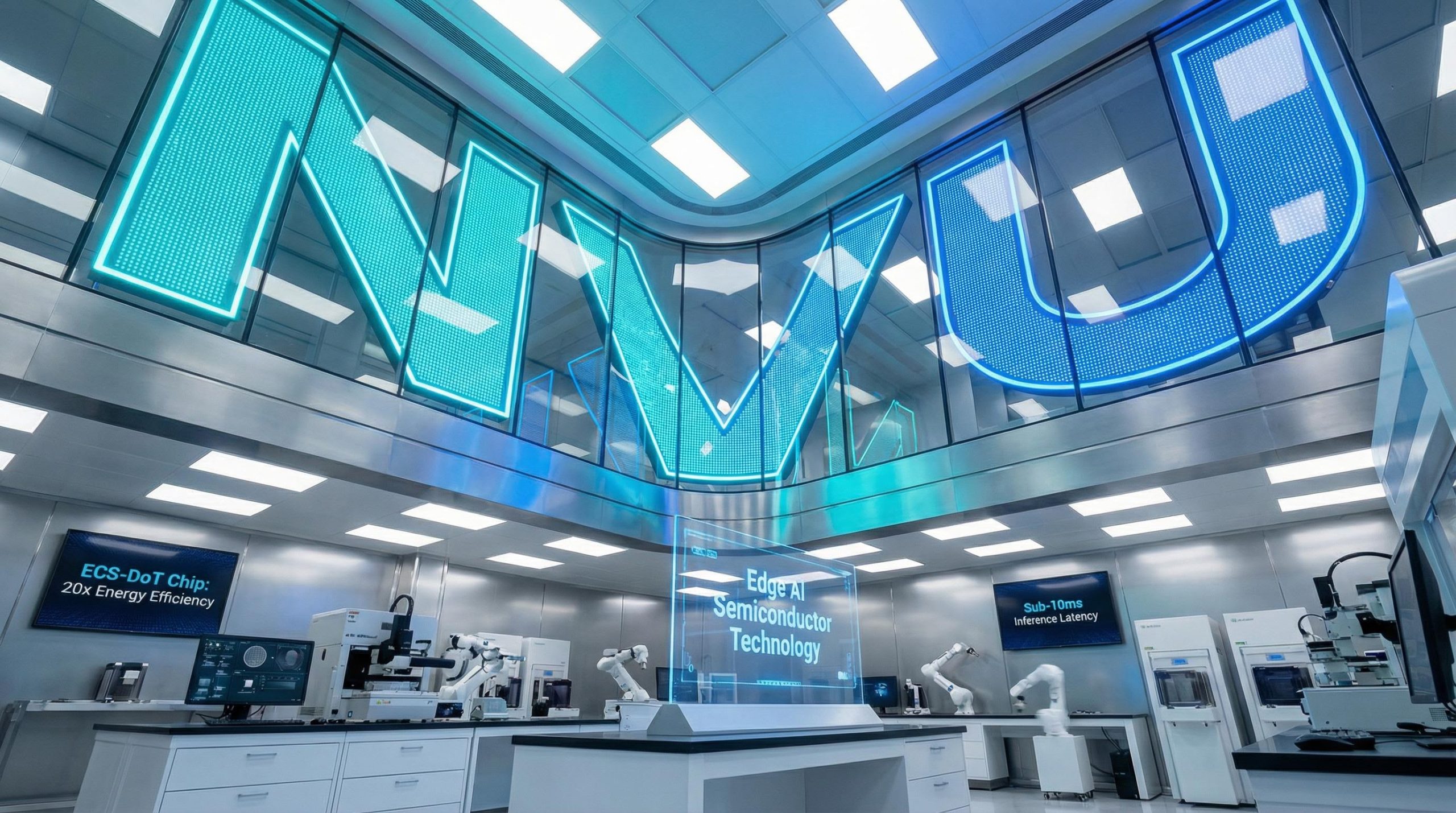
The flagship ECS-DoT chip is reported to deliver up to 20 times greater energy efficiency compared to competitor solutions, according to MLCommons benchmarking data from 2025. The chip operates at power consumption levels between less than 1mW to 5mW, with an average of 2mW for always-on operation. The architecture executes AI inference directly at the sensor without requiring external memory, achieving sub-10 millisecond inference latency compared to 150-300 milliseconds for competing chips.
The technology has received industry recognition through best-in-show awards at CES and embedded world for AI and Machine Learning categories. These accolades acknowledge the chip’s innovative architecture and performance characteristics in ultra-low-power edge AI processing for vision, audio, and sensor data applications.
| Metric | ECS-DoT | Competitors |
|---|---|---|
| Energy efficiency | Up to 20x better | Baseline |
| Inference latency | Sub-10ms | 150-300ms |
| Power consumption | <1mW to 5mW | Higher |
Drone trials demonstrate real-world performance gains
Simulation testing has demonstrated substantial drone endurance improvements using the ECS-DoT chip. Live trials are underway with partners, with results expected in April 2026. The testing involves hardware integration collaborations to validate the simulation data under real-world flight conditions.
Performance gains reported from simulations include:
- 60% increase in flight time without hardware modifications
- Quadcopter configurations achieved up to 80% improvement in mission endurance, with 60% average extended flight time
- Hexacopter configurations delivered up to 75% improvement in flight endurance
- Octocopter configurations achieved up to 85% improvement with 57% average gains
The drone market is projected to reach $223.66 billion by 2034. The April 2026 live trial results represent a near-term catalyst for validating simulation claims under operational conditions, with potential implications for the company’s positioning in commercial drone applications.
Commercial partnerships accelerate path to first sales
Nanoveu has established collaborations with established semiconductor ecosystem participants to support commercialisation efforts. The company is targeting first sales of the ECS-DoT chip in 2026.
-
Arrow Electronics (NYSE: ARW), a global technology distributor with $28 billion in 2024 sales, is collaborating on reference designs for predictive maintenance and cold asset tracking applications.
-
Semtech Corporation (Nasdaq: SMTC) is combining its LoRaWAN wireless transceiver technology with the ECS-DoT chip, with a demonstration showcased at CES 2026.
-
STMicroelectronics has developed a reference design integrating its inertial sensing technology with the ECS-DoT chip for bone-conduction audio applications in hearables.
These partnerships provide access to established distribution channels and customer bases whilst reducing technical adoption barriers through pre-validated reference designs. The collaboration structure supports design-in processes by enabling product development teams to integrate the technology more rapidly than custom development approaches would allow.
Near-term catalysts and strategic roadmap
Nanoveu has outlined technical and commercial milestones for 2026 as it scales EMASS operations globally. The company is expanding its commercial footprint across the USA, European Union, and Asia through additional sales personnel and distribution partnerships.
Technical development priorities include:
- Next-generation ECS-DoT 16nm chip enhancements featuring integrated Bluetooth Low Energy, expanded on-chip memory, and dedicated object detection AI module
- Live drone validation to assess power consumption, latency, and endurance under operational conditions
- Expanded drone ecosystem integration building on existing technology licensing
Commercial catalyst timeline includes:
- Extended reference designs across multiple application categories
- Active engagement with OEMs who have received evaluation boards
- Design-in processes initiated with prospective customers
- First ECS-DoT sales targeting completion in 2026
The geographic expansion includes sales directors and field applications engineers in the USA, sales representation and distribution partnerships in Europe, and commercial teams in Asian markets. This multi-region approach positions the company to engage customers across major semiconductor markets as design-in cycles progress toward commercial production.
Want the Next Tech Breakthrough in Your Inbox?
Join 20,000+ investors receiving FREE breaking ASX tech news within minutes of release, complete with in-depth analysis. Click the “Free Alerts” button at StockWire X to get market-moving semiconductor and AI announcements delivered instantly, with expert coverage already done for you.