
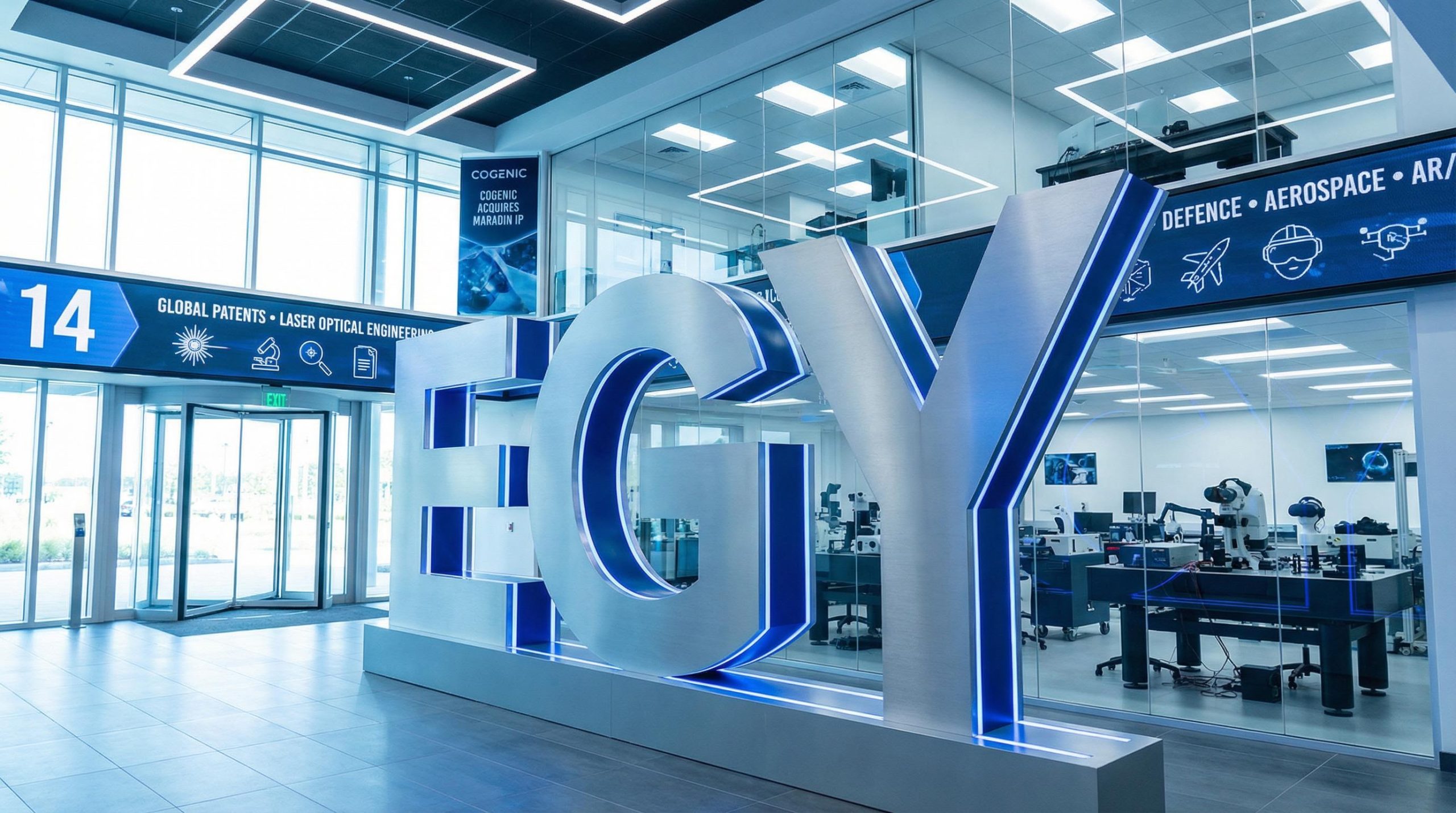
Cogenic acquires Maradin’s laser optical engineering portfolio
Energy Technologies (ASX: EGY) has announced the acquisition of Maradin Limited’s Laser Optical Engineering IP Portfolio through its wholly owned subsidiary Cogenic Pty Limited. The transaction positions Cogenic as a late-stage prototype-ready developer rather than an early-stage research operation, potentially accelerating the path to commercialisation across defence, aerospace, and extended reality markets.
The acquisition delivers 14 global patents alongside Maradin’s complete development and technical team, which will be retained and reorganised under Cogenic. Matan Naftali, Maradin’s CEO, will continue leading the development efforts. The deal follows 12 months of due diligence and establishes Cogenic’s entry into full laser projection optical engineering with both ultra-near eye display and direct retina display capabilities.
For investors, this strategic move inserts the company at an advanced development stage with established intellectual property and technical expertise already in place. Rather than building from scratch, Cogenic inherits prototype-ready technology targeting high-value sectors including defence systems, aerospace applications, Virtual Reality (VR), Augmented Reality (AR), Extended Reality (XR), and lifestyle products.
When big ASX news breaks, our subscribers know first
What is Laser Beam Scanning technology?
The acquired technology centres on Laser Beam Scanning (LBS) using Micro-Electro-Mechanical Systems (MEMS), which enables large scanning angles with precise control. This system projects laser-generated images onto surfaces, with the key differentiator being the “focus-free” nature of laser projection.
Unlike conventional display technologies, focus-free lasers can project images from acute angles and onto non-flat surfaces without losing sharpness. This creates flexibility in how and where images can be displayed, from curved windscreens in aircraft cockpits to the irregular surfaces inside smart glasses.
Core technology benefits for commercial deployment:
- Surface flexibility: Images maintain sharpness on curved, angled, or irregular surfaces
- Projection angles: Systems can project from acute angles without image distortion
- Character complexity: Technology supports complex characters and infinite location possibilities
- Dual display methods: Enables both ultra-near eye and direct retina display configurations
These technical capabilities translate into practical applications across multiple sectors. Defence heads-up displays can project onto curved helmet visors, AR headsets can deliver images directly to the eye from compact form factors, and aerospace systems can integrate displays into existing cockpit geometries without requiring flat screens.
Target markets and commercial applications
Cogenic has identified six primary market verticals for the technology: Defence, Aerospace, VR, AR, Extended Reality (XR), and Lifestyle. Each sector presents distinct use cases that leverage the focus-free projection and compact MEMS scanning systems.
The technology supports two display delivery methods. Ultra-near eye display positions projection systems extremely close to the user’s eye, suitable for smart glasses and consumer AR headsets. Direct retina display projects images directly onto the retina itself, offering applications in high-precision defence and aerospace systems where clarity and minimal hardware footprint are critical.
| Target Market | Display Type | Example Applications | Development Stage |
|---|---|---|---|
| Defence | Direct retina | Heads-up displays, helmet systems | Late-stage prototype |
| Aerospace | Ultra-near eye | Cockpit systems, pilot displays | Late-stage prototype |
| VR/AR/XR | Both | Consumer headsets, training systems | Late-stage prototype |
| Lifestyle | Ultra-near eye | Smart glasses, wearables | Late-stage prototype |
The late-stage prototype status across all target markets indicates the technology has progressed beyond theoretical research. For investors, this suggests reduced technical risk compared to early-stage R&D, though commercialisation pathways and revenue timelines remain to be established as Cogenic integrates the team and IP portfolio.
Acquisition funding and payment structure
The total acquisition cost is approximately $953,872 AUD, funded from existing facilities without requiring a capital raise or shareholder dilution. The payment structure spreads costs across 18 months through four tranches.
Payment schedule:
- Tranche 1: ~$192,200 AUD within 14 days of announcement
- Tranche 2: ~$213,500 AUD at 6 months from first settlement
- Tranche 3: ~$213,500 AUD at 12 months from first settlement
- Tranche 4: ~$334,500 AUD at 18 months from first settlement
All figures are calculated using an exchange rate of AUD/USD = 0.7024.
The staged payment structure preserves near-term cash reserves whilst spreading acquisition costs over time. Funding from current facilities avoids the dilutive impact of an equity raise, maintaining existing shareholder positions. For a company in Energy Technologies’ market capitalisation range, the staggered payment approach balances acquisition execution with working capital management.
The 18-month payment timeline also aligns with typical technology integration and team reorganisation periods. This structure allows Cogenic to bring the development team online, validate the technology roadmap, and establish commercialisation pathways before final payment tranches fall due.
Development team and path to commercialisation
Cogenic will retain Maradin’s complete development and technical team, reorganising them under the Cogenic structure. Matan Naftali, who served as Maradin’s CEO, will continue leading the team through the technology progression phase.
The retention of the original development team reduces execution risk inherent in technology acquisitions. The team holds institutional knowledge of the IP portfolio, existing prototype systems, and the technical challenges already overcome during development. This continuity avoids the knowledge loss and restart delays that can occur when acquirers attempt to rebuild technical capabilities from scratch.
Upon completion of the reorganisation, Cogenic will hold 14 global patents alongside the fully operational team required to drive commercialisation. The company noted the acquisition followed 12 months of due diligence, suggesting management conducted thorough technical and commercial risk assessment before committing capital.
Next steps for Cogenic
Cogenic will now coordinate the team reorganisation and appointment process to integrate Maradin’s development capabilities. The subsidiary aims to continue the IP portfolio’s progression towards commercial applications across the identified target markets.
The 12-month due diligence period that preceded the acquisition indicates management assessed technical viability, patent strength, market opportunity, and team capability before proceeding. For investors evaluating the acquisition, this extended assessment period suggests a measured approach to technology acquisitions rather than opportunistic deal-making.
The focus now shifts to execution: integrating the team, validating commercialisation pathways in target markets, and establishing partnerships or customer relationships that can translate prototype-stage technology into revenue-generating products across defence, aerospace, and consumer technology sectors.
Want the Next Tech Breakthrough in Your Inbox?
Join 20,000+ investors receiving FREE ASX tech alerts within minutes of release, complete with expert analysis. Big News Blast delivers breaking news and in-depth coverage the moment market-moving announcements hit. Click the “Free Alerts” button to stay ahead on tech sector developments.