

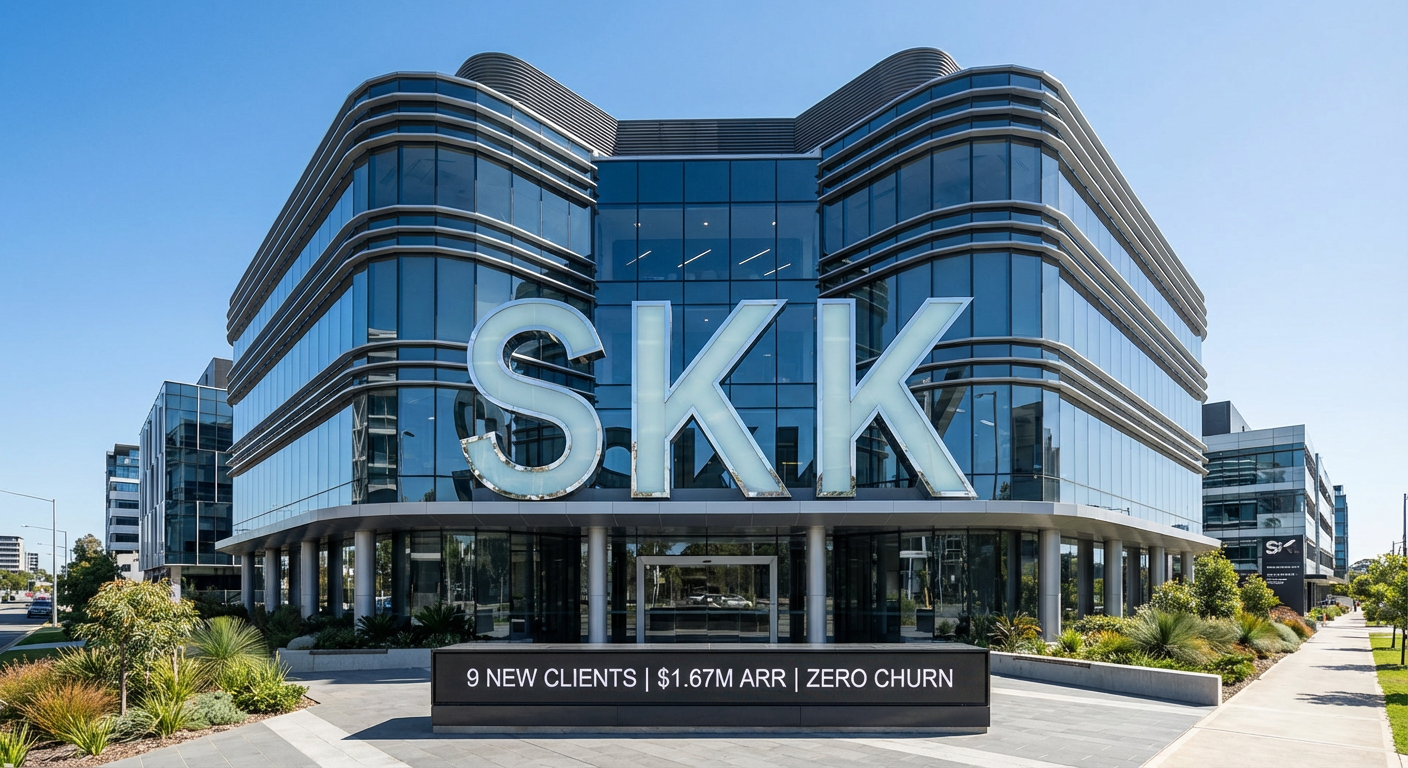
Stakk secures nine institutional clients in February, adding $1.67m annualised revenue
Stakk Ltd (ASX: SKK) has secured nine institutional clients in February 2026, adding $1.67 million in annualised run-rate revenue (ARR) upon go-live. The contracts, signed across U.S. and Australian regulated markets, represent $140,000 in monthly recurring revenue (MRR) when fully activated. Go-live is scheduled between now and the end of May, with June marking the first full month reflecting aggregate MRR across all nine clients.
The client wins span traditional banks, neo-banks, regulated enterprise networks, and mobile-first platforms. Each institution is contracted under Stakk’s standard Master Services Agreement, with revenue commencing upon activation and billed monthly in arrears. This performance builds on momentum from January and reflects sustained institutional demand in regulated financial services markets.
For investors, the Stakk February revenue growth provides contracted visibility into Q3 FY26 performance. The staggered go-live schedule across the next three months creates a predictable activation timeline, with revenue recognition beginning upon each client’s platform launch. June’s full-month MRR figure will establish a new baseline for recurring revenue assessment.
Financial snapshot: balance sheet and margin profile
Stakk’s announcement confirms continued execution discipline across operational and financial metrics. The company maintains gross margins between 75% and 82% on a quarterly basis, fluctuating depending on solution mix and delivery costs. Over the past 36 months, Stakk has recorded zero customer churn, indicating strong revenue durability and client retention.
| Metric | Value | Context |
|---|---|---|
| Cash position | $15.09m | Exceeds working capital requirements |
| Net assets | $26.65m | Strongest in company history |
| Gross margins | 75–82% | Maintained quarterly |
| Customer churn | Zero | Last 36 months |
As at 31 December 2025, Stakk’s ARR run-rate stood at $8.53 million. The company reported a normalised EBITDA loss of $365,110 for H1 FY26. During calendar year 2025, revenue growth represented a compound quarterly growth rate (CQGR) of 222%. Client concentration remains controlled, with one client representing greater than 10% but less than 20% of revenue, while all other clients contribute less than 10% individually.
The balance sheet position provides strategic optionality for both organic growth investment and potential acquisition activity. Cash reserves materially exceed working capital requirements, while net assets have reached their highest level in the company’s operating history. This financial foundation supports management’s stated intention to progress a disciplined acquisition pipeline alongside organic client wins.
When big ASX news breaks, our subscribers know first
What makes AI-native architecture different from retrofitted solutions
Stakk’s platform was engineered around artificial intelligence and machine learning from inception, distinguishing it from competitors who added AI capabilities to existing legacy systems. The difference resembles building a house with plumbing designed into the original blueprint versus installing pipes in an already-constructed building. The former approach creates structural integration, while the latter produces workarounds and limitations.
For institutional buyers evaluating vendor solutions, this architectural distinction affects four critical selection criteria: accuracy, speed, explainability, and operational resilience. Regulated environments require auditable decision trails, real-time processing capability, and reliable performance under scale. Systems retrofitted with AI often struggle to meet these requirements because their underlying infrastructure was designed for manual workflows and static processes.
Stakk’s core AI/ML capabilities include:
- Signal capture at source – Data collection occurs at the point of transaction initiation, ensuring high-integrity inputs
- Real-time ML model application – Purpose-built machine learning models process information as it enters the system
- Document classification – Automated categorisation and validation of submitted documentation
- Fraud scoring – Risk assessment algorithms evaluate transaction patterns and user behaviour
- Explainable decisioning – Audit trails document the logic path for each automated decision, meeting regulatory requirements
The company states it has displaced incumbent vendors in several of the February client wins. These legacy platforms were designed for static workflows requiring manual intervention rather than autonomous, ML-driven environments. Stakk captures high-integrity signals at source, applies purpose-built ML models in real time, and delivers auditable decisions inside regulated workflows. This structural differentiation creates a competitive moat that legacy vendors cannot easily replicate through incremental software updates.
Workflow integration creates switching costs
Once Stakk’s platform becomes embedded within institutional systems, displacement becomes operationally complex. Integration touchpoints extend across client servers, regulatory approval processes, mobile SDKs in production applications, and internal operational, escalation, and compliance workflows. Each integration layer adds technical and procedural dependencies that make migration to alternative vendors economically unattractive.
This integration depth reinforces the company’s zero-churn record over the past 36 months. Revenue durability stems not solely from contractual terms but from the operational disruption required to extract and replace the platform once it becomes embedded in production environments. For investors assessing Stakk February revenue growth, this stickiness factor provides confidence in the durability of the $1.67 million ARR addition beyond initial contract periods.
Path to profitability: management’s NPAT target
Stakk currently generates negative net profit after tax (NPAT), consistent with its growth-stage SaaS business model. Management has stated the company is targeting a run-rate of approximately 5% of ARR by the end of calendar year 2026, reflecting improving scale economics and operating leverage as the revenue base expands.
The H1 FY26 normalised EBITDA loss of $365,110 represents the current loss trajectory. As ARR grows from the $8.53 million run-rate recorded at 31 December 2025, fixed operating costs become distributed across a larger revenue base. The addition of $1.67 million in ARR from February’s client wins, combined with anticipated future client additions, creates the scale dynamics required to reach management’s profitability target.
The mechanics depend on gross margin maintenance and controlled operating expense growth. With gross margins consistently ranging between 75% and 82%, the company retains substantial contribution margin from each revenue dollar. As this contribution margin pool expands through ARR growth, it absorbs fixed costs and moves the business toward positive NPAT. Investors should monitor Q3 FY26 and H2 FY26 results for progress against the stated 5% NPAT/ARR target.
Expansion beyond financial services
While Stakk’s current client base concentrates in financial services, the platform’s AI-native architecture is portable to adjacent verticals requiring real-time identity, entitlement, fraud, and compliance decisions. Target sectors include:
- Lending
- Payments
- Telecommunications onboarding
- Marketplace verification
- Travel credential validation
- Employment workflows
These markets collectively represent an expanded total addressable market (TAM) beyond the company’s current financial services concentration. For investors, this portability reduces single-sector risk over time and provides optionality for revenue diversification as the platform matures. The technical architecture’s applicability across high-trust digital environments creates multiple growth pathways without requiring fundamental platform redesign.
Executive commentary and strategic outlook
Andy Taylor, Executive Director
“We committed to disciplined growth and improving financial performance as we scale. February demonstrates both. Despite broader sector volatility and share price pressure across small-cap technology, our execution has remained consistent and customer adoption continues to accelerate. Our AI and ML architecture was built into the core of the platform from inception, and that design discipline is translating into durable institutional wins. In parallel, we are progressing a disciplined acquisition pipeline to complement organic growth, deepen proprietary capability, and enhance distribution where it strengthens intrinsic value.”
Management’s commentary frames February’s performance as counter-narrative to broader technology sector weakness affecting small-cap stocks. While the SaaS sector has experienced re-rating and share price pressure, Stakk’s client acquisition velocity has accelerated and financial discipline has strengthened. The reference to a “disciplined acquisition pipeline” signals potential inorganic growth activity, with the company’s $15.09 million cash position providing capacity for strategic transactions.
The balance sheet strength creates optionality for management to pursue either organic growth investment or complementary acquisitions that deepen proprietary capability or enhance distribution channels. Investors gain visibility into management’s dual-path approach: sustained organic client wins alongside selective M&A opportunities that meet intrinsic value criteria.
What to watch next
Key catalysts for Stakk (ASX: SKK) include:
- Go-live activations scheduled through May 2026
- June 2026 as the first full MRR month across all nine February client wins
- Progress toward the NPAT profitability target of approximately 5% of ARR by CY26 year-end
- Updates on the acquisition pipeline referenced by management
The staggered go-live timeline provides multiple near-term milestones for revenue recognition confirmation. June’s full-month MRR figure will establish whether the $140,000 aggregate target materialises as projected. Subsequent quarterly reports will reveal whether the profitability trajectory aligns with management’s stated calendar year 2026 target.
Get Tech News Before the Market Moves
Join 20,000+ investors receiving FREE breaking ASX technology news within minutes of release, complete with in-depth analysis. The Big News Blast delivers real-time alerts straight to your inbox the moment market-moving announcements drop. Click the “Free Alerts” button to start receiving expert coverage before the crowd reacts.