
ImpediMed expands beyond oncology as H1 revenue climbs to $7.5 million
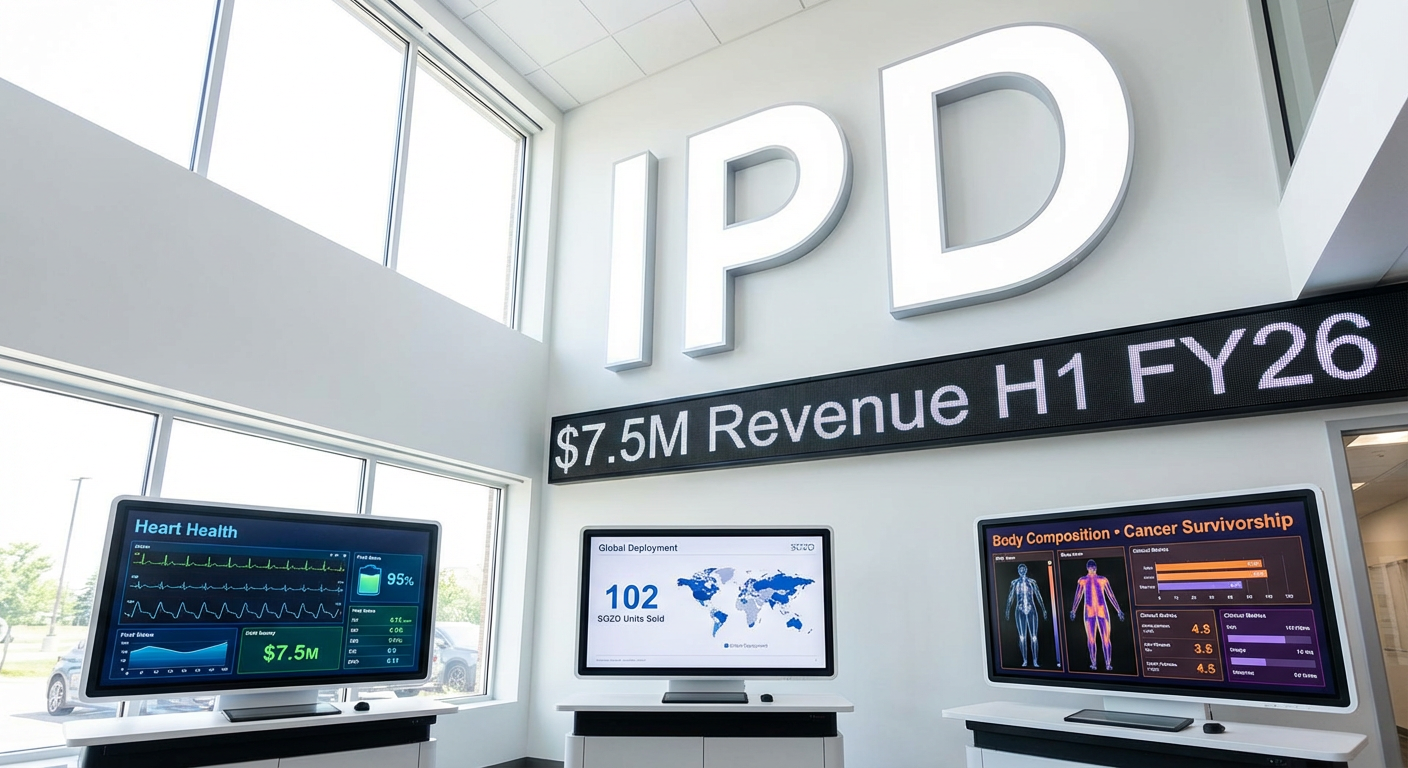
ImpediMed Limited (ASX: IPD) has delivered $7.5 million in revenue for H1 FY26 alongside a pivotal strategic expansion that positions the biotech as a multi-market platform company. The period saw 102 SOZO units sold globally—up 22 units compared to 2H FY25—whilst management launched dedicated Heart Health and Body Composition teams in Q2 FY26 to target two large adjacent markets. The company achieved >93% payor coverage in Q2 FY26, a critical commercial milestone that unlocks the growth runway for its established oncology survivorship business whilst providing infrastructure for capital-light expansion into heart failure monitoring and weight management.
The ImpediMed FY26 H1 Results demonstrate the company’s ability to leverage its existing oncology infrastructure to enter two structural growth markets with minimal incremental capital. Annual recurring revenue reached $14.4 million, with total contract value of $8.7 million and a cash balance of $18.8 million, equating to 6.5 quarters of operating cash flow. SOZO unit sales comprised 45 units in the US and 57 units in rest of world, with US contract renewals commanding an average 10% price increase—evidence of pricing power in the established oncology market. Operating cash outflow was $8.5 million for the half, with Q2 alone at $2.9 million, whilst the company received a $1.2 million R&D tax incentive in Q2.
Financial snapshot
| Metric | 1H FY26 | 2H FY25 | 1H FY25 |
|---|---|---|---|
| Revenue | $7.5M | Not disclosed | Not disclosed |
| SOZO Units Sold | 102 | 80 | 77 |
| Annual Recurring Revenue | $14.4M | Not disclosed | Not disclosed |
| Cash Balance | $18.8M | Not disclosed | Not disclosed |
| Gross Margin | 87% | Not disclosed | Not disclosed |
The unit sales trajectory shows consistent acceleration, with 1H FY26 volumes up 25 units year-on-year and 22 units half-on-half. The 10% average price increase on renewed US contracts reflects strengthening market position, whilst the 87% gross margin demonstrates the high-margin nature of the SOZO platform business model. Total contract value reached $8.7 million, supporting the $14.4 million annual recurring revenue base that provides revenue visibility for the platform expansion strategy.
When big ASX news breaks, our subscribers know first
What is bioimpedance spectroscopy and why does it matter for investors?
Bioimpedance spectroscopy (BIS) is a non-invasive measurement technology that assesses fluid levels and body composition by sending low-level electrical signals through the body. SOZO devices measure these signals in approximately 30 seconds to provide detailed analysis of fluid distribution, muscle mass, and fat composition.
The technology addresses clinical needs across multiple settings. In cancer survivorship, it detects lymphedema by identifying fluid accumulation in limbs. In heart failure management, it monitors fluid overload that can trigger hospitalisations. In weight management, it tracks muscle versus fat mass during weight loss programmes, particularly for patients on GLP-1 medications where skeletal muscle preservation is critical.
ImpediMed’s competitive position rests on FDA clearances across these indications and proprietary scoring algorithms. The L-Dex score measures lymphedema risk, HF-Dex assesses heart failure fluid status, and Hy-Dex evaluates hydration levels. These algorithms convert raw bioimpedance data into clinical decision tools, creating a regulatory and intellectual property moat that would require years for competitors to replicate.
SOZO is a platform technology rather than a single-use device. This allows expansion into adjacent markets without requiring entirely new regulatory pathways or significant R&D investment—the company holds existing FDA clearances and leverages the same hardware across indications, with software updates enabling new clinical applications.
Three markets, one platform: ImpediMed’s growth strategy
ImpediMed is pursuing a phased expansion strategy across three market segments, each with distinct market dynamics and adoption timelines:
-
BCRL and Cancer Survivorship (Established): The core market with $400 million TAM, 172 of top 500 US cancer centres as customers, and 17 of 20 top IDNs by patient revenue with SOZO installed. Pipeline growth of 141% since 1H FY24 to 708 devices, with 300 devices in active proposals.
-
Heart Health (Newly Launched): A $1.1 billion TAM addressing 6.7 million US heart failure patients. Dedicated team launched Q2 FY26, targeting Texas and New York initially. CMS 2027 monitoring mandate provides regulatory tailwind. First sale already completed within existing IDN customer base.
-
Weight Management (Newly Launched): A $425 million TAM serving 15+ million US patients on GLP-1 medications (projected 30% CAGR FY23–FY29). Three major 2025 guidelines now recommend bioimpedance for body composition assessment. Approximately 3,700 leads in pipeline across primary care and lifestyle medicine practices.
Cancer survivorship remains the growth engine
The oncology survivorship business provides both revenue foundation and expansion infrastructure for adjacent markets. 172 of the top 500 US cancer centres are now customers, including 24 of 33 NCCN centres and 17 of 20 top IDNs by patient revenue. The >93% payor coverage milestone achieved in Q2 FY26 removes a critical adoption barrier, with pipeline growth demonstrating market response—the 708 devices in pipeline represents 141% growth from 1H FY24, whilst 300 devices sit in active proposals.
The installed base expansion opportunity remains substantial. Current deployment represents only 10% of eligible breast cancer sites of care, with approximately 6,000 eligible locations identified versus ~600 installed devices. Within existing customer networks alone, management has identified approximately 250 devices of upside opportunity through land-and-expand strategies. Major academic medical centres such as Cleveland Clinic have expanded from initial 2-device placements to 11 devices across 8 sites, demonstrating the multi-site adoption model. Regional IDN health systems such as KU Health have achieved 12x increases in device count through system-wide protocol mandates, whilst NCCN member centres collectively represent 88 devices across 24 network sites with standardised protocols.
The business development approach has shifted to emphasise customer economics and ROI, which management expects to increase conversion rates. The company plans attendance at 19 conferences in H2 FY26, comprising 10 BCRL-focused, 6 body composition, and 3 heart failure events. The ~6-month hospital sales cycle creates a lag between increased payor coverage and site adoption, positioning H2 FY26 as a critical period for pipeline conversion.
Heart health market entry underway
The heart health opportunity addresses an urgent clinical and economic need. 6.7 million US patients currently have heart failure, with approximately 1 million new diagnoses annually and projected US costs of $70 billion by 2030. Congestion-driven hospitalisations cost approximately $30,000 per patient annually, with 29.8% readmitted within 30 days. ImpediMed’s HF-Dex score identifies patients carrying 4.25x higher 30-day readmission risk compared to clinical judgement alone.
The commercial execution model launched in Q2 FY26 with a dedicated team targeting Texas and New York as initial launch states, selected for high SOZO penetration and favourable reimbursement. The economic proposition for cardiology practices shows <3 month payback period and 2–6x three-year ROI, with annual clinic revenue potential of $30,000–$90,000 depending on utilisation and setting. Medicare covers 73–78% of heart failure patients, providing a clear reimbursement pathway, whilst the CMS 2027 monitoring mandate creates regulatory tailwind for adoption.
The capital-light expansion model is critical to investor understanding of this opportunity. Master Service Agreements (MSAs), IT security approvals, Business Associate Agreements (BAAs), and procurement processes are already completed through existing BCRL relationships across 17 of 20 top IDNs. This removes 6–12 month legal and IT security cycles, converting market entry into primarily a clinical and commercial conversation. Approximately 325 heart failure clinics exist across these 17 IDNs with SOZO already installed, whilst the first sale has already been completed within an existing IDN customer. The company has hired two dedicated representatives to execute the heart health expansion.
Weight management rides the GLP-1 tailwind
The weight management market expansion capitalises on structural growth in GLP-1 adoption, with 15+ million US patients currently on GLP-1 medications and 30% CAGR projected FY23–FY29. Clinical data demonstrates 25–40% skeletal muscle mass loss per kilogram of weight lost on GLP-1 therapy, creating demand for objective body composition monitoring to prevent sarcopenia and bone density reduction.
Guideline support for bioimpedance monitoring strengthened significantly in 2025. The WHO GLP-1 Guideline (December 2025) recommends personalised periodic monitoring of treatment response. The Lancet Diabetes & Endocrinology Commission (January 2025) endorsed by 75+ organisations states BMI alone is insufficient and recommends direct body fat measurement including bioimpedance. The joint advisory from The Obesity Society, American Society for Nutrition, and American College of Lifestyle Medicine (May 2025) explicitly recommends validated tools such as bioimpedance for baseline and serial tracking of lean body mass.
The cross-sell opportunity is substantial. Approximately 80% of GLP-1 prescriptions originate in primary care and lifestyle medicine settings, whilst ~3,000 primary care and lifestyle medicine sites already exist within the 17 IDNs with SOZO installed for BCRL monitoring. The pipeline includes approximately 3,700 leads, positioning body composition as a high-leverage expansion with minimal customer acquisition cost. The cardiometabolic crossover further expands addressable market, with 70–80% of US heart failure patients obese or overweight, whilst certain GLP-1s are now FDA-approved for cardiovascular risk reduction in obese/overweight adults.
Outlook and what to watch in H2 FY26
Management has outlined clear priorities for H2 FY26 centred on executing the multi-market expansion whilst maintaining financial discipline. The company aims to drive continued SOZO unit sales and annual recurring revenue growth in oncology survivorship, accelerate heart health market entry with targeted sales and clinical pilots, and launch body composition solutions into wellness and weight management markets. The expanded Board expertise, including Mr Anderson’s cancer survivorship, body composition, and US commercial background, provides additional strategic capability to support execution.
Capital management remains central to the outlook, with investment prioritised toward revenue-generating activities and commercial milestones. Heart Health and Body Composition expansions are described as capital-light opportunities that benefit from existing infrastructure, avoiding the need for substantial incremental investment. The $18.8 million cash balance provides 6.5 quarters of operating cash flow runway at current burn rates, whilst the focus on disciplined cost base management aims to extend this runway as commercial momentum builds.
Management Commentary
“2H FY26 is expected to see strengthening commercial momentum across its core oncology survivorship business, and newly activated Heart Health and body composition market opportunities.”
The H2 period will provide the first full reporting period with dedicated heart health and body composition teams operational. Early commercial traction in these markets—measured by unit sales, customer pilots, and pipeline development—will serve as the critical proof point for the platform expansion thesis. Investors should monitor unit sales trajectory across all three segments, annual recurring revenue growth rate, and cash burn relative to revenue expansion. The >93% payor coverage milestone achieved in Q2 FY26 removes a historical adoption barrier for oncology, positioning conversion of the 708-device pipeline as a key metric. In heart health, initial customer adoption within existing IDN relationships will validate the capital-light expansion model, whilst body composition lead conversion from the ~3,700 pipeline will demonstrate cross-sell effectiveness.
Want the Next Healthcare Breakthrough in Your Inbox?
Join 20,000+ investors receiving FREE breaking ASX news within minutes of release, complete with in-depth analysis. Click the “Free Alerts” button at Big News Blast to get market-moving healthcare announcements delivered straight to your inbox the moment they break.