
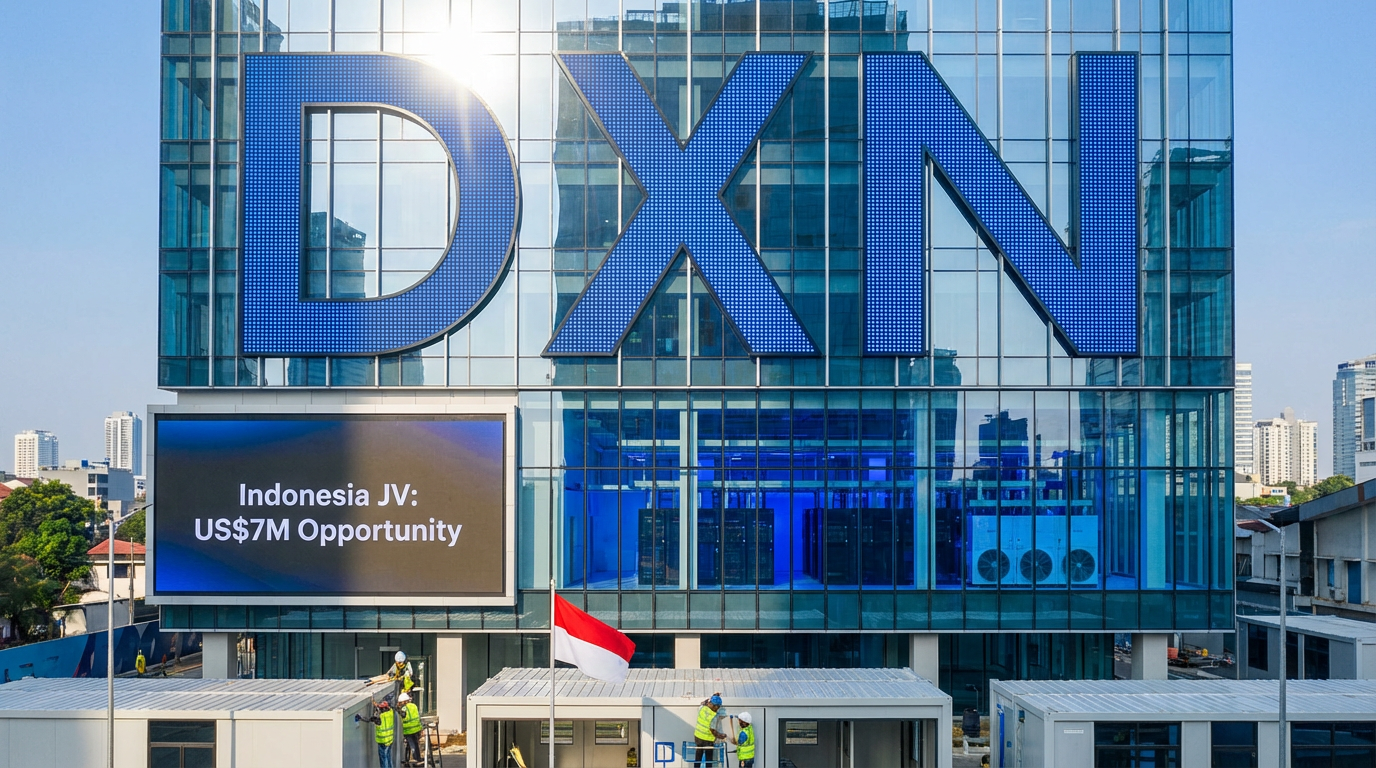
DXN secures $14.5 million backlog and Indonesia joint venture in 1HFY26
DXN Limited has reported its half-year results for the period ending 31 December 2025, revealing a $14.5 million total backlog despite revenue timing challenges. The DXN Indonesia Data Centre Expansion strategy took centre stage through a joint venture agreement targeting Southeast Asia’s fastest-growing digital infrastructure market.
Revenue declined 65% to $2.7 million in 1HFY26, impacted by customer-driven project deferrals rather than demand weakness. The modular backlog reached $10.1 million, supported by a pipeline of 80 identified projects.
The company held a cash position of $1.7 million as at 31 December 2025, expected to strengthen as milestone payments from contracted work flow through in the second half.
The strategic highlight centres on a Memorandum of Understanding with Super Sistem Indonesia (SSI) to establish local manufacturing capabilities in Jakarta, positioning (ASX: DXN) to capture Indonesia’s data centre capacity growth projected to expand from approximately 970 MW to 1,800 MW by 2028.
When big ASX news breaks, our subscribers know first
What is modular data centre manufacturing?
Modular data centres are prefabricated facilities constructed in factory environments before transportation to site, enabling faster deployment than traditional construction methods. Components including power systems, cooling infrastructure, and server racks are integrated off-site, reducing on-site installation time and construction risk.
Traditional “stick-built” data centres require extended construction timelines with higher labour costs and greater exposure to weather delays and site-specific challenges. The modular approach allows parallel manufacturing and site preparation, compressing deployment schedules by months.
Key differences include:
- Construction speed: Modular facilities deploy in weeks versus months for traditional builds
- Quality control: Factory conditions ensure consistent build standards and testing protocols
- Scalability: Additional modules can be added incrementally as capacity requirements grow
- Capital efficiency: Lower upfront costs and faster revenue generation from operational facilities
For edge computing and AI infrastructure applications requiring rapid deployment near data sources, modular construction provides material advantages. Time-sensitive contracts in emerging markets favour suppliers capable of delivering operational capacity quickly.
Indonesia joint venture targets US$7 million opportunity
The joint venture with Super Sistem Indonesia establishes 50/50 ownership of a manufacturing entity focused on serving Indonesia’s expanding digital economy. The DXN Indonesia Data Centre Expansion includes plans for a Jakarta-based production facility designed to bypass import tariffs and comply with local data sovereignty regulations driving domestic infrastructure requirements.
Indonesia’s data centre market presents substantial growth potential as digital adoption accelerates across the archipelago. Localised manufacturing removes tariff barriers that can add 15-25% to imported equipment costs, improving DXN’s competitive positioning for government and enterprise contracts requiring local content compliance.
| Metric | Detail |
|---|---|
| JV Partner | Super Sistem Indonesia (SSI) |
| Ownership Structure | 50/50 Joint Venture |
| Revenue Opportunity | ~US$7 million (3 years) |
| Indonesia DC Growth | 970 MW → 1,800 MW by 2028 |
The structure enables capital-efficient market entry through SSI’s established customer relationships and regulatory knowledge, whilst DXN contributes manufacturing expertise and modular design capabilities. Initial orders from SSI are expected to seed the facility before expansion to additional customers across Indonesia’s enterprise and hyperscale segments.
First recurring DCaaS revenue marks strategic milestone
Data Centre as a Service (DCaaS) revenue commenced in 1HFY26 following completion of the company’s first operational site. Civil works, power infrastructure, and fibre installations reached practical completion, enabling service fee receipts to begin flowing.
Data Centre Operations generated approximately $1.3 million in revenue during the half, with DCaaS representing the establishment of recurring income streams alongside project-based modular sales. The capital-light model involves operating data centre facilities on behalf of customers who pay ongoing service fees rather than purchasing infrastructure outright.
Recurring revenue improves earnings predictability by reducing dependence on lumpy contract wins. As additional DCaaS sites reach operational status, this division is positioned to contribute stable cash flow supporting the company’s working capital requirements and growth investments.
Project pipeline provides 2HFY26 visibility
The 80-project pipeline spans multiple stages from initial identification through to verbal wins awaiting formal contract execution. Three projects currently sit in the Verbal Win/Contracting phase, indicating near-term backlog conversion potential.
Significant contracts secured during the half include a $1.8 million APTelecom project and a $1.4 million Edge Data Centre deployment, both scheduled for completion by June 2026. These contracts underpin second-half revenue expectations and demonstrate continued customer demand for modular infrastructure solutions.
Pipeline breakdown by stage:
- Identified: 27 projects (34%)
- Qualified: 28 projects (35%)
- Proposal or RFP Submitted: 18 projects (22%)
- Final Negotiations: 4 projects (5%)
- Verbal Win/Contracting: 3 projects (4%)
The weighting toward early-stage opportunities reflects active business development across target markets, whilst the progression of projects through qualification and proposal stages indicates healthy conversion funnel dynamics. The modular division supported approximately 50% of half-year revenue through progress on key projects including Globalstar and APTelecom.
The next major ASX story will hit our subscribers first
Management commentary
Managing Director Shalini Lagrutta emphasised the distinction between revenue timing and underlying demand strength, pointing to the substantial contracted backlog as evidence of market traction.
Shalini Lagrutta, Managing Director
“While project deferrals have delayed revenue recognition in the first half, our growing backlog of $14.5 million and expanding pipeline provide strong visibility for underlying demand. The JV with SSI is a transformative step in executing our Asia-Pacific strategy, unlocking access to one of Southeast Asia’s fastest-growing markets and establishing localised operations for sustainable growth. With new recurring DCaaS revenue now flowing and key projects advancing, we remain confident in delivering revenue growth this financial year.”
Outlook and catalysts
The company targets revenue growth in FY26, weighted toward 2HFY26 as the $14.5 million backlog converts to recognised revenue and new initiatives ramp operational capacity. Focus areas include mission-critical infrastructure, edge computing, AI applications, and hyperscale deployments across the Asia-Pacific region.
Key forward catalysts include:
- Backlog conversion: Second-half delivery of contracted projects totalling $14.5 million
- Indonesia JV execution: Establishment of Jakarta manufacturing facility and initial production runs
- DCaaS expansion: Additional sites reaching operational status and generating recurring fees
- Pipeline progression: Advancement of 3 verbal wins through formal contracting and 4 projects in final negotiations
- Regional expansion: Customer portfolio leverage across Singapore, Malaysia, and Indonesia markets
The modular and DCaaS divisions provide complementary growth drivers, with project-based revenue supporting near-term financial performance whilst recurring income builds longer-term earnings stability. Geographic expansion through the Indonesia joint venture diversifies revenue sources and positions the company to capture infrastructure investment across Southeast Asia’s rapidly digitising economies.
Want the Next Tech Breakthrough in Your Inbox?
Join 20,000+ investors receiving FREE breaking ASX news delivered within minutes of release, complete with in-depth analysis. Click the “Free Alerts” button at Big News Blast to get real-time coverage of market-moving announcements the moment they drop.