

RPM Automotive delivers EBITDA growth despite softer revenue conditions
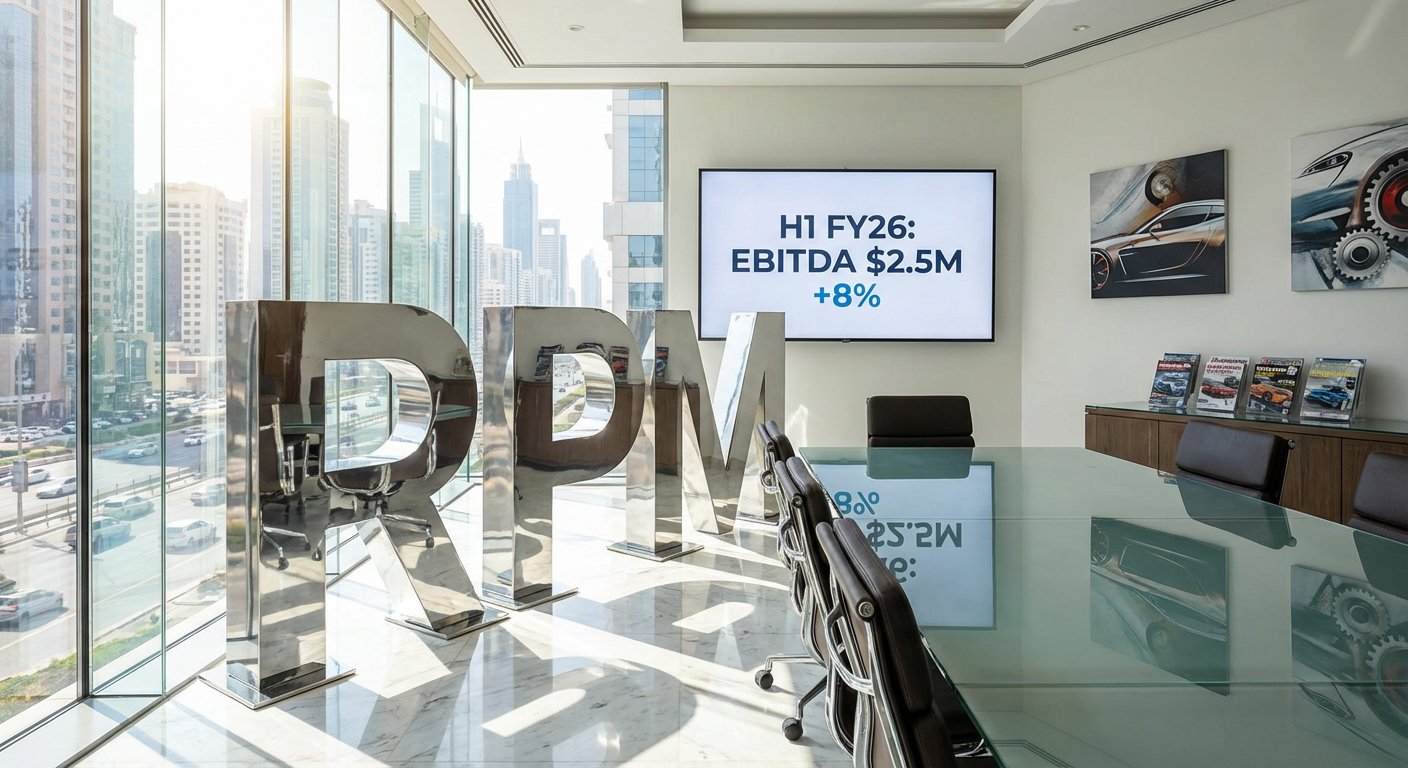
RPM Automotive Group Limited (ASX: RPM) has reported its H1 FY26 Results, showing earnings resilience despite challenging market conditions across its tyre operations. In its H1 FY26 results presentation, the company reported EBITDA of $2.5m, up 8% on the prior corresponding period (pcp), whilst revenue declined 10.9% to $53.5m. The EBITDA margin improved to 4.7% from 3.9% in the pcp, indicating stronger cost discipline and operational leverage even as top-line pressures mounted.
Revenue softness was attributed to weaker demand in Wholesale & Retail Tyres, alongside increased investment in growth initiatives. Gross profit came in at $18.5m, down 11.6% on pcp, with gross margin slipping marginally to 34.5% from 34.8%. Net profit before tax (NPBT) was -$1.1m, compared to $1.7m in the pcp, reflecting lower revenue and margin compression. Despite the subdued result, management confirmed the company remains within banking covenants and has the necessary funding to support working capital requirements and organic growth.
The company’s balance sheet showed cash of $3.9m and net debt of $28.0m, compared to $25.2m in the pcp. Borrowings reduced to $31.9m from $33.1m, whilst inventory was managed down to $23.4m from $24.8m, highlighting efforts to tighten working capital. Net assets increased to $56.6m from $54.9m, indicating financial stability underpinning the company’s position during the downturn.
When big ASX news breaks, our subscribers know first
How RPM’s four business segments performed
RPM Automotive operates across four distinct segments, each contributing differently to the H1 FY26 revenue mix. The diversified model provided stability despite macro headwinds affecting the broader tyre industry.
Repairs & Roadside proved resilient, accounting for 37% of H1 FY26 revenue. This segment, which includes commercial tyre and auto service centres, roadside assistance, and retail tyre sales, maintained stable demand despite challenging trading conditions.
Wheels & Tyres, the largest segment at 38% of revenue, faced weaker macro conditions. This wholesale division distributes in-house and commercial tyre brands across passenger, commercial, and industrial categories. Revenue declined as the tyre industry experienced broader softness, particularly in Victoria.
The Motorsport segment delivered growth during H1 FY26, contributing 9% of total revenue. RPM Racewear and exclusive distribution of certified race safety wear, suits, helmets, and brands including Bell, Simpson, Chillout, Alpinestars, Hans Devices, and Cobra drove performance in this niche category.
Performance & Accessories accounted for 16% of revenue but was lower due to a prior business divestment in H1 FY25. This segment supplies bolt-on vehicle parts, accessories, and best-in-class accessory brands to nationwide auto repair groups and national fleet customers.
| Segment | H1 FY26 Revenue Share | Performance Note |
|---|---|---|
| Wheels & Tyres | 38% | Challenging conditions |
| Repairs & Roadside | 37% | Resilient |
| Performance & Accessories | 16% | Impacted by divestment |
| Motorsport | 9% | Growth delivered |
The segment mix highlights RPM’s exposure to both wholesale and retail channels, with Motorsport and Repairs & Roadside offsetting weaker wholesale tyre demand.
Understanding the Australian tyre industry opportunity
The Australian tyre industry is valued at $6 billion and comprises three primary categories: Passenger, Truck & Bus, and Off-the-road (OTR). Annual consumption totals 563,000 tonnes, distributed across 227,600 tonnes for Passenger, 194,400 tonnes for Truck & Bus, and 141,000 tonnes for OTR.
Tyre recycling represents a significant opportunity within this market. Australia generates 330,300 tonnes of tyre waste annually, yet 459,000 tonnes are recovered, indicating a substantial gap between waste produced and materials successfully recycled. Passenger tyres account for 169,800 tonnes of waste generated and 187,600 tonnes recovered. Truck & Bus tyres generate 113,600 tonnes of waste with 157,800 tonnes recovered. OTR tyres contribute 146,300 tonnes of waste generated, with only 14,200 tonnes recovered, highlighting the environmental challenge across the sector.
RPM views this as a “once in a generation” consolidation opportunity. The company’s competitive advantage lies in its reverse logistics capabilities, which enable efficient collection and processing of end-of-life tyres across its national distribution network. Management believes the industry’s fragmented structure and growing environmental focus position RPM to capture value across the full tyre lifecycle.
The company has been actively investing in forward integration of tyre recycling, aiming to address the environmental problem whilst unlocking medium-to-long-term commercial value. This strategic imperative complements RPM’s existing platform and positions the business to capture adjacent growth opportunities as the sector consolidates.
Balance sheet remains stable with moderate debt levels
RPM Automotive maintained a stable balance sheet position during H1 FY26. Cash holdings were $3.9m as at December 2025, down from $7.7m in the pcp. Net debt increased to $28.0m from $25.2m, reflecting working capital movements and ongoing investment in growth initiatives.
Borrowings reduced to $31.9m from $33.1m in the pcp, whilst inventory was managed down to $23.4m from $24.8m, indicating tighter working capital discipline. Net assets increased to $56.6m from $54.9m, supporting the company’s financial position. Management confirmed RPM remains within banking covenants, with funding in place to cover working capital requirements and further organic growth.
Strategic outlook and path to improved H2 performance
Management has outlined clear priorities for stabilising performance and positioning RPM Automotive for improved results in H2 FY26. Key focus areas include:
- Stabilising Wholesale & Retail Tyres profitability
- Improving cash generation and free cash flow
- Reducing gearing levels
- Pursuing non-core asset divestments
- Investing in tyre recycling and geographic expansion
The divestment of non-core assets remains a Board priority, with strategic options currently under review. Management continues to pursue ways to unlock value across the Tyre business, whilst allocating capital to initiatives with medium-to-long-term growth potential.
Management Outlook
“Given the macroeconomic conditions and the changes made in H1 FY26, we anticipate an improved result in H2 FY26.”
Active investments in strategic imperatives continue, particularly the forward integration of tyre collections and recycling, alongside geographic platform expansion and product range extension. Management acknowledged that the return on investment from tyre recycling has been slower than expected, but remains committed to unlocking value over the medium to long term.
For investors, the focus remains on whether RPM can stabilise divisional profitability whilst maintaining financial discipline. The company’s diversified segment exposure and recycling initiative provide strategic optionality, though near-term performance will depend on macro conditions in the wholesale tyre market improving.
Get Consumer Discretionary Alerts Before the Market Moves
Join 20,000+ investors receiving FREE breaking ASX news within minutes of release, complete with in-depth analysis. Click the “Free Alerts” button at Big News Blast to start getting real-time alerts the moment market-moving announcements hit the wire.