

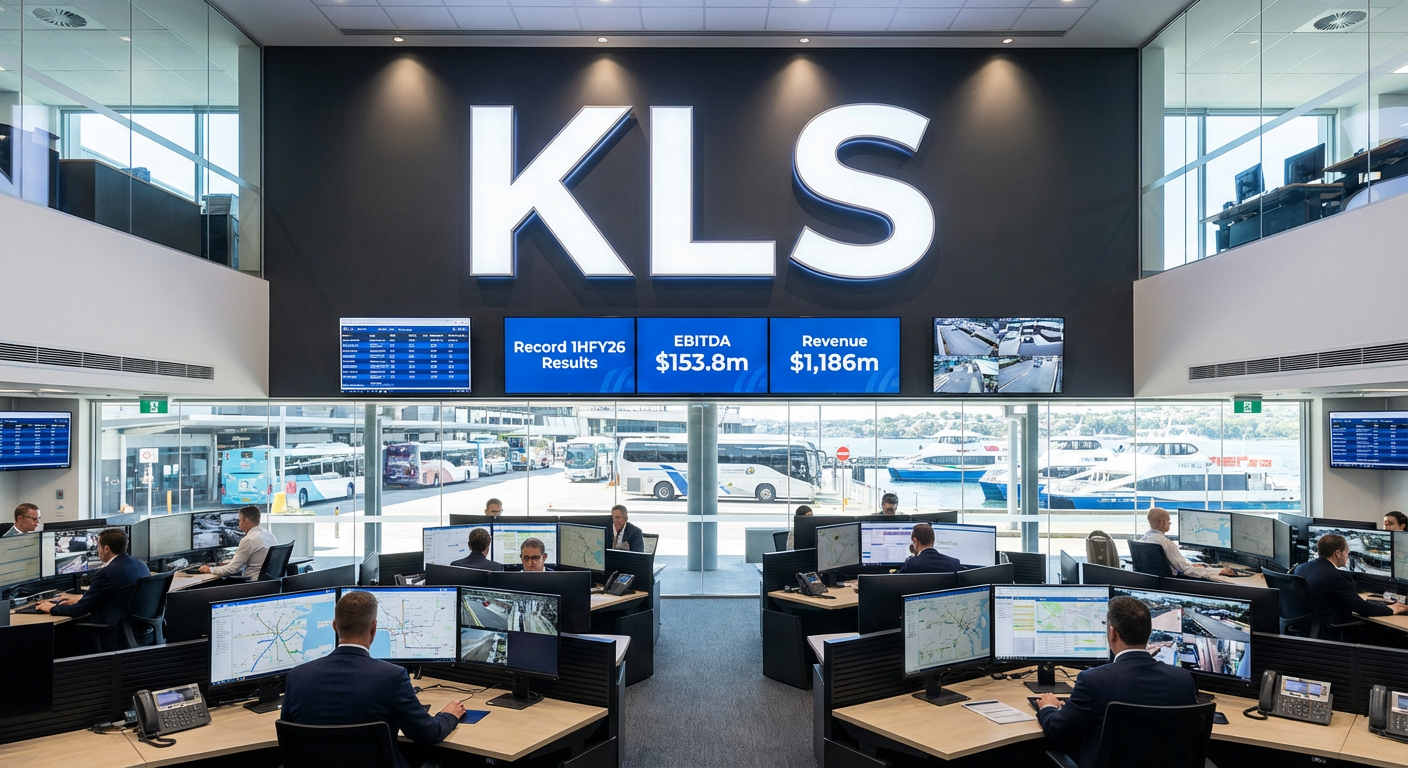
Kelsian delivers record first-half result as earnings guidance lifted
Kelsian Group has reported its strongest first-half performance on record, with underlying earnings before interest, tax, depreciation and amortisation (EBITDA) climbing 16.4% to $153.8m for the six months ending 31 December 2025. The global transport operator, which provides bus, motorcoach and marine services across four continents, upgraded its full-year earnings guidance following the result and entered binding agreements to divest its Tourism Portfolio for $161m.
Revenue increased 10.6% to $1,186m, driven by contract growth, cost indexation and strong performance across all three operating divisions. Underlying net profit after tax and before amortisation (NPATA) surged 32.2% to $52.5m, while statutory net profit after tax rose 61.6% to $32.4m. Management lifted FY26 underlying EBITDA guidance to a range of $303m to $312m, up from the previous $297m to $310m forecast.
The result demonstrates operational momentum across Kelsian’s diversified contract base, with approximately 93% of 1HFY26 revenue contracted or non-discretionary in nature. Net operating cash flow strengthened 26.1% to $83.1m, reflecting cash conversion of 94.5%.
When big ASX news breaks, our subscribers know first
What is underlying EBITDA and why does it matter for transport stocks?
Underlying EBITDA measures earnings before interest, tax, depreciation and amortisation, adjusted for one-off items such as acquisition costs, transaction related costs and group systems costs. This metric strips out non-cash expenses like depreciation and one-time events to show the core operational profitability of a business.
For transport operators like Kelsian, underlying EBITDA provides investors with a clearer view of whether revenue growth is translating into genuine profit improvement. The 16.4% increase in 1HFY26 underlying EBITDA demonstrates operating leverage, as scale benefits from contract growth and disciplined cost control converted top-line expansion into meaningful margin improvement. The underlying EBITDA margin expanded from 12.3% in 1HFY25 to 13.0% in 1HFY26.
Divisional performance drives broad-based growth
Kelsian’s three operating divisions all delivered revenue and earnings growth, with International Bus emerging as the standout performer.
Australian Bus generated revenue of $595.8m, up 5.6%, with underlying earnings before interest and tax (EBIT) rising 2.0% to $37.3m. The division continued operating Bankstown rail replacement services for the full period and was awarded a new contract to deliver Ipswich and Logan bus services in Queensland. Margin performance was impacted by higher maintenance costs on an ageing diesel fleet, delayed depot electrification, and the sale-and-leaseback of Western Australian depots.
International Bus recorded the strongest growth, with revenue climbing 20.8% to $384.9m and underlying EBIT surging 130.4% to $29.3m. The USA motorcoach business delivered ahead of expectations as industrial client contracts ramped up faster than anticipated. Corporate and technology shuttle clients renewed and expanded multi-year agreements. In the UK, Kelsian acquired South Wales Transport ahead of regional bus franchising.
Marine & Tourism achieved revenue growth of 8.6% to $205.4m, with underlying EBIT up 15.7% to $29.9m. Dynamic pricing and yield management initiatives drove improved performance, while disciplined cost control offset higher repairs and maintenance costs from five-year vessel overhauls.
| Division | Revenue ($m) | Revenue Growth | Underlying EBIT Growth |
|---|---|---|---|
| Australian Bus | 595.8 | 5.6% | 2.0% |
| International Bus | 384.9 | 20.8% | 130.4% |
| Marine & Tourism | 205.4 | 8.6% | 15.7% |
The International Bus division now contributes meaningfully to group earnings, diversifying Kelsian’s geographic exposure and reducing reliance on Australian government contracts.
Tourism Portfolio divestment unlocks $161m
Kelsian entered binding sale agreements with Journey Beyond to divest its Tourism Portfolio for total cash consideration of $161m. Completion is subject to Australian Competition and Consumer Commission (ACCC), Foreign Investment Review Board (FIRB) and other conditions, with settlement expected in 1HFY27.
The Tourism Portfolio generated last twelve months (LTM) underlying EBITDA of $23.7m to 31 December 2025. Other identified tourism assets, including two properties, will be sold separately for expected additional proceeds of approximately $3m.
Management stated proceeds will be applied consistently with the Capital Management and Allocation Framework, including accelerating leverage reduction and funding targeted organic and inorganic growth. On a proforma basis for the twelve months to 31 December 2025, leverage post-divestment would fall within the target range.
The divestment simplifies the business model by focusing operations on transport services with infrastructure-like cash flow characteristics. Post-transaction, Kelsian will operate marine, bus and motorcoach services backed by long-term, low-risk, government and corporate contracts. This streamlined structure improves earnings predictability and reduces exposure to discretionary consumer spending in tourism.
Balance sheet strengthens as leverage falls to 2.7x
Kelsian’s leverage ratio improved from 3.2x at 31 December 2024 to 2.7x at 31 December 2025, measured as last twelve months underlying EBITDA (pre-AASB 16, excluding special purpose vehicle (SPV) earnings and indebtedness). The company remains on track to reach its target leverage range of 2.0x to 2.5x by 30 June 2026, assuming no divestment of the Tourism Portfolio and subject to no additional growth capital expenditure or decline in business performance.
Net debt stood at $664.9m, with cash reserves of $141.9m. The balance sheet features significant headroom in all bank covenants, with limited recourse ring-fenced SPV debt excluded from covenant calculations.
The SPV structure allows Kelsian to warehouse government-contracted bus assets on its balance sheet along with corresponding debt for the contract duration. Asset value and debt profiles are matched and amortised over contract terms, with assets and debt reverting to government if contracts are not renewed. This eliminates stranded asset risk and financial exposure. As at 31 December 2025, government-backed contracted assets financed in SPV structures totalled approximately $83.8m, with an additional $117.3m in contracted assets carrying vehicle termination payment obligations.
- Net debt: $664.9m
- Cash reserves: $141.9m
- Leverage: 2.7x (down from 3.2x at 31 December 2024)
- Net operating cash flow: $83.1m (up 26.1%)
- Cash conversion: 94.5%
Falling leverage combined with high cash conversion supports dividend sustainability and provides capacity for opportunistic growth investments. The strengthened balance sheet positions Kelsian to capitalise on its growth pipeline across multiple geographies and transport modes.
Capital allocation priorities remain disciplined
Kelsian’s Capital Management and Allocation Framework targets leverage of 2.0x to 2.5x LTM underlying EBITDA, retaining flexibility for attractive organic and inorganic growth opportunities. The company maintains a dividend payout ratio of 40% to 60% of underlying NPATA.
The board declared an interim dividend of 8.0 cents per share (fully franked), unchanged from 1HFY25. Earnings per share before amortisation (EPSA) increased 31.9% to 19.3 cents per share, demonstrating underlying earnings growth while maintaining dividend stability.
For strategic growth investments, management applies return on invested capital (ROIC) hurdles, requiring projects to deliver ROIC greater than pre-tax weighted average cost of capital (WACC) after three full years including synergies. The company targets group ROIC at least 200 basis points above pre-tax WACC over the medium term.
The unchanged dividend signals confidence in underlying earnings momentum, while the payout ratio allows retained earnings to fund both growth and deleveraging. Surplus cash flow beyond these priorities is returned to investors through special dividends, capital returns or buybacks.
Growth pipeline spans multiple geographies and transport modes
Kelsian has identified near-term and medium-term growth opportunities across all three operating divisions, offering multiple avenues for earnings expansion without excessive capital deployment.
Australian Bus opportunities:
- Region 6 contract extension negotiations on track (two-year extension from 1 July 2026)
- Western Sydney Airport bus services
- Queensland and Victoria market expansion
- Newcastle (NSW) and Wellington (NZ) capital-light organic growth opportunities
International Bus opportunities:
- USA industrial and corporate shuttle contract expansion
- Regional UK bus franchising (contracts for 10,000+ buses over three to five years)
- Singapore Serangoon Eunos Bus Package tender
- Targeted mergers and acquisitions and organic growth in existing geographies
Marine opportunities:
- Auckland Transport ferry contract
- Perth ferries (Transperth)
- Sydney Ferries
- Maximise returns from new, higher-capacity vessels
- Further yield management and asset utilisation initiatives
The contracted revenue base provides stability while the growth pipeline offers earnings expansion opportunities aligned with disciplined capital management targets. The company’s operational excellence record positions it to win contract renewals and extensions.
FY26 outlook points to continued momentum
Management confirmed January 2026 trading remained in line with expectations, with continued strong performance from International Bus. Ongoing ramp-up of industrial contracts in the USA includes two new leased depots opening in March 2026. Bankstown rail replacement services are expected to continue for the full period.
Kangaroo Island contract transition and mobilisation costs of approximately $4m will be incurred during 2HFY26. The company will focus on Sydney bus operational improvements and efficiencies, alongside the rollout of its new global finance and human resources platform. Near-term growth opportunities in the UK and New Zealand are being pursued, while preparations continue for the separation of the Tourism Portfolio from retained marine operations.
FY26 guidance and estimates:
- Underlying EBITDA: $303m to $312m (upgraded from $297m to $310m)
- Capital expenditure: approximately $135m
- Depreciation: approximately $129m (core assets ~$87m, right-of-use ~$33m, SPV ~$9m)
- Amortisation: approximately $32m
- Interest: approximately $59m (corporate facilities ~$46m, right-of-use ~$8m, SPV ~$5m)
- Effective tax rate: 22% to 25%
Upgraded guidance mid-year typically reflects genuine operational outperformance rather than conservative initial targets. The diversified contract base limits downside risk in the second half, with 93% of revenue contracted or non-discretionary. The guidance assumes no significant deterioration in operating environment and no material change to business structure or key input prices.
Want the Next Industrials Breakout in Your Inbox?
Join 20,000+ investors getting FREE breaking ASX news delivered within minutes of release, complete with in-depth analysis. Click the “Free Alerts” button at StockWire X to start receiving real-time alerts the moment market-moving announcements drop across Industrials, Tech, Healthcare and beyond.