
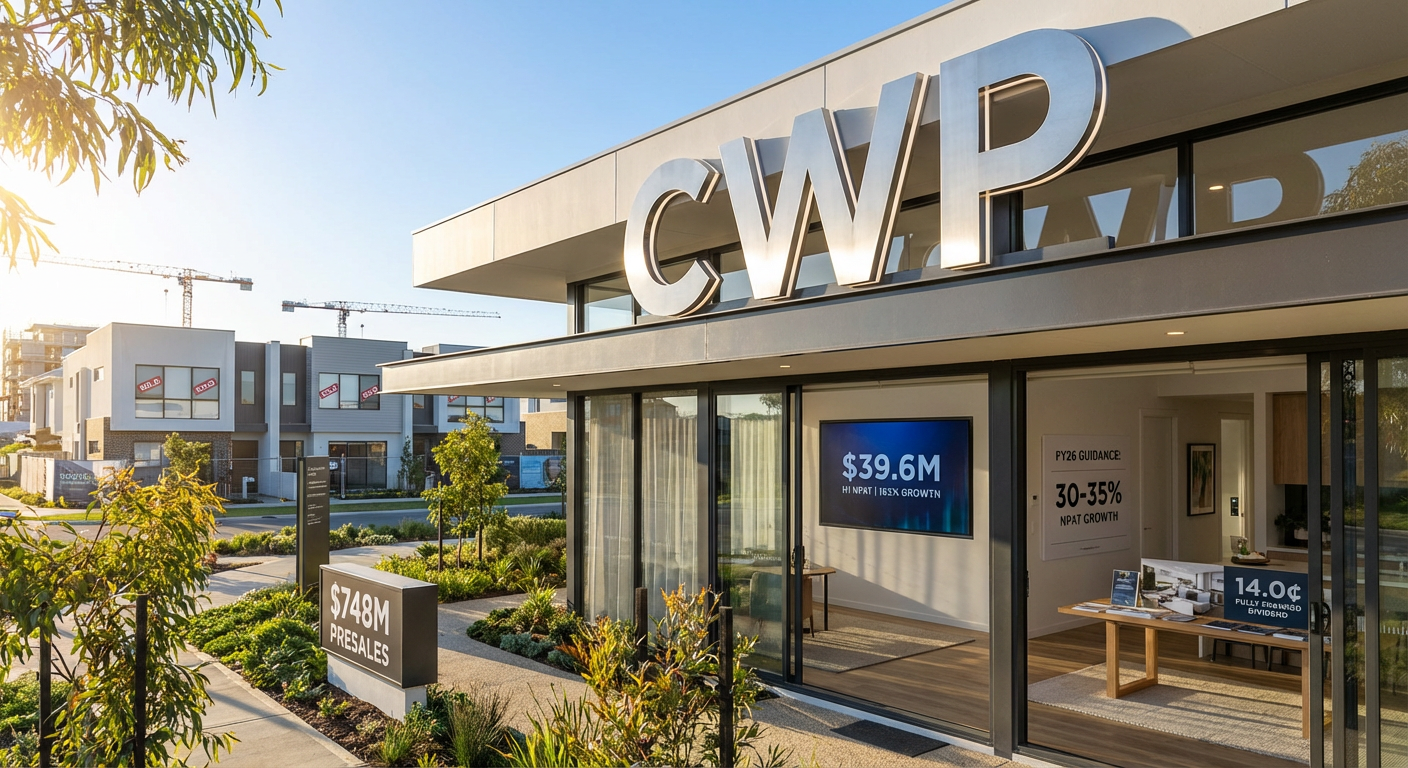
Cedar Woods Properties (ASX: CWP) has reported a record net profit after tax of $39.6 million for the first half of FY26, representing 163% growth on the previous corresponding period’s $15.0 million. The residential property developer has upgraded its full-year guidance to NPAT growth of 30-35%, up from the previously stated “minimum 20%”, and declared a fully franked interim dividend of 14.0 cents per share, marking a 40% increase on the prior period.
The Cedar Woods H1 FY26 results come alongside presales of $748 million, up 16% on the prior corresponding period, positioning the company for what management describes as a record full-year result.
Cedar Woods delivers record first-half profit, upgrades full-year guidance
The property developer’s upgraded guidance reflects strong sales conditions that enabled additional price growth, further settlements, and significantly lower marketing expenditure during the period. Managing Director Nathan Blackburne stated the company is now set up for a record full-year profit result that will deliver very strong shareholder return metrics.
The interim dividend increase to 14.0 cents per share from 10.0 cents in the prior period represents a substantial return to shareholders. Both the Dividend Reinvestment and Bonus Share Plans remain in operation for the interim dividend.
First-half revenue reached $274.8 million, up 40% on the prior corresponding period, while gross margin improved to 31% from 26%. The combination of higher revenue and improved margin drove the significantly higher first-half profit compared to $15.0 million in H1 FY25.
FY26 earnings are weighted to the first half, with fewer stages settling in H2 FY26 before a high volume of presold settlements are expected to take place in Q1 FY27. Full-year gross margin is expected to be similar to H1 FY26, exceeding the prior full-year margin of 28%.
When big ASX news breaks, our subscribers know first
Financial performance breakdown
| Metric | H1 FY26 | H1 FY25 | Change |
|---|---|---|---|
| Revenue | $274.8m | ~$196m | +40% |
| NPAT | $39.6m | $15.0m | +163% |
| Gross Margin | 31% | 26% | +5pp |
| Interim Dividend | 14.0 cps | 10.0 cps | +40% |
| Presales | $748m | $642m | +16% |
The margin expansion alongside revenue growth demonstrates pricing power across the portfolio. Higher revenue in the period and improved margin resulted in the significantly higher first-half profit compared to the prior corresponding period.
The second-half settlements are significantly derisked by presales. Following consistently strong demand for Cedar Woods’ diversified products, the company has amassed $748 million in presales as at 31 December 2025, up from $642 million in the prior corresponding period.
Balance sheet strength and facility extensions
The company maintained a low gearing position of 10% (net bank debt-to-total tangible assets less cash) as at 31 December 2025. Net bank debt stood at $85.1 million, with bank facility headroom exceeding $170 million. Interest cover was 8.9 times, well above the covenant requirement of 2 times for CY25.
In February 2026, Cedar Woods completed its annual review of corporate finance facilities, extending the terms to 31 January 2029 for the 3-year debt (representing 80% of facilities) and to 31 January 2031 for the 5-year debt (representing 20% of facilities). The facilities are provided by CBA, NAB and ANZ, providing long tenure and security of funding.
The strong capital position with substantial headroom provides flexibility for acquisitions and development pipeline expansion without requiring equity dilution. This positions the company to capitalise on the elevated due diligence activity on potential new projects during the period.
What drives property developer profitability?
Residential property developers like Cedar Woods generate returns through several key levers that investors should understand when evaluating the Cedar Woods H1 FY26 results.
Presales provide revenue visibility and funding certainty. These are contracts secured before settlements occur, meaning the developer has locked in future sales at agreed prices. For Cedar Woods, the $748 million presales book means the company has visibility into future earnings, reducing uncertainty around FY26 and FY27 results.
Gross margins reflect pricing power and cost control. This is the difference between what a developer receives for a property and what it costs to develop. Cedar Woods’ margin improvement from 26% to 31% indicates the company achieved better pricing or managed development costs more effectively.
Settlement timing affects when profits are recognised. Developers recognise revenue when properties settle (transfer to buyers), not when they’re sold. This is why “lots sold” differs from “settlements”, and why the company notes fewer H2 FY26 settlements before a high volume of presold settlements expected in Q1 FY27. Understanding this timing difference is critical when assessing developer earnings patterns.
Sales momentum and portfolio performance
Cedar Woods achieved record sales volume of 859 gross sales in H1 FY26, up 18% on the 732 gross sales recorded in H1 FY25. The company experienced particularly strong performance in the second quarter, with growth in sales volumes achieved across all states.
Q2 FY26 experienced 14% growth in enquiry on the prior quarter and 56% growth on the prior corresponding period (Q2 FY25). The strength of new enquiries in the first half supports continued strong sales performance in FY26.
State-by-state performance varied but remained positive across all markets:
- Western Australia — continues to be the strongest market with high demand for affordable land lots in particular
- Queensland — conditions remain strong
- South Australia — steady performance
- Victoria — improving across all product types and projects
Price growth ranges from modest to strong across the portfolio, with the best performing estates achieving more than 10% price growth in the first half. First home buyers are the most active buyer profile nationally, boosted by attractive government incentives.
Construction activity is progressing well across projects in Western Australia, Queensland, South Australia and Victoria, with numerous stages completing in the first half. Built form projects completed in the period included the North Melbourne townhouses and Williams Landing strata offices.
The diversified geographic exposure reduces single-market risk while Western Australia and Queensland strength drives near-term momentum.
Development pipeline and apartment progress
Eight apartment buildings are currently under construction. Two are scheduled to complete in H2 FY26: Sirocco (the first apartment building at Fletcher’s Slip in South Australia) and Bloom stage 2 at Glenside in South Australia, which is the third joint venture project with Tokyo Gas Real Estate Australia.
Four apartment buildings are completing in FY27, with a further two completing in early FY28. These projects are strongly presold, with some completely sold, providing earnings visibility through FY28 with presales derisking settlement outcomes.
The staged completion schedule ensures a consistent pipeline of settlements over the next two financial years, supporting the company’s confidence in continued profit growth into FY27.
Growth pipeline and acquisitions
Due diligence activities on potential new projects were elevated over the first half, with one land acquisition contracted in the period and several others in advanced stages of assessment.
Key acquisitions and settlements include:
- Aveley, Western Australia: Contracted acquisition of a 27.7 hectare site for $22 million, subject to planning approval, which will add 254 residential lots to the project pipeline if successful
- Corio, Victoria: Settled post-period
- Mount Barker, South Australia: Settled post-period
- Combined settlement payments: $78.4 million for Corio and Mount Barker acquisitions
The active pipeline replenishment signals management confidence in medium-term market conditions and positions the company for sustained growth beyond FY27. The acquisitions expand the company’s footprint across multiple states, maintaining the diversification strategy that has supported performance during the first half.
Market tailwinds supporting the outlook
Residential property market conditions were positive across all four states over H1 FY26. Every capital city recorded price growth in 2025, with an 8.2% increase in combined capital city dwelling values over the year.
Dwelling value growth in 2025 varied by capital city:
- Perth: 15.9% (highest growth of all major capital cities)
- Brisbane: 14.5%
- Adelaide: 8.8%
- Melbourne: 4.8%
Strong price growth is expected to continue over 2026, with KPMG forecasting national house prices to rise 7.7% and unit prices 7.1% as supply constraints and demand continue to underpin values. KPMG price growth forecasts for 2026 by city:
- Perth: 12.2%
- Brisbane: 9.4%
- Adelaide: 7.4%
- Melbourne: 7.1%
Australia’s population grew by 420,000 (1.5%) in the year to June 2025 and is forecast to grow by 362,000 (1.3%) to reach 28 million by the end of 2025-26. Amid strong population growth, Australia is experiencing a significant shortfall of housing across all markets, which will serve to support housing demand and values.
Dwelling supply is tracking significantly short of the Federal Government’s housing target of an additional 1.2 million dwellings over five years to 30 June 2029. A shortfall of around 400,000 dwellings is expected, suggesting the issue will persist at least for the medium term.
Despite recent interest rate rises, housing demand remains strong across Cedar Woods’ core markets due to ongoing structural undersupply, robust population growth, attractive government incentives and a resilient labour market. Cost of living and housing affordability pressures continue to push demand towards affordable product, with the company’s more affordable estates outperforming.
Outlook and investment thesis
Cedar Woods anticipates delivering 30-35% growth in full-year NPAT in FY26, with further profit growth anticipated in FY27. More than half of forecast FY27 revenue is already presold, providing rare earnings certainty in the property development sector.
Nathan Blackburne, Managing Director
“This exceptional first half result helps set the Company up for a record full year profit result. We are upgrading guidance to 30% to 35% NPAT growth, a result that will deliver very strong shareholder return metrics.”
The company’s confidence is based on presale contracts in hand of more than $748 million, most of which will settle in H2 FY26 and FY27, solid progress with the project delivery program, and supportive market conditions.
Good enquiry and sales continue to be underpinned by a nationwide shortage of housing, good economic conditions, low unemployment and continued population growth. Limited housing supply, migration, low unemployment and a long pipeline of undeveloped projects across four states positions Cedar Woods well for the medium term.
The upgraded guidance with presales visibility into FY27, combined with diversified state exposure and balance sheet strength, positions (ASX: CWP) to capitalise on structural housing demand across its key markets. The record Cedar Woods H1 FY26 results demonstrate execution strength translating into tangible shareholder returns through both profit growth and increased dividends.
Want the Next Property Development Winner in Your Inbox?
Join 20,000+ investors receiving FREE breaking ASX news within minutes of release, complete with expert analysis. Click the “Free Alerts” button at Big News Blast to get real-time alerts across property, finance, healthcare, tech and more the moment market-moving announcements drop.