
Clarity Pharmaceuticals’ diagnostic outperforms standard-of-care by detecting 2.6x more prostate cancer lesions
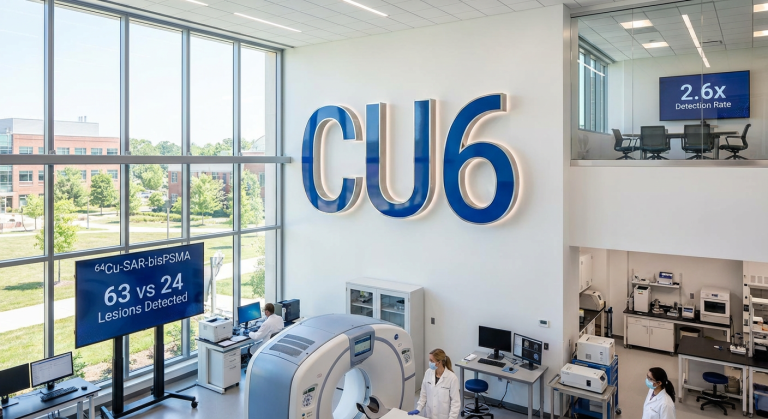
Clarity Pharmaceuticals (ASX: CU6) has released results from the Co-PSMA trial demonstrating its 64Cu-SAR-bisPSMA diagnostic product detected 2.6 times more prostate cancer lesions than the current standard-of-care agent in a head-to-head comparison. The Co-PSMA trial identified 63 lesions with Clarity’s product versus 24 lesions for Ga-68 PSMA-11 across 50 patients with biochemical recurrence following prostatectomy.
The difference achieved statistical significance with a p-value of <0.0001. Mean per-patient lesion counts were 1.26 for 64Cu-SAR-bisPSMA compared to 0.48 for Ga-68 PSMA-11, representing a difference of 0.78 (95% confidence interval: 0.52-1.04, ratio 2.63). The abstract outlining these findings has been accepted for oral presentation at the European Association of Urology Congress 2026, Europe’s largest urological conference, scheduled for 13-16 March 2026 in London.
The trial enrolled patients with prostate-specific antigen levels between 0.2-0.75 ng/mL who were candidates for curative salvage therapy. This low PSA range represents a particularly challenging detection scenario where current imaging agents demonstrate limited sensitivity. Both scans were performed within three weeks using the same digital PET camera, with 64Cu-SAR-bisPSMA evaluated at 1 hour and 24 hours post-injection.
Patient detection rates doubled: 78% versus 36%
The trial’s per-patient analysis revealed 64Cu-SAR-bisPSMA identified prostate cancer in 78% (39/50) of participants, compared to 36% (18/50) for Ga-68 PSMA-11. This means nearly four in five patients showed positive scans with Clarity’s diagnostic versus only two in five with the standard-of-care agent.
True positive rates favoured 64Cu-SAR-bisPSMA at 75% (21/28 participants with evaluable standard of truth) compared to 39% (11/28) for Ga-68 PSMA-11. The standard of truth incorporated biopsy results, response to targeted treatment without androgen deprivation therapy, and corroborative imaging.
| Metric | 64Cu-SAR-bisPSMA | Ga-68 PSMA-11 | Improvement |
|---|---|---|---|
| Total lesions detected | 63 | 24 | 2.6x |
| Patients with positive scan | 78% (39/50) | 36% (18/50) | More than doubled |
| True positive rate | 75% | 39% | +36 percentage points |
| Mean lesions per patient | 1.26 | 0.48 | +0.78 |
The improved detection reliability translates directly into clinical confidence. Where Ga-68 PSMA-11 left nearly two-thirds of patients without identifiable disease despite biochemical evidence of recurrence, 64Cu-SAR-bisPSMA provided actionable diagnostic information for the substantial majority.
Treatment plans changed for 44% of patients
Planned patient management changed following 64Cu-SAR-bisPSMA assessment in 22 out of 50 participants (44%). This mirrors findings from Clarity’s earlier COBRA trial, where approximately half of participants experienced treatment plan modifications based on the diagnostic results.
Dr Alan Taylor, Executive Chairperson
“This is the difference between allowing prostate cancer lesions to grow or having a clear diagnosis and an active and highly targeted treatment plan. Earlier intervention in BCR can prevent cancer growth and spread, avoid side effects from systemic therapies and considerably improve patient outcomes.”
The clinical impact extends beyond detection accuracy. When physicians can identify disease location with greater certainty, treatment strategies shift from broad systemic approaches to targeted interventions. This potentially reduces unnecessary side effects whilst addressing cancer recurrence more precisely.
What is PSMA PET imaging and why does sensitivity matter?
PSMA (prostate-specific membrane antigen) PET imaging uses radioactive tracers that bind to proteins expressed on prostate cancer cells, enabling physicians to locate cancer lesions throughout the body. The technology has become standard practice for staging prostate cancer and detecting recurrence after initial treatment.
Current approved agents, Ga-68 PSMA-11 and F-18 DCFPyL, demonstrate low sensitivity particularly at low PSA levels. Their prescribing information acknowledges this limitation. Patients with rising PSA but negative scans face diagnostic uncertainty, complicating treatment decisions and potentially allowing disease progression during the observation period.
Clarity’s 64Cu-SAR-bisPSMA addresses this limitation through four key differentiators:
- Dual PSMA-targeting motifs that bind to two protein sites simultaneously, compared to single-targeting in competing products
- Proprietary sarcophagine chelator technology that securely holds copper isotopes in a cage-like structure, preventing leakage into the body
- Next-day imaging capability at 24 hours post-injection, allowing enhanced detection compared to same-day imaging
- Theranostic platform design enabling use with Cu-64 for imaging and Cu-67 for therapy using the identical targeting molecule
The dual-targeting approach originated from benchtop research approximately seven years ago, specifically developed to overcome the shortfalls of single-targeting standard-of-care agents. The molecule’s design allows simultaneous binding to two PSMA proteins on cancer cells, increasing the probability of detection and retention at disease sites.
US$2 billion market opportunity with path towards commercialisation
The US PSMA PET imaging market currently generates approximately US$2 billion annually, with projections indicating growth beyond US$3 billion by 2029. This market is dominated by Ga-68 PSMA-11 and F-18 DCFPyL, both acknowledged to have low sensitivity in their regulatory documentation.
The competitive pipeline offers limited differentiation from existing agents. Multiple groups have commercialised the unpatented Ga-68 PSMA-11 formulation, whilst other development candidates utilise similar single-targeting approaches. Clarity’s dual-targeting technology represents a distinct mechanistic advance rather than an incremental modification.
The company has secured three FDA Fast Track Designations supporting the development programme. Two registrational trials are advancing toward completion:
- AMPLIFY registrational trial nearing completion of recruitment
- CLARIFY registrational trial nearing completion of recruitment
- Co-PSMA data reinforces findings from earlier COBRA, PROPELLER, and SECuRE trials
Prof Louise Emmett, Principal Investigator, St Vincent’s Hospital Sydney
“Our research demonstrates that 64Cu-SAR-bisPSMA PET/CT offers a significant advancement in the detection of recurrent prostate cancer. Compared to 68Ga-PSMA-11, the 24-hour 64Cu-SAR-bisPSMA images identified the site of disease recurrence in a higher proportion of patients, directly informing tailored treatment decisions for men in BCR. These findings highlight the potential for 64Cu-SAR-bisPSMA to improve patient outcomes.”
The acceptance of Co-PSMA data for oral presentation at the EAU Congress signals peer recognition of clinical significance. Oral presentation slots at major medical conferences are typically reserved for the highest-impact findings, distinguishing them from poster presentations.
COBRA trial consistency strengthens the evidence base
The Co-PSMA results align with Clarity’s earlier COBRA trial, which evaluated 64Cu-SAR-bisPSMA in patients with biochemical recurrence following definitive therapy. COBRA enrolled participants with median PSA of 0.9 ng/mL (range 0.25-17.6), representing a broader patient population than Co-PSMA’s 0.2-0.75 ng/mL range.
In COBRA, 64Cu-SAR-bisPSMA next-day imaging identified 52.6 lesions compared to 20 lesions detected by standard-of-care PSMA PET (average sum across all readers), representing a similar >2.6 times improvement. A subset of COBRA participants underwent follow-up standard-of-care PSMA PET scans with 90% showing positive results on initial 64Cu-SAR-bisPSMA imaging versus 60% positive on follow-up standard-of-care scans, despite a median 73.5-day interval between assessments.
The consistency across multiple trial programmes (COBRA, PROPELLER, SECuRE, and Co-PSMA) demonstrates reproducible performance across different patient populations and clinical settings. This body of evidence supports the registrational trial programmes currently underway.
What’s next for Clarity Pharmaceuticals
Full Co-PSMA data will be presented at the EAU Congress 2026 in mid-March, providing additional detail beyond the abstract release. The oral presentation format allows for comprehensive discussion of methodology, additional endpoints, and clinical implications with the urology community.
Near-term development milestones include:
- Mid-March 2026: Oral presentation of complete Co-PSMA data at EAU Congress (London)
- AMPLIFY registrational trial approaching recruitment completion
- CLARIFY registrational trial approaching recruitment completion
- Pathway toward regulatory submissions following registrational trial readouts
The registrational trials represent the primary pathway toward commercialisation. AMPLIFY and CLARIFY are designed to meet regulatory requirements for marketing authorisation, with Co-PSMA serving as supportive evidence demonstrating head-to-head superiority against the current market leader.
If approved, 64Cu-SAR-bisPSMA could establish a new standard-of-care in PSMA PET imaging whilst expanding market opportunity through improved diagnosis across multiple disease stages, from pre-definitive therapy through biochemical recurrence and oligometastatic disease settings. The combination of superior detection rates, treatment plan impact, and growing clinical evidence positions the product for potential market leadership in a multi-billion dollar opportunity.
Want to Learn More About Clarity’s Prostate Cancer Diagnostic Breakthrough?
With two registrational trials nearing completion and a growing body of clinical evidence demonstrating superior detection capabilities, Clarity Pharmaceuticals is advancing towards potential commercialisation in a US$2 billion market. The Co-PSMA trial results reinforce the company’s competitive position with its dual-targeting technology platform.
Discover how Clarity’s pipeline is progressing and access detailed investor information by visiting the Clarity Pharmaceuticals investor centre. Stay informed about upcoming milestones including the EAU Congress presentation and registrational trial readouts.