
Osteopore Gains Malaysian Regulatory Access for Orthopaedic Bone Reconstruction
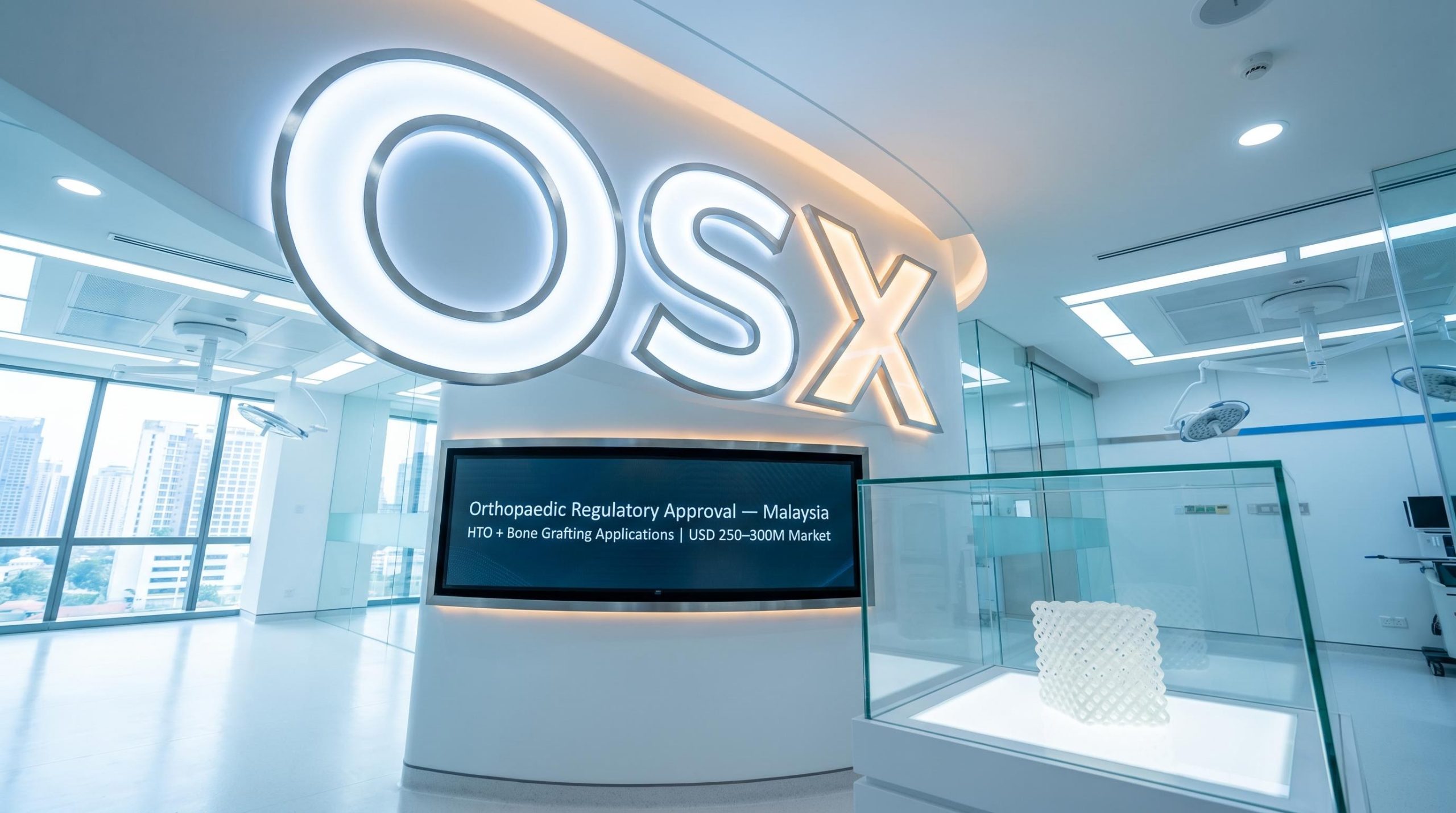
Osteopore (ASX: OSX) secures regulatory access to Malaysia’s orthopaedic bone reconstruction market
Osteopore Limited (ASX: OSX) has received regulatory access to Malaysia’s orthopaedic bone reconstruction market, with approval granted for its flagship high tibial osteotomy (HTO) solution and additional bone grafting applications. The Malaysian bone graft and substitute market was valued at approximately USD 250–300 million (AUD 360–465 million) in 2025 and is projected to grow at a compound annual growth rate (CAGR) of 7–9% over the next two years. The approval adds orthopaedic coverage to Osteopore’s existing Malaysian commercial footprint, with initial engagement planned at Hospital Kuala Lumpur, Hospital Sungai Buloh, and University Malaya Medical Centre.
When big ASX news breaks, our subscribers know first
Why Malaysia is a strategic market for Osteopore’s orthopaedic growth
A market with scale and momentum
The Malaysian bone graft and substitute market presents a commercially attractive entry window. At a 2025 valuation of USD 250–300 million (AUD 360–465 million), with a projected 7–9% CAGR over the next two years (according to a January 2026 market research report), the market offers meaningful near-term volume potential for a company with an approved orthopaedic portfolio.
A unique product fit for Muslim patients
Osteopore’s implants are produced from biomaterials and are not derived from cadaveric or animal sources. This characteristic is clinically relevant in a country with a predominantly Muslim population, where the sourcing of medical implants is an important consideration for patients and clinicians alike.
This attribute was publicly acknowledged at Arab Health 2016, lending independent credibility to the product’s suitability for Muslim patient populations. It is a genuine clinical differentiator, not simply a positioning claim.
Building on existing Malaysian commercial infrastructure
The orthopaedic approval does not represent a standing start in Malaysia. Osteopore already holds a craniofacial reconstruction presence in the country and, as announced on 25 November 2025, established a dental commercial partnership with DKSH Malaysia. The orthopaedic regulatory access now extends the company’s presence across a third therapeutic vertical in the market, broadening what is already an active commercial relationship.
What is high tibial osteotomy — and why does Osteopore’s approach matter?
High tibial osteotomy is a surgical procedure that realigns the knee joint by reshaping the upper portion of the tibia (the shin bone). It is commonly used to treat osteoarthritis or structural deformities that cause uneven load distribution across the knee, and is often preferred in younger, active patients who wish to avoid or defer knee replacement surgery.
In a conventional HTO procedure, surgeons typically use cadaveric bone grafts, animal-derived materials, or permanent metal implants to fill the gap created during realignment. Each of these approaches carries its own limitations, from ethical and religious considerations around sourcing, to the complications that can arise from leaving permanent foreign materials in the body.
Osteopore’s approach differs through its 3D-printed micro-architecture, which is designed to mimic cancellous bone — the spongy, lattice-like structure found inside natural bone. This scaffold supports the regrowth of the patient’s own bone tissue. Critically, the implant is bioresorbable, meaning it gradually dissolves as natural bone regenerates, ultimately leaving no permanent implant in the body. This may reduce the risk of post-surgery complications that are commonly associated with permanent bone implants.
Dr Yujing Lim, CEO
“This approval allows us to expand our important orthopaedic product line into Malaysia. We observed encouraging adoption patterns in Singapore, and given substantial similarities in treatment methodologies between Singapore and Malaysia, our team is focused to leverage on our experience in Singapore to approach the Malaysian market.”
The next major ASX story will hit our subscribers first
Next steps and commercial pathway in Malaysia
With regulatory access granted, Osteopore has outlined the following commercial steps for its Malaysian orthopaedic entry:
- Establish commercial representation in Malaysia
- Begin customer engagement activities
- Focus initial efforts on major trauma centres: Hospital Kuala Lumpur, Hospital Sungai Buloh, and University Malaya Medical Centre
- Apply learnings from Singapore adoption patterns and leverage regulatory reliance frameworks between Singapore and Malaysia to streamline market entry
Dr Yujing Lim, CEO
“Leveraging regulatory reliance frameworks between Singapore and Malaysia helped streamline access, and our focus now is to establish strong commercial partnerships and engage leading trauma centres to support surgeons and their patients.”
Malaysia as part of Osteopore’s broader ASEAN commercial strategy
With this orthopaedic approval, Osteopore’s Malaysia commercial presence now spans three therapeutic categories: craniofacial reconstruction, dental (via DKSH Malaysia), and orthopaedic bone reconstruction. Singapore remains the company’s proven regional base, and the Malaysian expansion applies that experience across an adjacent market with closely aligned clinical practices.
The table below summarises Osteopore’s current commercial presence across its Malaysian product categories.
| Product Category | Regulatory Status | Commercial Partner / Channel | Key Target Institutions |
|---|---|---|---|
| Craniofacial reconstruction | Approved | Existing Malaysian presence | Not specified |
| Orthopaedic (HTO + bone grafting applications) | Regulatory access granted (May 2026) | Commercial representation to be established | Hospital Kuala Lumpur, Hospital Sungai Buloh, University Malaya Medical Centre |
| Dental | Approved | DKSH Malaysia (partnership announced 25 November 2025) | Not specified |
The company has not disclosed specific revenue targets or timelines for its Malaysian orthopaedic programme, and investors should note that commercial outcomes remain subject to the successful execution of the steps outlined above.
Don’t Miss the Next ASX Healthcare Breakout
Big News Blast delivers FREE breaking ASX healthcare news directly to your inbox within minutes of release, complete with in-depth analysis. Over 20,000 subscribers are already ahead of the market. Click the “Free Alerts” button at StockWire X to make sure the next market-moving announcement lands with you first.