ASX Information Technology Shares: Why the Index Misleads Investors
1 hr ago


A single ETF now gives Australian investors exposure to Nvidia, Broadcom, and SK Hynix in one trade on the ASX, for a management fee of 0.57% per year. The Global X Artificial Intelligence ETF (ASX: GXAI), launched in April 2024, has grown to approximately A$240.75 million in funds under management as of May 2026, a signal of genuine and sustained demand from local retail investors. Yet strong returns and a compelling growth theme do not eliminate the concentration and volatility risks that come with thematic investing. This guide explains how GXAI works, what it holds, how it has performed against comparable ASX AI ETFs, what the growth case rests on, and what risks to weigh before adding it to a portfolio.
Before evaluating performance or holdings, it helps to understand the product’s mechanics. Here are the structural facts at a glance:
GXAI is an open-ended, index-tracking ETF quoted on the ASX. It is managed by Global X Management (AUS) Limited, and its purpose is to hold companies positioned to benefit from AI development, adoption, and hardware supply, rather than to select individual winners through active stock-picking.
The fund tracks the Indxx Artificial Intelligence and Big Data Index, a rules-based benchmark. That distinction matters. Buying GXAI means buying a basket that rebalances according to index methodology on a set schedule. Holdings change because the index rules dictate it, not because a portfolio manager made a discretionary call.
GXAI is listed under the ASX’s AQUA framework, the market structure designed for managed investment products such as ETFs. In practice, this means GXAI trades on-exchange like a share but is priced by net asset value (NAV), the total value of the fund’s underlying holdings divided by the number of units on issue.
The most recent NAV per unit was A$16.4844 (20-21 May 2026), with the trading price ranging between A$16.30 and A$16.76. That gap between NAV and market price is normal for ETFs. Intraday pricing may diverge slightly from NAV, and liquidity depends on market maker activity, so investors placing large orders should be aware of potential spread costs.
The AQUA framework, NAV-based pricing, and the legal separation of fund assets from the issuer’s balance sheet are core features of ASX ETF structure and tax mechanics that shape both trading costs and after-tax outcomes for Australian investors holding thematic positions like GXAI.
GXAI’s index spans multiple sectors where AI value is accumulating. The investment thesis expressed through the fund is not limited to one segment; it captures:
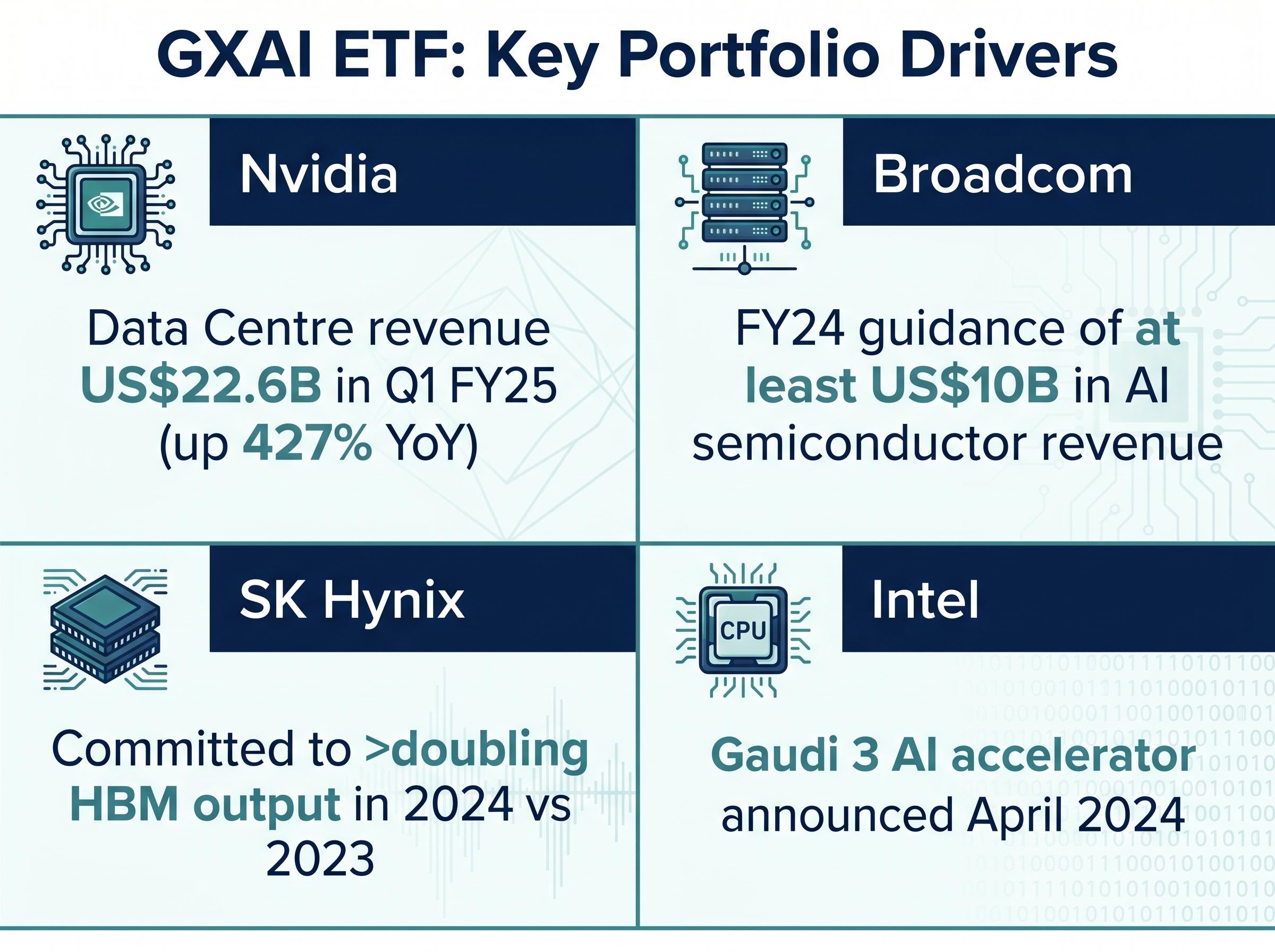
That breadth is deliberate. Rather than concentrating on a single layer of the AI supply chain, the index aims to spread exposure across companies that build, enable, and deploy artificial intelligence. Four holdings illustrate how this works in practice.
| Company | AI Role | Key Data Point | Risk Note |
|---|---|---|---|
| Nvidia | AI compute leader (GPUs for training and inference) | Data Centre revenue of US$22.6 billion in Q1 FY25 (to 28 April 2024), up 427% year-on-year | Valuation reflects near-perfect execution; any demand slowdown could trigger sharp repricing |
| Broadcom | AI networking and custom silicon for hyperscale data centres | CEO guidance of at least US$10 billion in AI-related semiconductor revenue for FY24, raised from US$7.5 billion | Revenue mix still includes legacy segments; AI share must keep growing to justify premium |
| SK Hynix | Lead supplier of HBM3 high-bandwidth memory for AI GPUs | Committed to more than doubling HBM output in 2024 versus 2023 | Memory is cyclical; oversupply corrections have historically been steep |
| Intel | Legacy chipmaker repositioning with Gaudi 3 AI accelerator | Gaudi 3 announced April 2024 as a cost-efficient alternative to Nvidia GPUs | Execution risk is high; Intel remains well behind Nvidia in AI market share |
Morgan Stanley has described Broadcom as “one of the most leveraged names to AI networking and custom silicon,” while Goldman Sachs labelled SK Hynix a “prime beneficiary” of HBM-driven AI server growth. Nvidia remains the most prominent name in the portfolio, with Bank of America analysts positioning it as the “clear AI compute leader” following its May 2024 results.
Holding this mix of hardware providers, networking specialists, memory manufacturers, and legacy chipmakers means the fund captures multiple entry points into the AI value chain. It also means investors should check whether they already hold these names through other global equity or technology ETFs before buying GXAI.
The case for an ETF structure in AI investing is not simply convenience. It is a rational response to a specific problem: the difficulty of identifying which companies will capture the most value as the technology matures.
AI architectures shift rapidly. The hardware that dominates training today may not dominate inference tomorrow. Software platforms consolidate, fragment, and consolidate again. Even sophisticated institutional investors frequently misjudge which layer of the stack will produce the greatest returns over a five-year horizon. A rules-based index approach systematically captures the sector’s growth without requiring a correct prediction about any single company.
According to Global X projections, AI tool users could exceed 729 million by 2030, up from approximately 254 million in 2023. That growth trajectory underpins the case for broad-based exposure rather than concentrated bets.
The investable universe is also widening. Enterprises are deploying AI across:
As adoption broadens from data-centre infrastructure into industry-specific commercial uses, the companies benefiting from AI spending will diversify too. An index that rebalances to reflect those shifts is better positioned to capture that broadening than a static portfolio of today’s winners.
Australian commentary from InvestSMART, ETFadviser, and Stake Australia consistently describes AI ETFs as long-term, high-growth, higher-volatility satellite positions, not core holdings, precisely because concentration and uncertainty are real. The ETF format does not eliminate those risks. It does prevent the investor from having to bet everything on a single name.
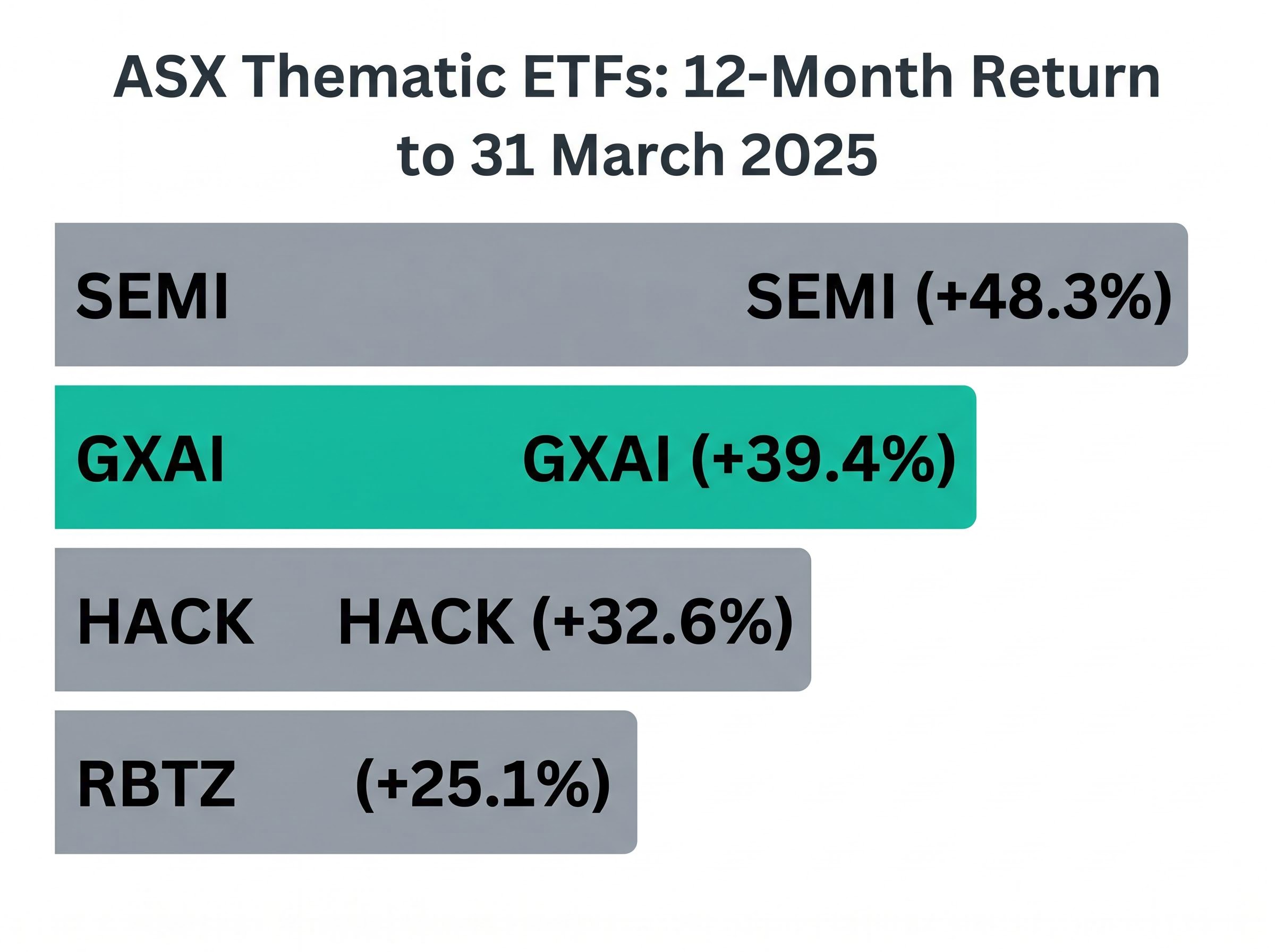
Comparative performance data helps locate GXAI in the broader landscape of ASX-listed thematic ETFs. The table below shows 12-month total returns (after fees) to 31 March 2025 for four funds with AI or technology exposure.
| Fund | Ticker | 12-Month Return (to 31 March 2025) | Focus |
|---|---|---|---|
| Global X Semiconductor ETF | SEMI | +48.3% | Pure semiconductor exposure |
| Global X Artificial Intelligence ETF | GXAI | +39.4% | Broad AI supply chain |
| BetaShares Global Cybersecurity ETF | HACK | +32.6% | Cybersecurity |
| BetaShares Global Robotics and AI ETF | RBTZ | +25.1% | Robotics and AI |
These figures come from each fund’s own issuer commentary and are not normalised across providers. Direct comparison carries caveats, as calculation methodologies differ.
GXAI sits in the mid-to-upper tier. A purer semiconductor play (SEMI) outperformed, while a broader robotics-and-AI fund (RBTZ) delivered lower returns. The choice between them depends on whether an investor wants concentrated chip exposure or broader supply-chain diversification.
As of approximately May 2026, GXAI’s most recent 12-month total return stands at approximately +34.90%.
Past performance in thematic ETFs is particularly susceptible to look-back bias. The assets that drove returns in the previous 12 months may already reflect elevated valuations, and entering at the top of a run-up carries different risk from entering early.
The behaviour gap in thematic ETFs, the divergence between the fund’s reported time-weighted return and the money-weighted return actually experienced by investors who buy near peaks, is why a trailing 12-month figure of +34.90% can coexist with negative real-money outcomes for a large cohort of that fund’s holders.
The Motley Fool Australia flagged this concern in May 2026, noting valuation risk after large run-ups in semiconductor and megacap technology stocks. Dollar-cost averaging, spreading purchases over regular intervals rather than investing a lump sum, is one practical way to manage that timing risk. Several Australian commentators have recommended this approach specifically for high-volatility thematic positions.
Strong returns can obscure the specific ways this investment could disappoint. Four risks deserve clear identification.
The custom silicon threat to Nvidia from its own largest customers (Alphabet, Amazon, and Microsoft) represents a structural risk that does not appear in trailing revenue figures: inference workloads, projected to represent approximately 80% of the AI accelerator market by 2030, are precisely where purpose-built chips are most competitive against Nvidia’s general-purpose GPU architecture.
ASIC Regulatory Guide RG 274 sets out the full framework governing Product Design and Distribution Obligations, including the specific requirements issuers must meet when preparing Target Market Determinations for retail investment products such as thematic ETFs.
Marc Jocum from Global X ETFs Australia noted on the Rask podcast that AI-thematic ETFs can complement a portfolio but should not replace low-cost, diversified core ETFs.
Australian expert consensus across InvestSMART, Stake Australia, ETFadviser, and the Rask podcast is consistent: AI ETFs are satellite positions with modest position sizing recommended relative to broad-market allocations. ASIC’s finfluencer guidance further underscores that commentary recommending specific ETFs can constitute financial product advice requiring an AFSL, which is why independent financial advice matters before entering thematic positions.
GXAI has earned its place in the conversation. It is a low-friction, rules-based, reasonably priced vehicle (0.57% p.a.) for capturing a secular growth theme without requiring stock-picking skill. Its asset base of A$240.75 million demonstrates genuine investor demand, and its track record now approaches two full years.
The fee sits above broad-market index ETFs (typically 0.07%-0.20% p.a.), but ETFadviser has described it as “in line with the market for thematic ETFs.” The premium buys targeted exposure to a specific investment thesis rather than general market beta.
The appropriate portfolio role, based on consistent Australian expert commentary, is a satellite position within a diversified portfolio anchored by broad-market, low-cost ETFs. Position size should reflect the investor’s risk tolerance and time horizon, not enthusiasm for the theme.
For investors wanting to work out exactly how a satellite position like GXAI fits within a broader allocation, our dedicated guide to ETF portfolio construction covers asset allocation splits, the cap-weighting concentration problem in domestic ETFs, and the practical case for keeping total fund count to 2-6 products to minimise fee drag and tax complexity.
Before committing capital, three questions help clarify whether GXAI fits:
A brief tax note: Australian resident investors are subject to standard ETF capital gains tax and distribution rules under ATO guidance (updated 2024). The GXAI PDS taxation section provides the detailed reference for individual circumstances. Dollar-cost averaging, flagged by multiple Australian sources, is worth considering for managing entry-point risk in a volatile theme.
The ATO guidance on ETF taxation details how Australian resident investors must declare both distribution income and capital gains or losses from ETF holdings, with specific treatment applying to distribution reinvestment plans and foreign income components.
GXAI is a structurally sound, index-based way for Australian investors to access the AI theme. The growth thesis is genuine: AI tool users could exceed 729 million by 2030, enterprise adoption is broadening across healthcare, agriculture, and everyday software, and the fund’s key holdings sit at the centre of that expansion.
So are the risks. Concentration toward a handful of semiconductor and megacap technology names, cyclical earnings exposure, and elevated valuations after strong trailing returns all warrant honest acknowledgement. The fund’s own TMD and independent expert consensus are clear: this is a high-risk, long-horizon product for a satellite role.
As AI adoption moves beyond data-centre infrastructure into industry-specific applications, GXAI’s diversified index structure means it is positioned to capture that broadening without requiring the investor to predict which new sector becomes the next growth area.
Investors ready to act should verify the current NAV, review the PDS and TMD on the Global X website, and consider speaking with a licensed financial adviser (AFSL holder) before entering a position. Dollar-cost averaging over several months, rather than a single lump-sum entry, aligns with how multiple Australian commentators suggest approaching thematic ETF allocations.
This article is for informational purposes only and should not be considered financial advice. Investors should conduct their own research and consult with financial professionals before making investment decisions. Past performance does not guarantee future results. Financial projections are subject to market conditions and various risk factors.
GXAI is an ASX-listed, index-tracking ETF launched in April 2024 that provides exposure to companies across the AI supply chain, including semiconductors, cloud infrastructure, software, and data analytics, by tracking the Indxx Artificial Intelligence and Big Data Index for a management fee of 0.57% per year.
To 31 March 2025, GXAI delivered a 12-month total return of approximately 39.4%, placing it above HACK (32.6%) and RBTZ (25.1%) but below the pure semiconductor ETF SEMI (48.3%); its most recent 12-month return as of May 2026 stands at approximately 34.90%.
The key risks include concentration toward a small number of US and Asian technology companies, semiconductor cyclicality, valuation risk after strong trailing returns, and a regulatory classification under Global X's Target Market Determination that restricts the product to investors with high risk tolerance and long-term investment horizons.
GXAI charges a management fee of 0.57% per year and trades on the ASX under the AQUA framework, meaning its price is based on net asset value (NAV), which was A$16.4844 per unit as of 20-21 May 2026, with intraday trading prices ranging between A$16.30 and A$16.76.
Australian experts across InvestSMART, Stake Australia, ETFadviser, and the Rask podcast consistently recommend treating GXAI as a satellite position with modest sizing relative to diversified core ETF holdings, not as a portfolio anchor, given its high-risk, high-volatility thematic nature.